
 Africa
 Asia
Asia Ulaya
Ulaya Amereka ya Kumwera
 Australia ndi Oceania
 Antarctica
 Nyanja ya Pacific
 Nyanja ya Atlantic
 Nyanja ya Indian
 Nyanja ya Arctic
 Nyanja ya Mediterranean
 Nyanja Yofiira
 Nyanja ya Caribbean
 Nyanja ya Coral
 Nyanja ya South China
 Nyanja ya Philippine
 Nyanja ya Andaman
 Nyanja ya Kumpoto (North Sea)
 Nyanja ya Timor ndi Arafura
 Nyanja ya Bengal
 Gulf ya California
Spotted scat
 Minga yaululu
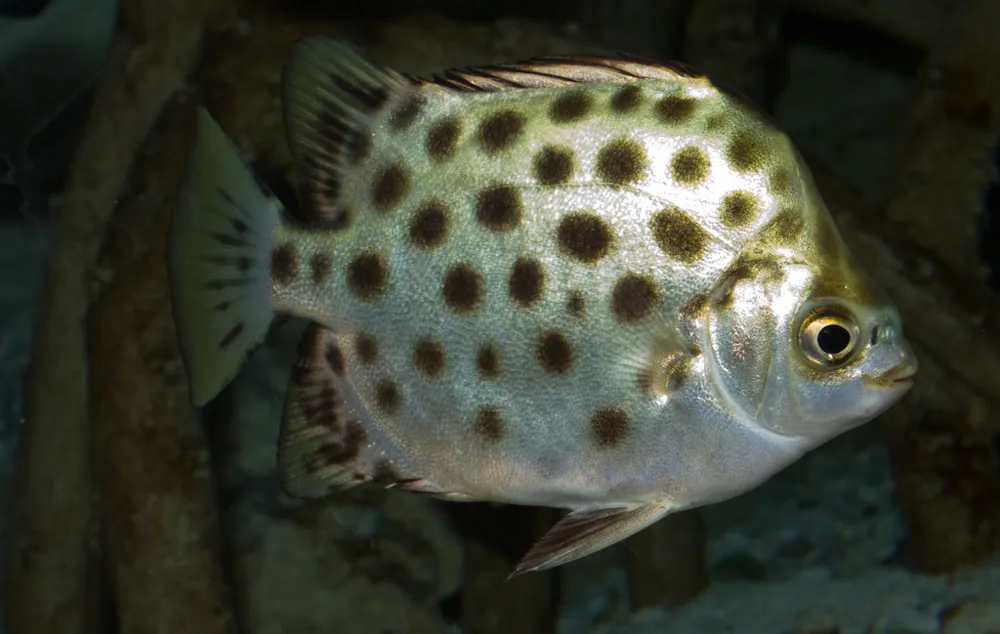
The spotted scat is a fish with a rectangular body covered in brown spots. It lives in shallow, muddy coastal waters across the Indo-Pacific, from the Persian Gulf to southeastern Australia. It can sting with small spines near its front, which makes it worth knowing about.1


 Mmene ungaizindikirire
- Rectangular, strongly flattened body with a steep head profile1
- Body greenish-brown to silvery, with many brown to red-brown spots1
- Occurs in two colour forms, green scat and ruby or red scat1
- Juveniles are greenish-brown with a few large dark blotches or five or six dark vertical bars1
- Adults reach a maximum total length of 38 cm1
Mphamvu ya ululu
Minga yakuthwa imanyamula ululu. Kuiponda kapena kuigwira kumapweteka.
Ululu wake umachita chiyani?
The spotted scat has small spines in its front parts that inject venom when it stings. The venom causes great pain and dizziness.1
Ndi yoopsa bwanji kwa anthu?
Ngozi kwa anthu: YopwetekaIngathe kupweteka kwambiri, koma pafupifupi nthawi zonse si vuto lalikulu.Its sting causes great pain and dizziness. Some people catch and eat it in its native waters, so fishers and anyone handling the fish are most at risk of being stung.1
 Minga yake ikakubaya
- Treatment is often done by soaking the sting site in hot water.1
- Ika bala m'madzi otentha, otentha monga momwe munthuyo angapirire osapsa (yesa ndi dzanja lako), kwa mphindi 30 mpaka 90. Peza thandizo la dokotala, makamaka pa stonefish ndi stingray.
Nthawi zonse yamba wayimbira nambala yadzidzidzi (112, 000, 911). Awa ndi malangizo wamba a chithandizo choyamba, osati malangizo a dokotala. Zoyambira za chithandizo choyamba
 Khala wotetezeka
- Usakhudze, kugwira kapena kuseweretsa nyama yakuthengo, ngakhale yaing'ono, ndipo ngakhale ikuoneka ngati yagona kapena yafa.
- Ipatse malo. Ukakumana nayo, khala chete, bwerera m'mbuyo pang'onopang'ono ndipo uilole ipite njira yake.
- Minga yake ikakubaya: khala chete, usasunthe, imbira nambala yadzidzidzi (112, 000, 911) kapena pita kuchipatala mwachangu. Kumbukira m'mene inkaonekera, chithunzi chimathandiza.
Sikufuna kukuvulaza. Imagwiritsa ntchito ululu wake kugwira chakudya kapena kudziteteza, ndipo imakonda kwambiri kubisala. Zambiri za kukhala wotetezeka
Kuti padziko lapansi?
Ndi yaikulu bwanji?
Ndi yaitali bwanji?
 yaitali ngati zidutswa zomangira zoseweretsa 12 pamzere
 ingasambire kutalika kwa dziwe lalikulu losambira (50 m) m'masekondi 33
Spotted scat ndi yaikulu bwanji poyerekeza ndi IWE?
Ndi masamu chabe mu msakatuli wako. Palibe chomwe chimasungidwa kapena kutumizidwa kwina.
Imathamanga bwanji?
Mfundo
Young scats live in freshwater and move to saltwater as they mature.1
The spotted scat comes in two colour forms, a green scat and a ruby or red scat.1
Spotted scats live in schools.1
The spotted scat is a popular aquarium fish.1
Females become sexually mature at around 7 to 9 months old and about 150 g in weight, while males mature at a smaller size.1
Kuthetsa nthano zabodza
Nthano yabodza: Scats are named because they feed on dung and offal.
Zoona: The name may be misleading. The habit of eating offal has not been confirmed in diet studies.1
Za akatswiri a ululu
- Dzina la sayansi
- Scatophagus argus
- Gulu
- Nsomba zaululu
- Banja
- Scatophagidae2
- Dongosolo
- Acanthuriformes
- Makontinenti
- Nyanja ya Indian, Nyanja ya Pacific, Nyanja Yofiira, Nyanja ya Andaman, Nyanja ya South China, Nyanja ya Philippine, Nyanja ya Coral, Nyanja ya Arabia ndi Gulf ya Persia, Nyanja ya Timor ndi Arafura, Nyanja ya Bengal, Nyanja zikuluzikulu
- Ana akhanda
- Females lay transparent, spherical eggs about 0.7 mm across, which hatch about 20 hours after fertilisation.1
- Ngozi kwa anthu
- 2 / 5: Yopweteka3
Kumene mfundo zimachokera
- Scatophagus argus (Wikipedia (CC BY-SA 4.0))
- Scatophagus argus (iNaturalist): mayina ndi magulu a sayansi.
- Venom Wiki: mlingo wa ngozi, kukula wamba ndi kuyerekeza kwa liwiro ndi zathu. Ona mmene timazipezera: Mmene timayezera ngozi.
Mfundo iliyonse patsamba lino ili ndi nambala yosonyeza kochokera. Ngati talakwitsa, pepani, ndife okonda nyama, osati magazini a sayansi. Tiuze pa [email protected] ndipo tikonza.
 Chinkhanira chili ndi njala! Venom Wiki ndi ntchito ya munthu mmodzi: yaulere, yopanda zotsatsa ndi zokutsatira. Mphatso yaing'ono imathandiza kuti ikhalebe pa intaneti.Dyetsa chinkhanira
Zina za gulu lomwelo: Nsomba zaululu
 Reef stonefishNsomba zaululuIngathe kuphaUsakhudze
 Red lionfishNsomba zaululuIkufuna dokotalaUsakhudze
 Estuarine stonefishNsomba zaululuIngathe kuphaUsakhudze
 Short-tail stingrayNsomba zaululuIngathe kupha
 Striped eel catfishNsomba zaululuIngathe kuphaUsakhudze
 Bluespotted ribbontail rayNsomba zaululuIkufuna dokotala
Imakhalanso ku: Nyanja ya Indian
 Australian box jellyfishJellyfish ndi zolasa za m'nyanjaYakuphaUsakhudze
 Geography coneNkhono za cone ndi ma octopusYakupha
 Greater blue-ringed octopusNkhono za cone ndi ma octopusYakupha
 Southern blue-ringed octopusNkhono za cone ndi ma octopusYakupha
 Hawksbill sea turtleNyama zina za poizoniIngathe kupha
 Irukandji jellyfishJellyfish ndi zolasa za m'nyanjaIngathe kuphaUsakhudze