
 Afurika
 Aziya
Aziya Uburayi
 Amerika y'Amajyepfo
 Ositaraliya na Oseyaniya
 Antaragitika
 Inyanja ya Pasifika
 Inyanja ya Atalantika
 Inyanja y'Abahinde
 Inyanja ya Arigitika
 Inyanja ya Mediterane
 Inyanja Itukura
 Inyanja ya Karayibe
 Inyanja ya Korali
 Inyanja y'Amajyepfo y'u Bushinwa
 Inyanja ya Filipine
 Inyanja ya Andamani
 Inyanja y'Amajyaruguru
 Inyanja ya Timor na Arafura
 Ikigobe cya Bengali
 Ikigobe cya Kaliforuniya
Emerald cockroach wasp
 Itera urubori
The emerald cockroach wasp is a solitary wasp with a shiny metallic blue-green body. It lives in tropical parts of Africa, South Asia, Southeast Asia and the Pacific islands, and it has an unusual way of raising its young. It uses a cockroach as food and a home for its larvae.1


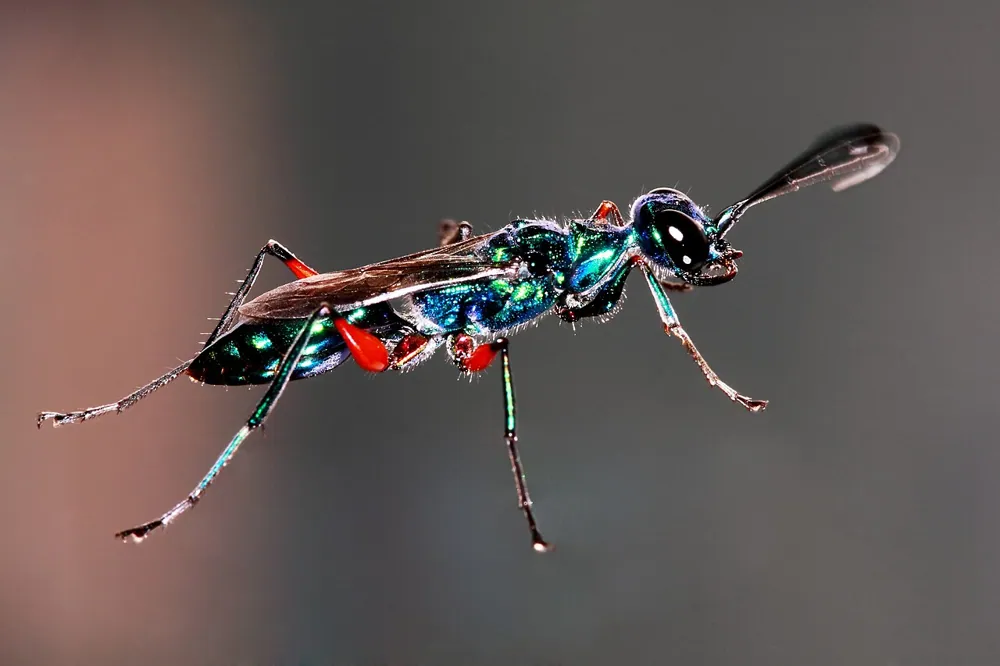
 Uko wayimenya
Imbaraga z'ubumara
Ubumara busohokera mu rubori.
Ubumara bwayo bukora iki?
The venom works on the cockroach's nervous system. The first sting causes short paralysis of the front legs, and the second sting, into the brain, stops the cockroach from escaping and makes it groom and move sluggishly. The effect lasts for about 72 hours.1
Iteje akaga kangana iki ku bantu?
Akaga ku bantu: YorohejeNko guterwa urubori n'uruyuki cyangwa munsi yaho. Mu by'ukuri ntacyo itwaye abantu. Niba itera urubori
- Kuramo urubori rw'uruyuki uruharura, kandi ukonjeshe aho rwateye.
- Niba umuntu ahumeka bimugoye, akabyimba mu maso cyangwa mu muhogo, cyangwa akumva agiye guta ubwenge, ni ikibazo cyihutirwa cya aleriji: hamagara nimero y'ubutabazi kandi ukoreshe urushinge rwe rwa adrenaline (adrenaline pen) niba arufite.
Buri gihe banza uhamagare nimero y'ubutabazi (112, 000, 911). Izi ni inama rusange z'ubutabazi bw'ibanze, si inama za muganga. Ibanze by'ubutabazi bw'ibanze
 Irinde akaga
- Ntuzigere ukora, ufata cyangwa ushotora inyamaswa yo mu gasozi, nubwo yaba ntoya, kandi nubwo yasa n'isinziriye cyangwa yapfuye.
- Yihe umwanya. Niba uhuye n'imwe, tuza, usubire inyuma buhoro buhoro kandi uyireke yigendere.
- Niba imwe igutereye urubori: tuza, ntunyeganyege, hamagara nimero y'ubutabazi (112, 000, 911) cyangwa ujye ku bitaro vuba. Ibuka uko yasaga, ifoto irafasha.
Ntigushakisha ngo ikugirire nabi. Ikoresha ubumara bwayo kugira ngo ifate ibyo kurya cyangwa yirinde, kandi ikunda cyane kwihisha. Ibindi ku kwirinda
Ingana gute?
Ireshya ite?
 ireshya hafi na trombone yo gufata impapuro
 yaguruka ikambuka ikibuga cyose cy'umupira w'amaguru mu masegonda 14
Emerald cockroach wasp ingana ite ugereranyije NAWE?
Ni imibare gusa ikorerwa muri mudasobwa yawe. Nta kintu kibikwa cyangwa cyoherezwa ahandi.
Yihuta gute?


Ibintu by'ukuri
The wasp stings a cockroach twice, aiming for specific nerve clusters in its body and head, rather than just injecting venom at random.1
After stinging, the wasp leads the cockroach to its burrow by pulling on one of its antennae, like a leash, even though the wasp is too small to carry it.1
The stung cockroach can still walk, swim and flip over, but it loses its normal urge to escape.1
The larva eats the cockroach's internal organs over about 8 days, and the adult wasp later emerges from the dead cockroach's body.1
A single mating is enough for a female to parasitise several dozen cockroaches.1
The wasp was brought to Hawaii in 1941 as a biological control, but this did not work well because of the wasp's territorial behaviour and the small scale on which it hunts.1
Ku bahanga mu by'ubumara
- Izina rya siyansi
- Ampulex compressa
- Itsinda
- Inzuki, amavubi n'amavubi manini
- Umuryango
- Ampulicidae2
- Itsinda rinini (order)
- Hymenoptera
- Imigabane
- Aziya, Afurika
- Abana bato
- The female lays one or two white eggs, about 2 mm long, between the legs of a stung cockroach. Each egg hatches after about 3 days.1
- Akaga ku bantu
- 1 / 5: Yoroheje3
Aho ibintu bivugwa bituruka
- Emerald cockroach wasp (Wikipedia (CC BY-SA 4.0))
- Ampulex compressa (iNaturalist): amazina n'ibyiciro.
- Venom Wiki: urwego rw'akaga, ingano isanzwe n'ikigereranyo cy'umuvuduko ni ibyacu bwite. Reba uko tubibara: Uko tugena akaga.
Buri kintu kivugwa kuri iyi paji gifite nimero yerekana aho cyavuye. Niba twibeshye, tubabarire, turi abakunzi b'inyamaswa, ntituri ikinyamakuru cya siyansi. Tubwire kuri [email protected] tuzabikosora.
 Sikorupiyo irashonje! Venom Wiki ni umushinga w'umuntu umwe: ni ubuntu, nta matangazo kandi nta bikurikirana abantu. Impano ntoya ifasha kugira ngo ikomeze kuboneka kuri interineti.Gaburira sikorupiyo
Izindi zo mu itsinda rimwe: Inzuki, amavubi n'amavubi manini
 Asian giant hornetInzuki, amavubi n'amavubi maniniIshobora kwica
 Common waspInzuki, amavubi n'amavubi maniniIrababaza gusa
 European hornetInzuki, amavubi n'amavubi maniniIrababaza gusa
 Western honey beeInzuki, amavubi n'amavubi maniniIrababaza gusa
 Giant honey beeInzuki, amavubi n'amavubi maniniBisaba muganga
 Asian hornetInzuki, amavubi n'amavubi maniniIrababaza gusa
 Deathstalker
 Indian cobra
 Indian saw-scaled viper
 King cobra
 Puff adder
 Impiri ya Russell