
 Afrika
 Asia
Asia Yuropu
 Amerika yeKumaodzanyemba
 Australia neOceania
 Antarctica
 Gungwa rePacific
 Gungwa reAtlantic
 Gungwa reIndia
 Gungwa reArctic
 Gungwa reMediterranean
 Gungwa Dzvuku
 Gungwa reCaribbean
 Gungwa reCoral
 Gungwa reChina yeKumaodzanyemba
 Gungwa rePhilippines
 Gungwa reAndaman
 Gungwa reKuchamhembe
 Gungwa reTimor neArafura
 Gungwa reBengal
 Gulf yeCalifornia
Indian cobra
 Inoruma
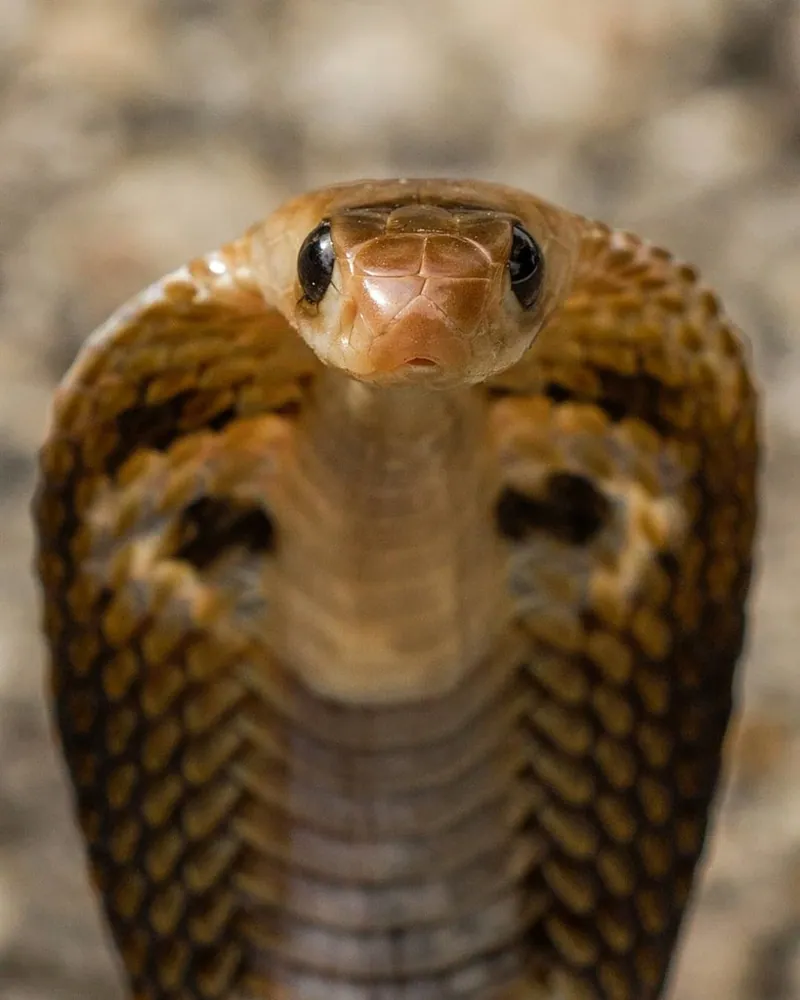
The Indian cobra is a heavy-bodied venomous snake that lives across the Indian subcontinent. It is famous for the large hood it spreads when threatened. It is one of the four snakes responsible for the most snakebites in India and Sri Lanka, so knowing how to recognise it matters.1



 Maziviro ayo
- A relatively large hood, which it expands when threatened.1
- Many individuals have a hood mark on the back of the hood: two round eye-like patterns joined by a curved line, looking like a pair of spectacles.1
- Colour varies widely. The underside can be grey, yellow, tan, brown, reddish or black, and many adults have salt-and-pepper speckles on the upper scales.1
- Adults in southern Pakistan are often uniformly black on top, with a light underside.1
Inowanzovhiringidzwa ne: The Oriental rat snake is often mistaken for this cobra, but it is much longer and has a more ridged-looking body. The monocled cobra has an O-shaped pattern on the back of its hood, while the Indian cobra has a spectacles-shaped pattern. The Caspian cobra can be confused with it where they share range in Pakistan and Afghanistan, but it is never fully black.1
Simba reuturu
Uturu hunobuda nemeno ayo painoruma.
Uturu hwayo hunoitei?
Its venom mainly contains a powerful neurotoxin, which attacks the nerves, and a cardiotoxin, which harms the heart. The neurotoxin paralyses muscles, and severe bites can lead to respiratory failure (breathing failure) or cardiac arrest (the heart stopping). Symptoms may appear between 15 minutes and two hours after a bite. Early signs include severe local pain and swelling that spreads up the limb, followed by darkening and blistering of the skin, as well as headache, nausea, vomiting, dizziness and drowsiness.1
Ine ngozi yakadii kuvanhu?
Ngozi kuvanhu: InourayaImwe yemhuka dzine ngozi zvikuru pasi rose.It is responsible for many snakebites and most snakebite cases in Bangladesh. In one study, untreated bite victims had a mortality rate of about 20–30%. In another study of patients who received prompt medical treatment, the rate was 9%. The amount of venom delivered varies from bite to bite.1
 Mashoko akanaka: vanachiremba vane mushonga (antivenom) kana kurapwa kwechinhu ichi.1
Inoitei kana yatya?
When threatened, it spreads its large hood.1
 Kana ikaruma
- Prompt medical treatment and antivenom reduce deaths from this snake's bites. Polyvalent serum, an antivenom that works against several snake species, is available for treating these bites.1
- Chengeta munhu asingafambe uye akadzikama, bvisa mhete nezvinhu zvakasunga, uende kuchipatara nokukurumidza: antivenom ndiwo mushonga wacho.
Gara uchitanga wafonera nhamba yechimbichimbi (112, 000, 911). Iri izano rakajairika rerubatsiro rwekutanga, kwete zano rechiremba. Zvakakosha zverubatsiro rwekutanga
 Gara wakachengeteka
- Usambobata mhuka yesango, kuedza kuitora kana kuinetsa, kunyange iri diki, uye kunyange ichiita seyakarara kana yakafa.
- Ipa nzvimbo. Kana ukasangana nayo, dzikama, dzokera shure zvishoma nezvishoma uirege iende nenzira yayo.
- Kana imwe ikakuruma: dzikama, gara wakanyarara, fonera nhamba yechimbichimbi (112, 000, 911) kana kuti enda kuchipatara nokukurumidza. Rangarira kuti yaitaridzika sei, mufananidzo unobatsira.
Haisi kukutsvaga. Inoshandisa uturu hwayo kubata chikafu kana kuzvidzivirira, uye inotonyanya kuda kuhwanda. Zvimwe pamusoro pekugara wakachengeteka
Yakakura sei?
Yakareba zvakadii?
 yakareba sekatsi dzepamba 4 kubva pamhuno kusvika kumuswe
 yakareba semabhanana 12 akateedzana
 inogona kumhanya mamita 100 mumasekondi 46 (munhu anomhanyisa kupfuura vose anoda 9.6)
Indian cobra yakakura sei kana yaenzaniswa NEWE?
Masvomhu chete mubrowser yako. Hapana chinochengetwa kana kutumirwa kupi zvako.
Inomhanya zvakadii?


Chokwadi
Its venom is used as an intoxicant in India. Snake charmers have been paid to provide bites from their snakes, and the effects include loss of consciousness, euphoria and sedation.1
Hatchlings are independent from birth and have fully working venom glands, so even young snakes can deliver venom.1
It is revered in Hindu mythology and culture, and is often seen with snake charmers.1
It is protected under the Indian Wildlife Protection Act (1972).1
Kwakabva chokwadi
- Indian cobra (Wikipedia (CC BY-SA 4.0))
- Naja naja (iNaturalist): mazita nekurongwa kwemhuka.
- Venom Wiki: danho rengozi, saizi yakajairika nekufungidzira kwekumhanya ndezvedu. Ona kuti tinozviwana sei: Matinoyera ngozi.
Chokwadi chimwe nechimwe pane peji rino chine nhamba inoratidza kwachakabva. Kana takakanganisa, ruregerero, tiri vanoda mhuka, kwete magazini yesainzi. Tiudze pa[email protected] tichazvigadzirisa.
 Chinyavada chine nzara! Venom Wiki iprojekiti yemunhu mumwe: yemahara, isina kushambadza uye isina zvinokuteedzera. Chipo chidiki chinobatsira kuti irambe iri paindaneti.Fudza chinyavada
 King cobra
 Caspian cobra
 Common krait
 Malayan krait
 Many-banded krait
 Monocled cobra
 Deathstalker
 Indian saw-scaled viper
 Puff adder
 Bvumbi raRussell
 Asian giant hornet
 Komodo dragon