
 Afrika
 Asia
Asia Yuropu
 Amerika yeKumaodzanyemba
 Australia neOceania
 Antarctica
 Gungwa rePacific
 Gungwa reAtlantic
 Gungwa reIndia
 Gungwa reArctic
 Gungwa reMediterranean
 Gungwa Dzvuku
 Gungwa reCaribbean
 Gungwa reCoral
 Gungwa reChina yeKumaodzanyemba
 Gungwa rePhilippines
 Gungwa reAndaman
 Gungwa reKuchamhembe
 Gungwa reTimor neArafura
 Gungwa reBengal
 Gulf yeCalifornia
Joro spider
 Inoruma
The Joro spider is a large orb-weaving spider from East Asia. It has spread into parts of the eastern United States since the 2010s. It rarely bites people, and its venom is not medically significant.1

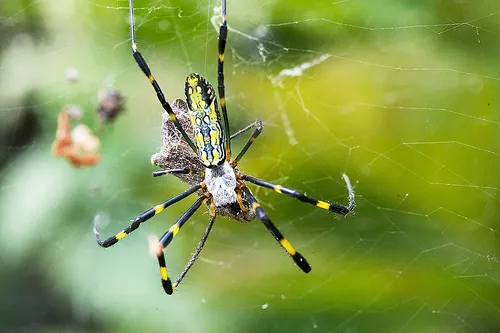
 Maziviro ayo
- Adult females have stripes of yellow and dark blue, with red toward the rear of the abdomen.1
- Both sexes have a large abdomen and long legs.1
- Females are much larger than males: about 1.7 to 2.5 cm, compared with about 0.7 to 1.0 cm for males.1
- The web's yellow threads look gold in sunlight. The web has three layers, unusual for an orb web: a central orb, plus two irregular layers in front and behind it.1
- Females' webs may reach several metres across.1
Simba reuturu
Uturu hunobuda nemeno ayo painoruma.
Uturu hwayo hunoitei?
Its venom is weak. A bite causes temporary pain and redness, which has been compared to a bee sting. The venom is not medically significant.1
Ine ngozi yakadii kuvanhu?
Ngozi kuvanhu: Ngozi shomaSenyuchi kubaya kana kushoma. Kazhinji haina ngozi kuvanhu.Its bite does not pose significant risks to humans. Its fangs are small and it is reluctant to bite, so bites are unlikely.1
Inoitei kana yatya?
It is reluctant to bite.1
 Kana ikaruma
- Geza parumwa woisa pakiti yechando kuderedza marwadzo. Wana rubatsiro rwechiremba kana marwadzo akanyanya, achipararira kana munhu asinganzwi zvakanaka.
Gara uchitanga wafonera nhamba yechimbichimbi (112, 000, 911). Iri izano rakajairika rerubatsiro rwekutanga, kwete zano rechiremba. Zvakakosha zverubatsiro rwekutanga
 Gara wakachengeteka
- Usambobata mhuka yesango, kuedza kuitora kana kuinetsa, kunyange iri diki, uye kunyange ichiita seyakarara kana yakafa.
- Ipa nzvimbo. Kana ukasangana nayo, dzikama, dzokera shure zvishoma nezvishoma uirege iende nenzira yayo.
- Kana imwe ikakuruma: dzikama, gara wakanyarara, fonera nhamba yechimbichimbi (112, 000, 911) kana kuti enda kuchipatara nokukurumidza. Rangarira kuti yaitaridzika sei, mufananidzo unobatsira.
Haisi kukutsvaga. Inoshandisa uturu hwayo kubata chikafu kana kuzvidzivirira, uye inotonyanya kuda kuhwanda. Zvimwe pamusoro pekugara wakachengeteka
Yakakura sei?
Yakareba zvakadii?
 inenge kureba sechibatanidzo chemapepa
 inogona kumhanya mamita 100 mumasekondi 210 (munhu anomhanyisa kupfuura vose anoda 9.6)
Joro spider yakakura sei kana yaenzaniswa NEWE?
Masvomhu chete mubrowser yako. Hapana chinochengetwa kana kutumirwa kupi zvako.
Inomhanya zvakadii?


Chokwadi
Females spin webs several metres long, and their yellow threads look gold in sunlight.1
The name comes from a shape-shifting spider in Japanese folklore that can breathe fire and control other spiders.1
By October 2022, its range covered at least 120,000 km² across several US states.1
In the Ao-Naga people's food tradition, this spider is eaten.1
The spider was first spotted in North America in Hoschton, Georgia, in 2013, and its presence was confirmed in 2014.1
Smaller males are sometimes seen in the females' webs during autumn, when they mate.1
Kwakabva chokwadi
- Trichonephila clavata (Wikipedia (CC BY-SA 4.0))
- Trichonephila clavata (iNaturalist): mazita nekurongwa kwemhuka.
- Venom Wiki: danho rengozi, saizi yakajairika nekufungidzira kwekumhanya ndezvedu. Ona kuti tinozviwana sei: Matinoyera ngozi.
Chokwadi chimwe nechimwe pane peji rino chine nhamba inoratidza kwachakabva. Kana takakanganisa, ruregerero, tiri vanoda mhuka, kwete magazini yesainzi. Tiudze pa[email protected] tichazvigadzirisa.
 Chinyavada chine nzara! Venom Wiki iprojekiti yemunhu mumwe: yemahara, isina kushambadza uye isina zvinokuteedzera. Chipo chidiki chinobatsira kuti irambe iri paindaneti.Fudza chinyavada
 Mediterranean black widow
 Diving bell spider
 European yellow sac spider
 Daddy long-legs spider
 Giant huntsman spider
 Hobo spider
 Deathstalker
 Indian cobra
 Indian saw-scaled viper
 King cobra
 Puff adder
 Bvumbi raRussell