
 Afrika
 Asia
Asia Yuropa
 Amerika Borwa
 Australia le Oceania
 Antarctica
 Lewatle la Pacific
 Lewatle la Atlantic
 Lewatle la India
 Lewatle la Arctic
 Lewatle la Mediterranean
 Lewatle le Lefubedu
 Lewatle la Caribbean
 Lewatle la Coral
 Lewatle la China Borwa
 Lewatle la Philippine
 Lewatle la Andaman
 Lewatle la Leboya
 Lewatle la Timor le Arafura
 Kgwohlo ya Bengal
 Kgwohlo ya California
Asian common toad
 Chefo letlalong la yonaE ja: NamaE chefang, eseng e nang le chefo
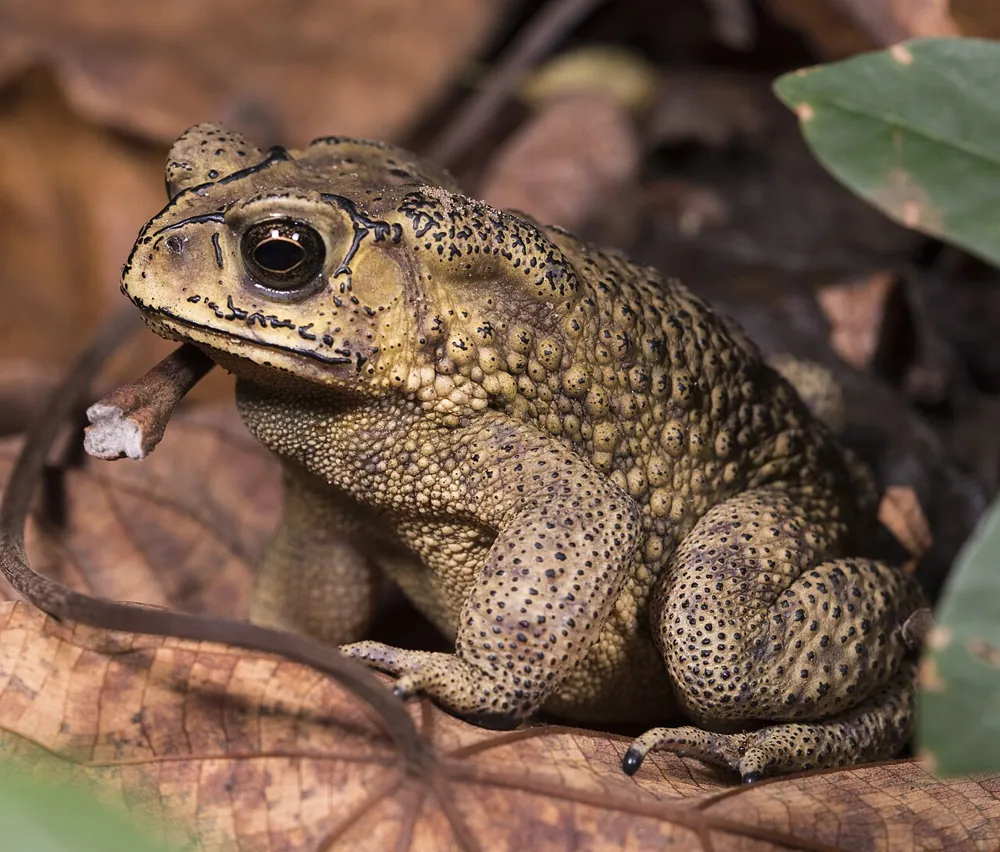
The Asian common toad is a large toad found across much of South and Southeast Asia. It grows to about 20 cm long and is often seen at night under street lamps. It matters because it has spread to places where it does not belong, and experts worry it could harm local wildlife.1

 Ho e tseba jwang
- Grows to about 20 cm long1
- Back is yellowish or brownish, with black spines and ridges1
- Large, kidney-shaped or elongated parotoid glands behind the eyes, which are prominent1
- Ear drum (tympanum) is very distinct, at least two-thirds the width of the eye1
- Short, blunt snout and several bony ridges on top of the head1
Matla a chefo
Letlalo la yona le a chefa. Ho kotsi ho e ama, ho e nyeka kapa ho e ja.
Chefo ya yona (e chefang ha o e ama kapa o e ja) e etsang?
Its parotoid glands secrete milky white bufotoxin, a toxin, from its back. It uses this to deter predators. The toxin would beyond reasonable doubt severely affect native predators such as snakes, goannas and quolls.1
E kotsi hakae ho batho?
Kotsi ho batho: E tebilengHaeba motho a e ama kapa a e ja, eya ho ngaka. Lefu le etsahala ka seoelo haholo.E etsang ha e tshohile?
Its glands in the back release toxin to deter predators.1
 Haeba motho a e amme kapa a e jele
- Haeba motho a amme e nngwe: hlatswa matsoho hantle mme o se ke wa ama mahlo kapa molomo. Haeba ngwana kapa phoofolo ya lapeng e e nyeditse kapa e e jele: letsetsa setsi sa chefo (poison centre) kapa nomoro ya tshohanyetso.
Kamehla letsetsa nomoro ya tshohanyetso pele (112, 000, 911). Ena ke tataiso e akaretsang ya thuso ya pele, hase keletso ya bongaka. Metheo ya thuso ya pele
 Dula o bolokehile
- O se ke wa ama, wa tshwara kapa wa tena phoofolo ya naheng, leha e le e nyenyane, le leha e shebahala e robetse kapa e shwele.
- E fe sebaka. Ha o kopana le yona, dula o kgutsitse, kgutlela morao butle mme o e tlohele e tsamaye ka tsela ya yona.
- Haeba o e amme kapa o e jele: o se ke wa hohla mahlo kapa molomo, hlatswa matsoho mme o fumane thuso ya bongaka.
Ha e o batle. Chefo ya yona e teng feela hore ho se be le letho le e jang. Ho eketsehileng ka ho dula o bolokehile
Hokae lefatsheng?
E kgolo hakae?
E telele hakae?
 e telele jwaloka diboloko tsa ho bapala tse 6 moleng
 e ka matha metara e 100 ka metsotswana e 180 (motho ya potlakang ka ho fetisisa o hloka 9,6)
Asian common toad e kgolo hakae ha e bapiswa le WENA?
Ke dipalo feela ka hara sebatli sa hao. Ha ho letho le bolokwang kapa le romelwang kae kapa kae.
E potlaka hakae?


Dintlha
It has been described as one of Australia's '10 most unwanted' species, and as potentially more damaging than the cane toad.1
Madagascar's native predators lack resistance to its toxins, which could affect local wildlife there.1
Tadpoles have been shown to be able to recognise their kin.1
Tadpoles grown in sibling groups metamorphosed faster than those kept in mixed groups.1
Bakeng sa ditsebi tsa chefo
Moo dintlha di tswang teng
- Duttaphrynus melanostictus (Wikipedia (CC BY-SA 4.0))
- Duttaphrynus melanostictus (iNaturalist): mabitso le tlhophiso.
- Venom Wiki: boemo ba kotsi, boholo bo tlwaelehileng le kakanyo ya lebelo ke tsa rona. Bona kamoo re di balang ka teng: Kamoo re lekanyang kotsi ka teng.
Taba e nngwe le e nngwe leqepheng lena e na le nomoro e bontshang mohlodi wa yona. Haeba re entse phoso, re kopa tshwarelo, re barati ba diphoofolo, hase makasine wa saense. Re bolelle ho [email protected] mme re tla e lokisa.
 Phepheng e lapile! Venom Wiki ke projeke ya motho a le mong: ke mahala, ha e na dipapatso ebile ha e na di-tracker. Thuso e nyenyane ya tjhelete e e boloka e ntse e le inthaneteng.Fepa phepheng
Tse ding tsa sehlopha se le seng: Dihoho tse chefang, mampotsana le di-newt
 Japanese fire-bellied newtDihoho tse chefang, mampotsana le di-newtE hloka ngakaO se ke wa ama
 Common toadDihoho tse chefang, mampotsana le di-newtE utlwisa bohloko feelaO se ke wa ama
 Oriental fire-bellied toadDihoho tse chefang, mampotsana le di-newtHa e na kotsi
 Asiatic toadDihoho tse chefang, mampotsana le di-newtE utlwisa bohloko feelaO se ke wa ama
 Emperor newtDihoho tse chefang, mampotsana le di-newtE utlwisa bohloko feelaO se ke wa ama
 Himalayan newtDihoho tse chefang, mampotsana le di-newtE utlwisa bohloko feelaO se ke wa ama
 Deathstalker
 Indian cobra
 Indian saw-scaled viper
 King cobra
 Puff adder
 Noha ea Russell
.jpg)