
 Afrika
 Asia
Asia Yuropa
 Amerika Borwa
 Australia le Oceania
 Antarctica
 Lewatle la Pacific
 Lewatle la Atlantic
 Lewatle la India
 Lewatle la Arctic
 Lewatle la Mediterranean
 Lewatle le Lefubedu
 Lewatle la Caribbean
 Lewatle la Coral
 Lewatle la China Borwa
 Lewatle la Philippine
 Lewatle la Andaman
 Lewatle la Leboya
 Lewatle la Timor le Arafura
 Kgwohlo ya Bengal
 Kgwohlo ya California
Blackspotted puffer
 E a chefa ha e jewaE ja: Hanyane ka tsohleE chefang, eseng e nang le chefo
The blackspotted puffer is a small tropical sea fish that lives on coral reefs and in lagoons across the Indian and Pacific Oceans. It is poisonous rather than venomous, so it is dangerous to eat but does not bite or sting.1


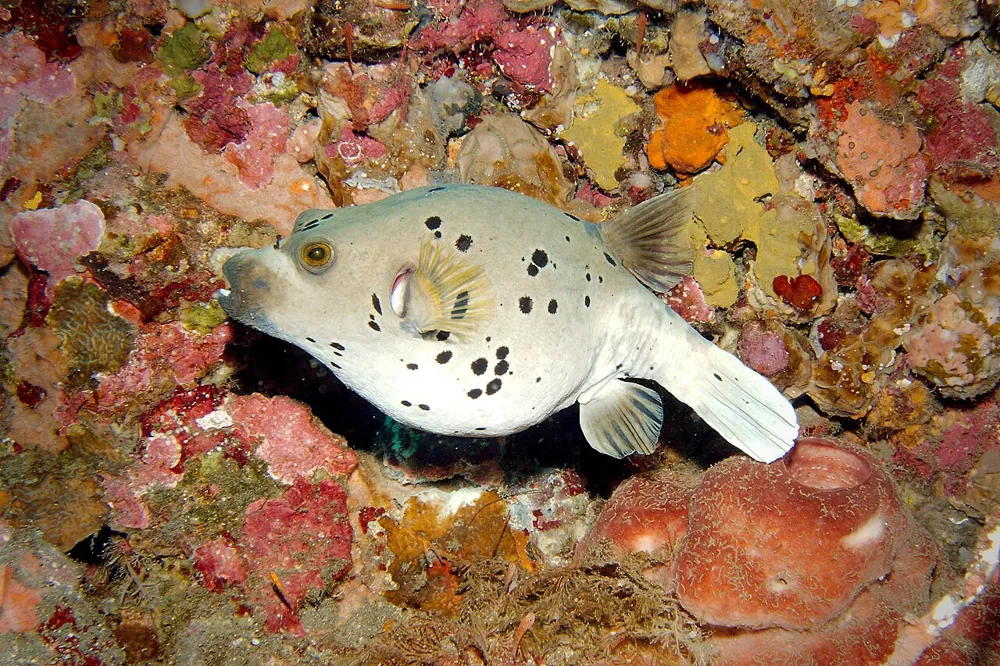
.jpg)
 Ho e tseba jwang
- Small, oval, rounded body with no scales; the skin is smooth.1
- Short snout with two pairs of nostrils and four strong teeth.1
- Background colour varies: grey, light brown, bluish, bright yellow or orangey yellow, and sometimes two colours such as blue and yellow.1
- Skin covered in dark blotches of varying size and shape.1
- Dark colouring around the eyes and mouth.1
Hangata e ferekanngwa le: The yellow colour forms are very similar to those of Arothron meleagris, but they can be told apart. The fully yellow form is much rarer in this species (about 1% of individuals, compared with 10% in A. meleagris). It usually keeps dark markings around the mouth, eyes and base of the dorsal fin, while A. meleagris is uniformly yellow with black spots.1
Matla a chefo
E kotsi feela haeba ho na le se e jang.
Chefo ya yona (e chefang ha o e ama kapa o e ja) e etsang?
It is not venomous. It holds tetrodotoxin, a deadly poison that protects it from predators.1
E kotsi hakae ho batho?
Kotsi ho batho: E kotsi haholoE ka bolaya motho ya sa fumaneng kalafo.Its tetrodotoxin is deadly. The risk comes from eating or handling the fish.1
E etsang ha e tshohile?
When threatened, it inflates its body by swallowing air or water.1
 Haeba motho a e amme kapa a e jele
- Haeba motho a e jele kapa a na le matshwao ka mora ho e ja: letsetsa nomoro ya tshohanyetso kapa setsi sa chefo (poison centre) hang-hang.
Kamehla letsetsa nomoro ya tshohanyetso pele (112, 000, 911). Ena ke tataiso e akaretsang ya thuso ya pele, hase keletso ya bongaka. Metheo ya thuso ya pele
 Dula o bolokehile
- O se ke wa ama, wa tshwara kapa wa tena phoofolo ya naheng, leha e le e nyenyane, le leha e shebahala e robetse kapa e shwele.
- E fe sebaka. Ha o kopana le yona, dula o kgutsitse, kgutlela morao butle mme o e tlohele e tsamaye ka tsela ya yona.
- Haeba o e amme kapa o e jele: o se ke wa hohla mahlo kapa molomo, hlatswa matsoho mme o fumane thuso ya bongaka.
Ha e o batle. Chefo ya yona e teng feela hore ho se be le letho le e jang. Ho eketsehileng ka ho dula o bolokehile
Hokae lefatsheng?
E kgolo hakae?
E telele hakae?
 e telele jwaloka diboloko tsa ho bapala tse 10 moleng
 e ka sesa bolelele ba letangwane le leholo la ho sesa (50 m) ka metsotswana e 45
Blackspotted puffer e kgolo hakae ha e bapiswa le WENA?
Ke dipalo feela ka hara sebatli sa hao. Ha ho letho le bolokwang kapa le romelwang kae kapa kae.
E potlaka hakae?
Dintlha
Its tetrodotoxin poison is strong enough to protect it from predators.1
It has no scales, and its skin is covered with dark blotches.1
It has no pelvic fins and no lateral line.1
It is active during the day and lives alone, defending its own territory.1
It has four strong teeth set in a terminal mouth.1
Bakeng sa ditsebi tsa chefo
- Lebitso la saense
- Arothron nigropunctatus
- Sehlopha
- Diphoofolo tse ding tse chefang
- Lelapa
- Tetraodontidae2
- Tatelano
- Tetraodontiformes
- Dikontinente
- Lewatle la Pacific, Lewatle la India, Lewatle le Lefubedu, Lewatle la Coral, Lewatle la Philippine, Lewatle la China Borwa, Lewatle la Timor le Arafura, Kgwohlo ya Bengal, Mawatle
- Kotsi ho batho
- 4 / 5: E kotsi haholo3
Moo dintlha di tswang teng
- Blackspotted puffer (Wikipedia (CC BY-SA 4.0))
- Arothron nigropunctatus (iNaturalist): mabitso le tlhophiso.
- Venom Wiki: boemo ba kotsi, boholo bo tlwaelehileng le kakanyo ya lebelo ke tsa rona. Bona kamoo re di balang ka teng: Kamoo re lekanyang kotsi ka teng.
Taba e nngwe le e nngwe leqepheng lena e na le nomoro e bontshang mohlodi wa yona. Haeba re entse phoso, re kopa tshwarelo, re barati ba diphoofolo, hase makasine wa saense. Re bolelle ho [email protected] mme re tla e lokisa.
 Phepheng e lapile! Venom Wiki ke projeke ya motho a le mong: ke mahala, ha e na dipapatso ebile ha e na di-tracker. Thuso e nyenyane ya tjhelete e e boloka e ntse e le inthaneteng.Fepa phepheng
Tse ding tsa sehlopha se le seng: Diphoofolo tse ding tse chefang
 Japanese pufferfishDiphoofolo tse ding tse chefangE a bolaya
 Hawksbill sea turtleDiphoofolo tse ding tse chefangE ka bolaya
 Greenland sharkDiphoofolo tse ding tse chefangE utlwisa bohloko feela
 Silver-cheeked toadfishDiphoofolo tse ding tse chefangE a bolaya
 White-spotted pufferDiphoofolo tse ding tse chefangE ka bolaya
 Long-spine porcupinefishDiphoofolo tse ding tse chefangE hloka ngaka
E boetse e phela: Lewatle la Pacific
 Australian box jellyfishDi-jellyfish le diphoofolo tsa lewatle tse hlabangE a bolayaO se ke wa ama
 Geography coneDikgofu tsa cone le di-octopusE a bolaya
 Greater blue-ringed octopusDikgofu tsa cone le di-octopusE a bolaya
 Southern blue-ringed octopusDikgofu tsa cone le di-octopusE a bolaya
 Irukandji jellyfishDi-jellyfish le diphoofolo tsa lewatle tse hlabangE ka bolayaO se ke wa ama
 Reef stonefishDitlhapi tse nang le chefoE ka bolayaO se ke wa ama