
 Afrika
 Asia
Asia Yuropa
 Amerika Borwa
 Australia le Oceania
 Antarctica
 Lewatle la Pacific
 Lewatle la Atlantic
 Lewatle la India
 Lewatle la Arctic
 Lewatle la Mediterranean
 Lewatle le Lefubedu
 Lewatle la Caribbean
 Lewatle la Coral
 Lewatle la China Borwa
 Lewatle la Philippine
 Lewatle la Andaman
 Lewatle la Leboya
 Lewatle la Timor le Arafura
 Kgwohlo ya Bengal
 Kgwohlo ya California
Brown-tail moth
 Boya bo hlabang
The brown-tail moth is a moth whose caterpillars are covered in tiny irritating hairs. It is native to Europe, neighbouring parts of Asia and the north coast of Africa. Its hairs can cause a very itchy rash, so it matters to anyone who works or plays near trees it feeds on.1

 Ho e tseba jwang
- Adults have pure white upper wings and a hairy white body with a tuft of brown hair at the tip of the tail end.1
- Adults have a wingspan of 36 to 42 millimetres.1
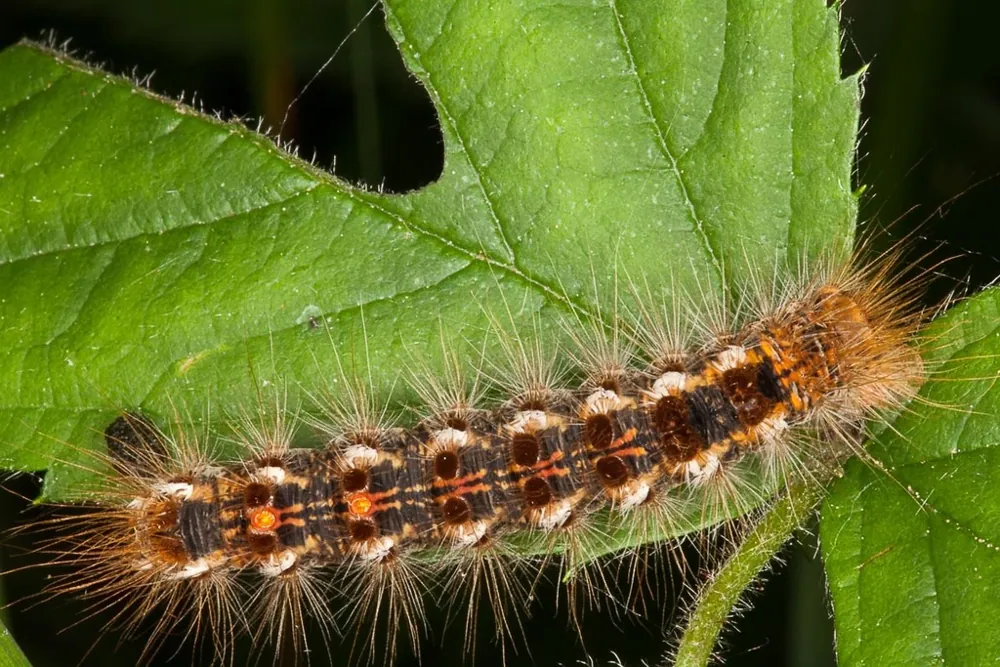
- Caterpillars are very hairy, brown with white markings, and have two prominent red spots toward the tail end.1
- In late autumn and winter, silken tents hang on branch tips, which are a sign that the caterpillars are present.1
Hangata e ferekanngwa le: Euproctis similis, also native to Europe, is similar as an adult but the female has a yellow tail tuft. Hyphantria cunea, native to North America, is similar too, but it lacks the coloured tail tuft.1
Matla a chefo
Boya bo bonyenyane kapa ditlhaka di robehela letlalong mme di a hlaba.
Chefo ya yona (eo e e kenyang ka ho loma kapa ho hlaba) e etsang?
The hairs are not venom injected by a bite or sting. They are toxic and irritating to skin. Barbed hairs lodge in the skin and cause physical irritation, and chemicals in the hairs also irritate it. If inhaled, the hairs can cause breathing difficulties similar to asthma. The toxins stay active for up to three years after the hairs are shed.1
E kotsi hakae ho batho?
Kotsi ho batho: E bohlokoE ka utlwisa bohloko haholo, empa hoo e batlang e le kamehla ha e kotsi haholo.Contact with the hairs causes a very itchy rash that can last for weeks. Doctors reported rashes worse than poison ivy rash in the early 1900s. Breathing difficulties can occur if the hairs are inhaled.1
E etsang ha e tshohile?
Its hairs protect the caterpillars from predators, and the caterpillars use some hairs in their cocoons.1
 Haeba o ama boya ba yona
- Bakeng sa boya bo hlabang ba diboko: bo tlose ka theipi e kgomarelang, ebe o hlatswa letlalo. O se ke wa hohla.
- Bakeng sa ho longwa: hlatswa mme o pholise. Fumana thuso ya bongaka haeba motho a ikutlwa a kula kapa a tswa madi habonolo.
Kamehla letsetsa nomoro ya tshohanyetso pele (112, 000, 911). Ena ke tataiso e akaretsang ya thuso ya pele, hase keletso ya bongaka. Metheo ya thuso ya pele
 Dula o bolokehile
- O se ke wa ama, wa tshwara kapa wa tena phoofolo ya naheng, leha e le e nyenyane, le leha e shebahala e robetse kapa e shwele.
- E fe sebaka. Ha o kopana le yona, dula o kgutsitse, kgutlela morao butle mme o e tlohele e tsamaye ka tsela ya yona.
- Haeba o ama boya ba yona: dula o kgutsitse, o se ke wa sisinyeha, letsetsa nomoro ya tshohanyetso (112, 000, 911) kapa o ye sepetlele kapele. Hopola hore e ne e shebahala jwang, foto e a thusa.
Ha e o batle. E sebedisa chefo ya yona ho tshwara dijo kapa ho itshireletsa, mme e kgetha ho ipata. Ho eketsehileng ka ho dula o bolokehile
Hokae lefatsheng?
E kgolo hakae?
E telele hakae?
 e kgutshwane ho feta monwana wa hao o monyenyane
 e dieha ho feta kgofu ya serapeng
Brown-tail moth e kgolo hakae ha e bapiswa le WENA?
Ke dipalo feela ka hara sebatli sa hao. Ha ho letho le bolokwang kapa le romelwang kae kapa kae.
E potlaka hakae?

Dintlha
The hairs of the caterpillars can cause a rash even when no one touches a caterpillar, because shed hairs can blow in the wind.1
Brown-tail moths were described in outbreaks in Paris, London and Berlin as far back as the 1500s, when they stripped trees of leaves.1
The species spends about nine months of its year as caterpillars, which is unusually long for a moth.1
Caterpillars spend the winter together in silken tents built at branch tips, rather than spreading out.1
A parasitic fly introduced to North America in 1906 to control spongy moths also strongly affected brown-tail moths.1
Ho senya ditshomo
Tshomo: You can only get the rash by touching the caterpillars.
Nnete: Hairs are shed and can become windblown, and they can be carried indoors on clothing and shoes, so a rash can occur without direct contact with the caterpillars.1
Moo dintlha di tswang teng
- Brown-tail moth (Wikipedia (CC BY-SA 4.0))
- Euproctis chrysorrhoea (iNaturalist): mabitso le tlhophiso.
- Venom Wiki: boemo ba kotsi, boholo bo tlwaelehileng le kakanyo ya lebelo ke tsa rona. Bona kamoo re di balang ka teng: Kamoo re lekanyang kotsi ka teng.
Taba e nngwe le e nngwe leqepheng lena e na le nomoro e bontshang mohlodi wa yona. Haeba re entse phoso, re kopa tshwarelo, re barati ba diphoofolo, hase makasine wa saense. Re bolelle ho [email protected] mme re tla e lokisa.
 Phepheng e lapile! Venom Wiki ke projeke ya motho a le mong: ke mahala, ha e na dipapatso ebile ha e na di-tracker. Thuso e nyenyane ya tjhelete e e boloka e ntse e le inthaneteng.Fepa phepheng
Tse ding tsa sehlopha se le seng: Diboko le dikokoanyana
 Oak processionaryDiboko le dikokoanyanaE utlwisa bohloko feelaO se ke wa ama
 Pine processionaryDiboko le dikokoanyanaE utlwisa bohloko feelaO se ke wa ama
 Common bombardier beetleDiboko le dikokoanyanaHa e na kotsi
 Asian giant water bugDiboko le dikokoanyanaE utlwisa bohloko feela
 Blue-striped nettle grubDiboko le dikokoanyanaE utlwisa bohloko feelaO se ke wa ama
 Masked hunterDiboko le dikokoanyanaE utlwisa bohloko feela
E boetse e phela: Yuropa
 Common European adderDi-viper le di-adderE hloka ngaka
 Spanish flyDiphoofolo tse ding tse chefangE hloka ngakaO se ke wa ama
 Common waspDinotshi, di-wasp le di-hornetE utlwisa bohloko feela
 European hornetDinotshi, di-wasp le di-hornetE utlwisa bohloko feela
 Fire salamanderDihoho tse chefang, mampotsana le di-newtE utlwisa bohloko feelaO se ke wa ama
 Western honey beeDinotshi, di-wasp le di-hornetE utlwisa bohloko feela