
 Afrika
 Asia
Asia Yuropa
 Amerika Borwa
 Australia le Oceania
 Antarctica
 Lewatle la Pacific
 Lewatle la Atlantic
 Lewatle la India
 Lewatle la Arctic
 Lewatle la Mediterranean
 Lewatle le Lefubedu
 Lewatle la Caribbean
 Lewatle la Coral
 Lewatle la China Borwa
 Lewatle la Philippine
 Lewatle la Andaman
 Lewatle la Leboya
 Lewatle la Timor le Arafura
 Kgwohlo ya Bengal
 Kgwohlo ya California
Masked hunter
 Ho loma
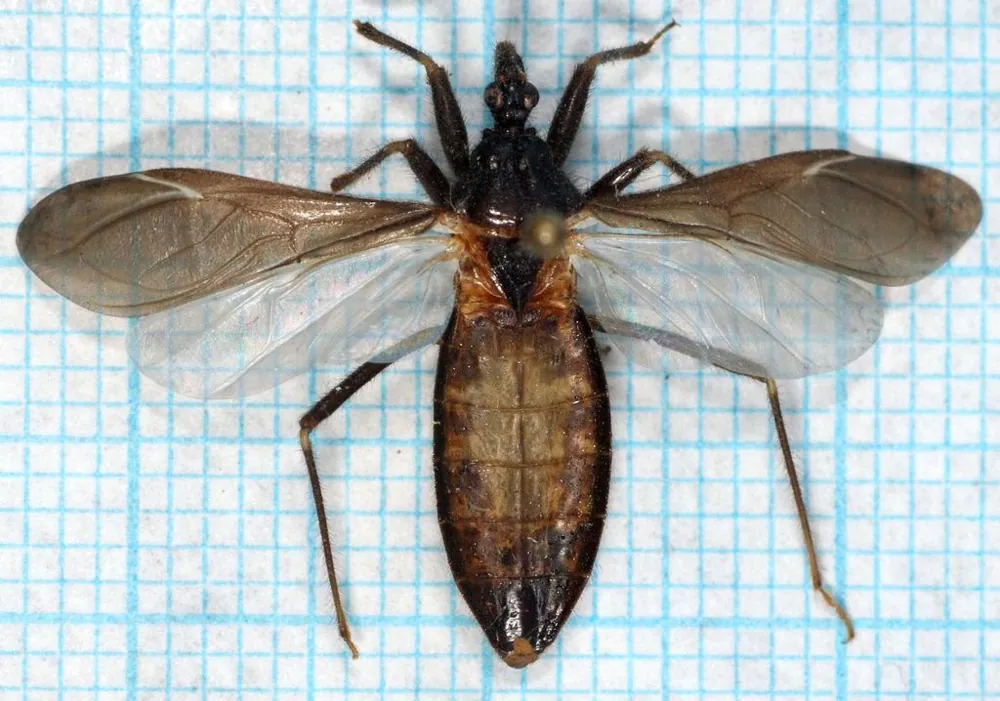
The masked hunter is a dark brown to black insect from the assassin bug family. It hunts small creatures such as bed bugs, woodlice and termites, and it is often found in homes. Its nymphs hide by covering their bodies with dust and debris.1

 Ho e tseba jwang
- Adults are uniformly dark brown to black and measure 17–22 mm in length.1
- The head is elongated, with a short, three-segmented beak and long, slender antennae.1
- The abdomen is wide and extends beyond the wings in the middle, showing the edges of its abdominal segments.1
- Nymphs look like small adults but are often grey or light-coloured, because a sticky body coat collects dust, lint and small particles.1
Hangata e ferekanngwa le: Masked hunters are sometimes mistaken for the kissing bug. Unlike the kissing bug, masked hunters do not carry Chagas disease.1
Matla a chefo
Chefo e tswa ka meno a yona a chefo (fangs) kapa ka meno a mang ha e loma.
E kotsi hakae ho batho?
Kotsi ho batho: E bohlokoE ka utlwisa bohloko haholo, empa hoo e batlang e le kamehla ha e kotsi haholo.A handled or trapped masked hunter can deliver a rostral stab, which is painful and comparable to a bee's sting. The swelling can last for about a week. They do not feed on human blood.1
E etsang ha e tshohile?
When handled or trapped, it defends itself by delivering a stab with its beak.1
 Haeba e loma
- Bakeng sa boya bo hlabang ba diboko: bo tlose ka theipi e kgomarelang, ebe o hlatswa letlalo. O se ke wa hohla.
- Bakeng sa ho longwa: hlatswa mme o pholise. Fumana thuso ya bongaka haeba motho a ikutlwa a kula kapa a tswa madi habonolo.
Kamehla letsetsa nomoro ya tshohanyetso pele (112, 000, 911). Ena ke tataiso e akaretsang ya thuso ya pele, hase keletso ya bongaka. Metheo ya thuso ya pele
 Dula o bolokehile
- O se ke wa ama, wa tshwara kapa wa tena phoofolo ya naheng, leha e le e nyenyane, le leha e shebahala e robetse kapa e shwele.
- E fe sebaka. Ha o kopana le yona, dula o kgutsitse, kgutlela morao butle mme o e tlohele e tsamaye ka tsela ya yona.
- Haeba e nngwe e o loma: dula o kgutsitse, o se ke wa sisinyeha, letsetsa nomoro ya tshohanyetso (112, 000, 911) kapa o ye sepetlele kapele. Hopola hore e ne e shebahala jwang, foto e a thusa.
Ha e o batle. E sebedisa chefo ya yona ho tshwara dijo kapa ho itshireletsa, mme e kgetha ho ipata. Ho eketsehileng ka ho dula o bolokehile
Hokae lefatsheng?
E kgolo hakae?
E telele hakae?
 e telele jwaloka klipi ya pampiri
Masked hunter e kgolo hakae ha e bapiswa le WENA?
Ke dipalo feela ka hara sebatli sa hao. Ha ho letho le bolokwang kapa le romelwang kae kapa kae.
E potlaka hakae?


Dintlha
Nymphs build two layers of camouflage on their bodies, an inner layer of fine particles and an outer layer of coarser ones, using their hind legs and a tarsal fan.1
Their sticky body coat catches dust, lint and other small particles, which hides them from both predators and prey.1
Because they hunt bed bugs, a masked hunter in the home can be a sign of a bed bug problem, and controlling the bed bugs usually deals with the hunters too.1
Masked hunters were probably introduced to North America by accident in the late 1800s to early 1900s. They were first found in Canada in 1905 and in the United States in 1917.1
Ho senya ditshomo
Tshomo: Masked hunters are kissing bugs and carry Chagas disease.
Nnete: Masked hunters are sometimes mistaken for kissing bugs, but they do not carry Chagas disease. Their stab is painful, but it does not spread that disease.1
Moo dintlha di tswang teng
- Reduvius personatus (Wikipedia (CC BY-SA 4.0))
- Reduvius personatus (iNaturalist): mabitso le tlhophiso.
- Venom Wiki: boemo ba kotsi, boholo bo tlwaelehileng le kakanyo ya lebelo ke tsa rona. Bona kamoo re di balang ka teng: Kamoo re lekanyang kotsi ka teng.
Taba e nngwe le e nngwe leqepheng lena e na le nomoro e bontshang mohlodi wa yona. Haeba re entse phoso, re kopa tshwarelo, re barati ba diphoofolo, hase makasine wa saense. Re bolelle ho [email protected] mme re tla e lokisa.
 Phepheng e lapile! Venom Wiki ke projeke ya motho a le mong: ke mahala, ha e na dipapatso ebile ha e na di-tracker. Thuso e nyenyane ya tjhelete e e boloka e ntse e le inthaneteng.Fepa phepheng
Tse ding tsa sehlopha se le seng: Diboko le dikokoanyana
 Oak processionaryDiboko le dikokoanyanaE utlwisa bohloko feelaO se ke wa ama
 Pine processionaryDiboko le dikokoanyanaE utlwisa bohloko feelaO se ke wa ama
 Common bombardier beetleDiboko le dikokoanyanaHa e na kotsi
 Asian giant water bugDiboko le dikokoanyanaE utlwisa bohloko feela
 Blue-striped nettle grubDiboko le dikokoanyanaE utlwisa bohloko feelaO se ke wa ama
 Brown-tail mothDiboko le dikokoanyanaE utlwisa bohloko feelaO se ke wa ama
E boetse e phela: Yuropa
 Common European adderDi-viper le di-adderE hloka ngaka
 Spanish flyDiphoofolo tse ding tse chefangE hloka ngakaO se ke wa ama
 Common waspDinotshi, di-wasp le di-hornetE utlwisa bohloko feela
 European hornetDinotshi, di-wasp le di-hornetE utlwisa bohloko feela
 Fire salamanderDihoho tse chefang, mampotsana le di-newtE utlwisa bohloko feelaO se ke wa ama
 Western honey beeDinotshi, di-wasp le di-hornetE utlwisa bohloko feela