
 Afrika
 Asia
Asia Yuropa
 Amerika Borwa
 Australia le Oceania
 Antarctica
 Lewatle la Pacific
 Lewatle la Atlantic
 Lewatle la India
 Lewatle la Arctic
 Lewatle la Mediterranean
 Lewatle le Lefubedu
 Lewatle la Caribbean
 Lewatle la Coral
 Lewatle la China Borwa
 Lewatle la Philippine
 Lewatle la Andaman
 Lewatle la Leboya
 Lewatle la Timor le Arafura
 Kgwohlo ya Bengal
 Kgwohlo ya California
East Pacific red octopus
 Ho loma
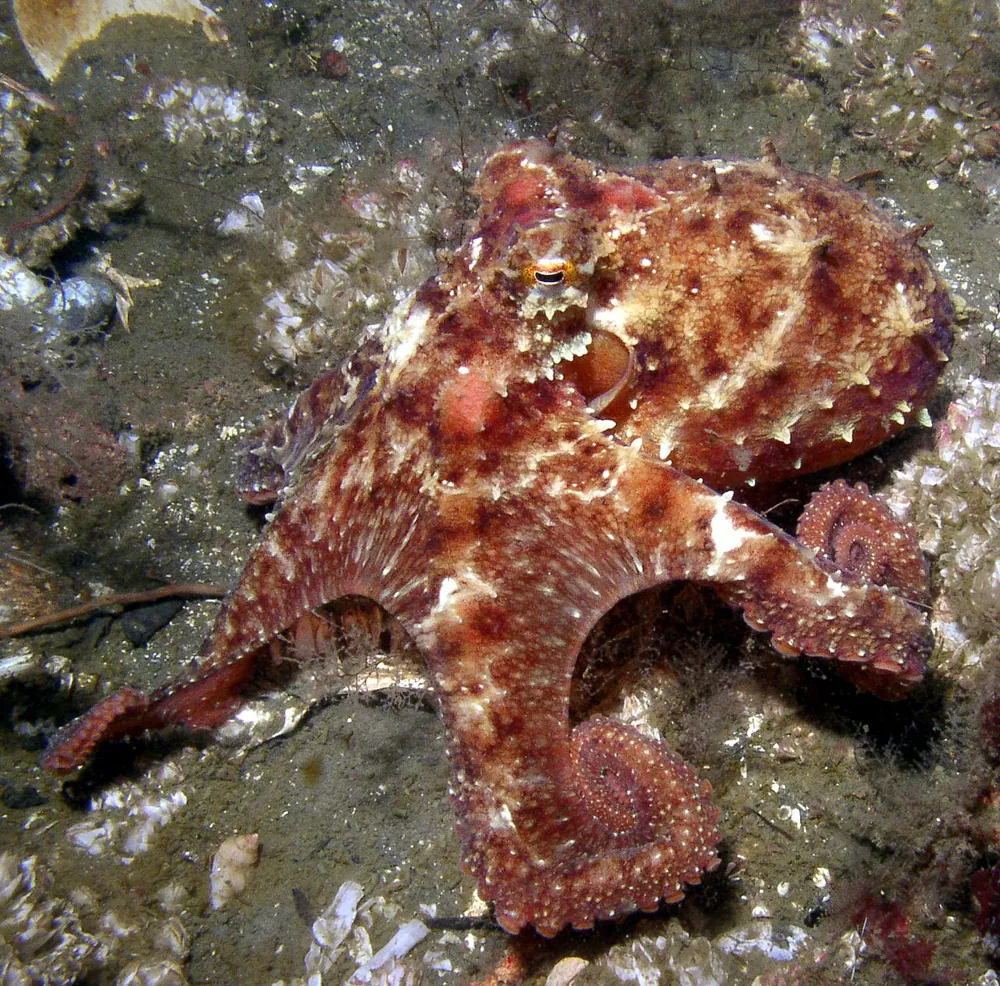
The East Pacific red octopus is a small octopus that lives along the North American West Coast. It is the most common shallow-water octopus in much of this region and hunts on the seabed. It is special because scientists have shown it has individual personalities, the first invertebrate found to have them.1


 Ho e tseba jwang
- Its colour can vary from deep brick red to brown, to white, or a mottled mixture of these.1
- It can change both its colour and skin texture.1
- It has three eyelash-like papillae (small bumps) below each eye.1
- Adults usually have a mantle (body) length of 8–10 cm, with arms of 30–40 cm.1
Hangata e ferekanngwa le: Small individuals of the giant Pacific octopus (Enteroctopus dofleini) can be mistaken for it in the north of its range. The East Pacific red octopus has three eyelash-like papillae below each eye, which the giant Pacific octopus lacks.1
Matla a chefo
Chefo e tswa ka meno a yona a chefo (fangs) kapa ka meno a mang ha e loma.
Chefo ya yona (eo e e kenyang ka ho loma kapa ho hlaba) e etsang?
It uses venom to subdue its prey. After catching a bivalve such as a clam, it drills a hole through the shell near the adductor muscles and injects venom through that hole.1
E kotsi hakae ho batho?
Kotsi ho batho: E bohlokoE ka utlwisa bohloko haholo, empa hoo e batlang e le kamehla ha e kotsi haholo. Haeba e loma
- Pressure immobilisation: phuthela bandeje e tiileng e huduhang (elastiki) hodima moo e lomileng teng ebe o nyolla setho sohle, o se tlame ka splint (lepolanka la ho se tshehetsa), mme o boloke motho a sa sisinyehe ho hang ho fihlela thuso e fihla.
- Octopus e nang le mehele e putswa kapa kgofu ya cone e ka etsa hore motho a emise ho hema a ntse a tsohile: bitsa thuso mme o itokisetse ho mo hemela ka molomo (rescue breaths) ho fihlela ambulense e nka boikarabelo.
Kamehla letsetsa nomoro ya tshohanyetso pele (112, 000, 911). Ena ke tataiso e akaretsang ya thuso ya pele, hase keletso ya bongaka. Metheo ya thuso ya pele
 Dula o bolokehile
- O se ke wa ama, wa tshwara kapa wa tena phoofolo ya naheng, leha e le e nyenyane, le leha e shebahala e robetse kapa e shwele.
- E fe sebaka. Ha o kopana le yona, dula o kgutsitse, kgutlela morao butle mme o e tlohele e tsamaye ka tsela ya yona.
- Haeba e nngwe e o loma: dula o kgutsitse, o se ke wa sisinyeha, letsetsa nomoro ya tshohanyetso (112, 000, 911) kapa o ye sepetlele kapele. Hopola hore e ne e shebahala jwang, foto e a thusa.
Ha e o batle. E sebedisa chefo ya yona ho tshwara dijo kapa ho itshireletsa, mme e kgetha ho ipata. Ho eketsehileng ka ho dula o bolokehile
E kgolo hakae?
E telele hakae?
E boima hakae?

 e telele jwaloka diboloko tsa ho bapala tse 3 moleng
 e ka sesa bolelele ba letangwane le leholo la ho sesa (50 m) ka metsotswana e 7,2
East Pacific red octopus e kgolo hakae ha e bapiswa le WENA?
Ke dipalo feela ka hara sebatli sa hao. Ha ho letho le bolokwang kapa le romelwang kae kapa kae.
E potlaka hakae?


Dintlha
It was the first invertebrate in which individual personalities were demonstrated.1
In the 2016 Pixar film Finding Dory, a character named Hank is an East Pacific red octopus. The animators gave him seven arms because they could not fit all eight on his model.1
It drills holes in bivalve shells, often near the adductor muscles, to reach the prey inside.1
A 2011 study suggested it may choose prey based on how easily the fat can be digested rather than on calories.1
It was widely thought to be a young giant Pacific octopus before it was described as a species in 1953.1
Ho senya ditshomo
Tshomo: Because captive animals were active at night, many people believed it hunts only at night.
Nnete: A study in Puget Sound, Washington, found that a local population was likely active during the day (diurnal).1
Moo dintlha di tswang teng
- East Pacific red octopus (Wikipedia (CC BY-SA 4.0))
- Octopus rubescens (iNaturalist): mabitso le tlhophiso.
- Venom Wiki: boemo ba kotsi, boholo bo tlwaelehileng le kakanyo ya lebelo ke tsa rona. Bona kamoo re di balang ka teng: Kamoo re lekanyang kotsi ka teng.
Taba e nngwe le e nngwe leqepheng lena e na le nomoro e bontshang mohlodi wa yona. Haeba re entse phoso, re kopa tshwarelo, re barati ba diphoofolo, hase makasine wa saense. Re bolelle ho [email protected] mme re tla e lokisa.
 Phepheng e lapile! Venom Wiki ke projeke ya motho a le mong: ke mahala, ha e na dipapatso ebile ha e na di-tracker. Thuso e nyenyane ya tjhelete e e boloka e ntse e le inthaneteng.Fepa phepheng
Tse ding tsa sehlopha se le seng: Dikgofu tsa cone le di-octopus
 Geography coneDikgofu tsa cone le di-octopusE a bolaya
 Greater blue-ringed octopusDikgofu tsa cone le di-octopusE a bolaya
 Southern blue-ringed octopusDikgofu tsa cone le di-octopusE a bolaya
 Blue sea dragonDikgofu tsa cone le di-octopusE utlwisa bohloko feela
 Common octopusDikgofu tsa cone le di-octopusHa e na kotsi
 Giant Pacific octopusDikgofu tsa cone le di-octopusHa e na kotsi
E boetse e phela: Lewatle la Pacific
 Australian box jellyfishDi-jellyfish le diphoofolo tsa lewatle tse hlabangE a bolayaO se ke wa ama
 Japanese pufferfishDiphoofolo tse ding tse chefangE a bolaya
 Hawksbill sea turtleDiphoofolo tse ding tse chefangE ka bolaya
 Irukandji jellyfishDi-jellyfish le diphoofolo tsa lewatle tse hlabangE ka bolayaO se ke wa ama
 Reef stonefishDitlhapi tse nang le chefoE ka bolayaO se ke wa ama
 Crown-of-thorns starfishDi-sea urchin, dinaledi tsa lewatle le dibokoE hloka ngakaO se ke wa ama