
 Afrika
 Asia
Asia Yuropa
 Amerika Borwa
 Australia le Oceania
 Antarctica
 Lewatle la Pacific
 Lewatle la Atlantic
 Lewatle la India
 Lewatle la Arctic
 Lewatle la Mediterranean
 Lewatle le Lefubedu
 Lewatle la Caribbean
 Lewatle la Coral
 Lewatle la China Borwa
 Lewatle la Philippine
 Lewatle la Andaman
 Lewatle la Leboya
 Lewatle la Timor le Arafura
 Kgwohlo ya Bengal
 Kgwohlo ya California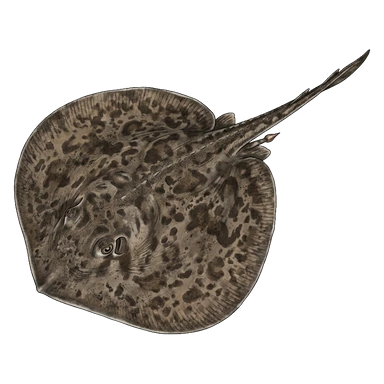
Giant freshwater stingray
 Ho hlaba
The giant freshwater stingray is a large ray that lives in big rivers and estuaries in Southeast Asia and Borneo. It is the widest freshwater fish in the world, and it is now endangered because of fishing and habitat loss. It has a long, whip-like tail with a sharp spine near the base.1



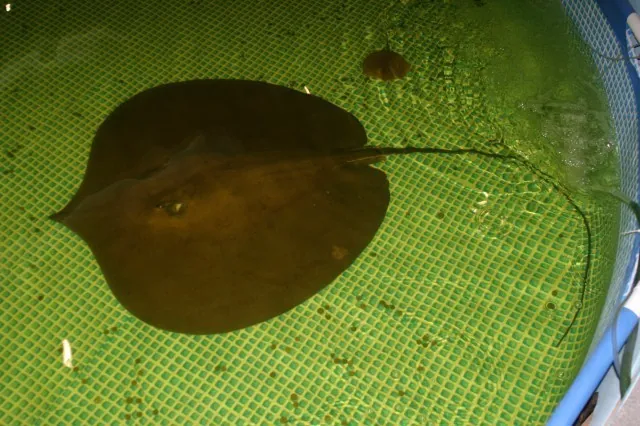
 Ho e tseba jwang
- Plain grayish brown on top, often with a yellowish or pinkish tint towards the fin edges1
- White underside with broad dark bands on the rear edges of the pectoral and pelvic fins1
- Thin, whip-like tail that is black behind the spine and has no fin folds1
- Sharply pointed snout that projects beyond the disc1
- A single serrated stinging spine on the upper tail near its base, up to 38 cm long1
Hangata e ferekanngwa le: Similar freshwater stingrays in South Asia, Southeast Asia and Australasia were once tentatively grouped with this species. Some of them, such as the Australian Urogymnus dalyensis, are now described as separate species.1
Matla a chefo
Chefo e tswa ka lemao le hlabang.
Chefo ya yona (eo e e kenyang ka ho loma kapa ho hlaba) e etsang?
Its sting is sheathed in toxic mucus. The sting is capable of piercing bone.1
E kotsi hakae ho batho?
Kotsi ho batho: E tebilengHo hlajwa ho hloka ngaka. Lefu le etsahala ka seoelo haholo.The giant freshwater stingray is not aggressive. Its sting is strong enough to pierce bone and is coated in toxic mucus, so it should be treated with care.1
 Haeba e hlaba
- Kenya leqeba metsing a tjhesang, a tjhesang hoo motho a ka a mamellang ntle le ho tjha (a leke ka letsoho la hao pele), metsotso e 30 ho isa ho e 90. Fumana thuso ya bongaka, haholoholo bakeng sa di-stonefish le di-stingray.
Kamehla letsetsa nomoro ya tshohanyetso pele (112, 000, 911). Ena ke tataiso e akaretsang ya thuso ya pele, hase keletso ya bongaka. Metheo ya thuso ya pele
 Dula o bolokehile
- O se ke wa ama, wa tshwara kapa wa tena phoofolo ya naheng, leha e le e nyenyane, le leha e shebahala e robetse kapa e shwele.
- E fe sebaka. Ha o kopana le yona, dula o kgutsitse, kgutlela morao butle mme o e tlohele e tsamaye ka tsela ya yona.
- Haeba e nngwe e o hlaba: dula o kgutsitse, o se ke wa sisinyeha, letsetsa nomoro ya tshohanyetso (112, 000, 911) kapa o ye sepetlele kapele. Hopola hore e ne e shebahala jwang, foto e a thusa.
Ha e o batle. E sebedisa chefo ya yona ho tshwara dijo kapa ho itshireletsa, mme e kgetha ho ipata. Ho eketsehileng ka ho dula o bolokehile
Hokae lefatsheng?
E kgolo hakae?
E telele hakae?
E boima hakae?
 e telele jwaloka dintja tse 5 ho tloha nkong ho isa mohatleng
 e telele jwaloka dibanana tse 28 tse latellanang
 e ka sesa bolelele ba letangwane le leholo la ho sesa (50 m) ka metsotswana e 6
Giant freshwater stingray e kgolo hakae ha e bapiswa le WENA?
Ke dipalo feela ka hara sebatli sa hao. Ha ho letho le bolokwang kapa le romelwang kae kapa kae.
E potlaka hakae?

Dintlha
In June 2022, a specimen caught in the Mekong River was reported as the largest strict freshwater fish ever documented, at about 300 kg.1
It is the widest freshwater fish in the world, growing up to 2.2 m across.1
Its tail spine is up to 38 cm long, the largest of any stingray species.1
Pups are nourished in the womb by a milk-like substance called histotroph, or 'uterine milk', made by the mother.1
In Cambodia, the average weight of a landed ray fell from 23.2 kg in 1980 to 6.9 kg in 2006.1
Bakeng sa ditsebi tsa chefo
- Lebitso la saense
- Urogymnus polylepis
- Sehlopha
- Ditlhapi tse nang le chefo
- Lelapa
- Dasyatidae2
- Tatelano
- Myliobatiformes
- Dikontinente
- Asia
- Masea
- It gives birth to live young. Females have litters of one to four pups, each about 30 cm across at birth.1
- Boemo ba yona naheng
- Endangered (IUCN overall); Critically Endangered in Thailand1
- Kotsi ho batho
- 3 / 5: E tebileng3
Moo dintlha di tswang teng
- Giant freshwater stingray (Wikipedia (CC BY-SA 4.0))
- Urogymnus polylepis (iNaturalist): mabitso le tlhophiso.
- Venom Wiki: boemo ba kotsi, boholo bo tlwaelehileng le kakanyo ya lebelo ke tsa rona. Bona kamoo re di balang ka teng: Kamoo re lekanyang kotsi ka teng.
Taba e nngwe le e nngwe leqepheng lena e na le nomoro e bontshang mohlodi wa yona. Haeba re entse phoso, re kopa tshwarelo, re barati ba diphoofolo, hase makasine wa saense. Re bolelle ho [email protected] mme re tla e lokisa.
 Phepheng e lapile! Venom Wiki ke projeke ya motho a le mong: ke mahala, ha e na dipapatso ebile ha e na di-tracker. Thuso e nyenyane ya tjhelete e e boloka e ntse e le inthaneteng.Fepa phepheng
Tse ding tsa sehlopha se le seng: Ditlhapi tse nang le chefo
 Walking catfishDitlhapi tse nang le chefoE utlwisa bohloko feelaO se ke wa ama
 Asian stinging catfishDitlhapi tse nang le chefoE hloka ngakaO se ke wa ama
 Reef stonefishDitlhapi tse nang le chefoE ka bolayaO se ke wa ama
 Red lionfishDitlhapi tse nang le chefoE hloka ngakaO se ke wa ama
 Estuarine stonefishDitlhapi tse nang le chefoE ka bolayaO se ke wa ama
 Short-tail stingrayDitlhapi tse nang le chefoE ka bolaya
 Deathstalker
 Indian cobra
 Indian saw-scaled viper
 King cobra
 Puff adder
 Noha ea Russell