
 Afrika
 Asia
Asia Yuropa
 Amerika Borwa
 Australia le Oceania
 Antarctica
 Lewatle la Pacific
 Lewatle la Atlantic
 Lewatle la India
 Lewatle la Arctic
 Lewatle la Mediterranean
 Lewatle le Lefubedu
 Lewatle la Caribbean
 Lewatle la Coral
 Lewatle la China Borwa
 Lewatle la Philippine
 Lewatle la Andaman
 Lewatle la Leboya
 Lewatle la Timor le Arafura
 Kgwohlo ya Bengal
 Kgwohlo ya California
Hime habu
 Ho loma
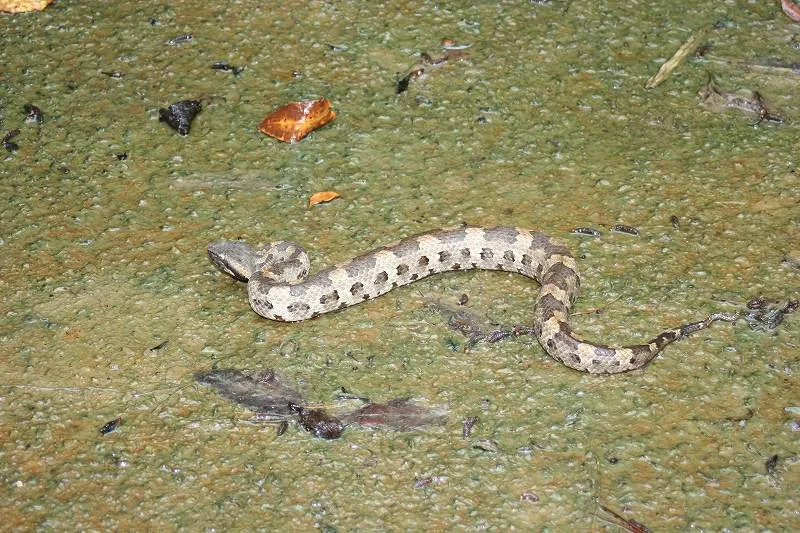
The hime habu is a pit viper, a type of venomous snake. It lives on the Ryukyu Islands of Japan, including Okinawa and the Amami Islands. It hunts rodents in open fields, especially sugar cane fields.1

 Ho e tseba jwang
- Adults are usually 30 to 80 cm long.1
- The body is pale greenish-brown or yellowish-olive, sometimes pale brown.1
- It has alternating darker brownish or greenish blotches, each edged with yellowish scales.1
- The head is large and triangular, clearly wider than the neck, with a narrow dark stripe behind the eye.1
Hangata e ferekanngwa le: The name Okinawa habu usually refers to a different species, Hon habu (Protobothrops flavoviridis). The mamushi, which is also a local name for this snake in the Amami language, is the common name for the unrelated species Gloydius blomhoffii.1
Matla a chefo
Chefo e tswa ka meno a yona a chefo (fangs) kapa ka meno a mang ha e loma.
Chefo ya yona (eo e e kenyang ka ho loma kapa ho hlaba) e etsang?
Like most vipers, its venom is mainly haemotoxin, which affects the blood, along with factors that damage cells. The venom is relatively weak. Because of this, it is usually not life-threatening.1
E kotsi hakae ho batho?
Kotsi ho batho: E tebilengHo longwa ho hloka ngaka. Lefu le etsahala ka seoelo haholo.The venom is usually not life-threatening. People should still seek medical attention promptly after a bite.1
 Haeba e loma
- Seek medical attention promptly after a bite.1
- Boloka motho a sa sisinyehe ebile a kgutsitse, boloka setho se lomilweng se lekana le bophahamo ba pelo, tlosa mesale le dintho tse tiileng, mme o mo ise sepetlele kapele.
Kamehla letsetsa nomoro ya tshohanyetso pele (112, 000, 911). Ena ke tataiso e akaretsang ya thuso ya pele, hase keletso ya bongaka. Metheo ya thuso ya pele
 Dula o bolokehile
- O se ke wa ama, wa tshwara kapa wa tena phoofolo ya naheng, leha e le e nyenyane, le leha e shebahala e robetse kapa e shwele.
- E fe sebaka. Ha o kopana le yona, dula o kgutsitse, kgutlela morao butle mme o e tlohele e tsamaye ka tsela ya yona.
- Haeba e nngwe e o loma: dula o kgutsitse, o se ke wa sisinyeha, letsetsa nomoro ya tshohanyetso (112, 000, 911) kapa o ye sepetlele kapele. Hopola hore e ne e shebahala jwang, foto e a thusa.
Ha e o batle. E sebedisa chefo ya yona ho tshwara dijo kapa ho itshireletsa, mme e kgetha ho ipata. Ho eketsehileng ka ho dula o bolokehile
Hokae lefatsheng?
E kgolo hakae?
E telele hakae?
 e telele jwaloka dikatse tsa lapeng tse 1,5 ho tloha nkong ho isa mohatleng
 e telele jwaloka dibanana tse 4 tse latellanang
 e ka matha metara e 100 ka metsotswana e 110 (motho ya potlakang ka ho fetisisa o hloka 9,6)
Hime habu e kgolo hakae ha e bapiswa le WENA?
Ke dipalo feela ka hara sebatli sa hao. Ha ho letho le bolokwang kapa le romelwang kae kapa kae.
E potlaka hakae?


Dintlha
Ho senya ditshomo
Tshomo: The name Okinawa habu refers to this snake.
Nnete: The name Okinawa habu usually refers to Hon habu (Protobothrops flavoviridis), a different species.1
Bakeng sa ditsebi tsa chefo
Moo dintlha di tswang teng
- Ovophis okinavensis (Wikipedia (CC BY-SA 4.0))
- Ovophis okinavensis (iNaturalist): mabitso le tlhophiso.
- Venom Wiki: boemo ba kotsi, boholo bo tlwaelehileng le kakanyo ya lebelo ke tsa rona. Bona kamoo re di balang ka teng: Kamoo re lekanyang kotsi ka teng.
Taba e nngwe le e nngwe leqepheng lena e na le nomoro e bontshang mohlodi wa yona. Haeba re entse phoso, re kopa tshwarelo, re barati ba diphoofolo, hase makasine wa saense. Re bolelle ho [email protected] mme re tla e lokisa.
 Phepheng e lapile! Venom Wiki ke projeke ya motho a le mong: ke mahala, ha e na dipapatso ebile ha e na di-tracker. Thuso e nyenyane ya tjhelete e e boloka e ntse e le inthaneteng.Fepa phepheng
 Brown spotted pit viper
 Habu
Habu Hump-nosed viper
 Hundred-pace viper
 Malayan pit viper
 Mamushi
 Deathstalker
 Indian cobra
 Indian saw-scaled viper
 King cobra
 Puff adder
 Noha ea Russell