
 Afrika
 Asia
Asia Yuropa
 Amerika Borwa
 Australia le Oceania
 Antarctica
 Lewatle la Pacific
 Lewatle la Atlantic
 Lewatle la India
 Lewatle la Arctic
 Lewatle la Mediterranean
 Lewatle le Lefubedu
 Lewatle la Caribbean
 Lewatle la Coral
 Lewatle la China Borwa
 Lewatle la Philippine
 Lewatle la Andaman
 Lewatle la Leboya
 Lewatle la Timor le Arafura
 Kgwohlo ya Bengal
 Kgwohlo ya California
Large-scaled pit viper
 Ho loma
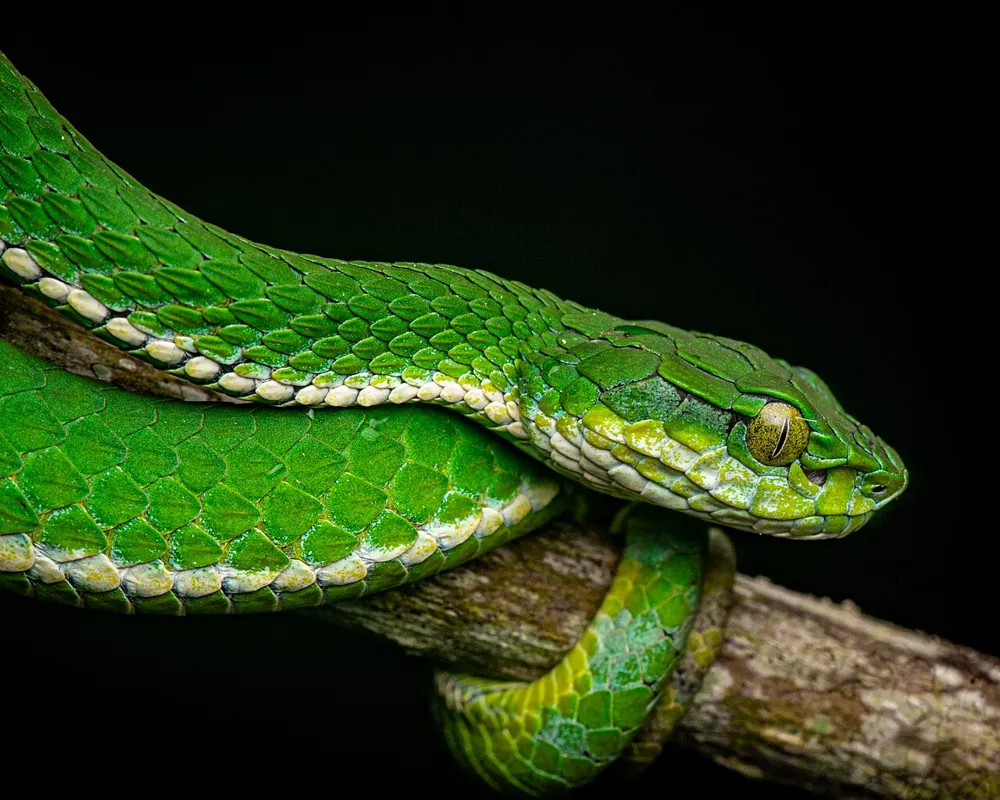
The large-scaled pit viper is a venomous snake that lives only in the southern Western Ghats mountains of South India. It is a bright green tree-dweller that hunts at night from high, cool forest. Tea pickers meet it often, which is why it matters to people who work on those plantations.1



 Ho e tseba jwang
- Bright green on the back, sometimes with blackish skin between the scales1
- A yellow or white stripe runs along each side of the body1
- Pale green upper lips, and sometimes a black streak behind the eye1
- Large, keeled, overlapping scales in 12 to 15 rows at the middle of the body1
- Often active at night, moving through trees and on the ground with a prehensile tail that grips branches1
Matla a chefo
Chefo e tswa ka meno a yona a chefo (fangs) kapa ka meno a mang ha e loma.
Chefo ya yona (eo e e kenyang ka ho loma kapa ho hlaba) e etsang?
Its venom is presumed to be hemotoxic, meaning it is thought to act on the blood. This has not been studied thoroughly, so the details of its effects are not well known.1
E kotsi hakae ho batho?
Kotsi ho batho: E tebilengHo longwa ho hloka ngaka. Lefu le etsahala ka seoelo haholo.Tea pickers are frequently bitten by this species, but the bites are seldom fatal.1
 Haeba e loma
- Boloka motho a sa sisinyehe ebile a kgutsitse, boloka setho se lomilweng se lekana le bophahamo ba pelo, tlosa mesale le dintho tse tiileng, mme o mo ise sepetlele kapele.
Kamehla letsetsa nomoro ya tshohanyetso pele (112, 000, 911). Ena ke tataiso e akaretsang ya thuso ya pele, hase keletso ya bongaka. Metheo ya thuso ya pele
 Dula o bolokehile
- O se ke wa ama, wa tshwara kapa wa tena phoofolo ya naheng, leha e le e nyenyane, le leha e shebahala e robetse kapa e shwele.
- E fe sebaka. Ha o kopana le yona, dula o kgutsitse, kgutlela morao butle mme o e tlohele e tsamaye ka tsela ya yona.
- Haeba e nngwe e o loma: dula o kgutsitse, o se ke wa sisinyeha, letsetsa nomoro ya tshohanyetso (112, 000, 911) kapa o ye sepetlele kapele. Hopola hore e ne e shebahala jwang, foto e a thusa.
Ha e o batle. E sebedisa chefo ya yona ho tshwara dijo kapa ho itshireletsa, mme e kgetha ho ipata. Ho eketsehileng ka ho dula o bolokehile
Hokae lefatsheng?
E kgolo hakae?
E telele hakae?
 e telele jwaloka dibanana tse 4 tse latellanang
 e ka matha metara e 100 ka metsotswana e 110 (motho ya potlakang ka ho fetisisa o hloka 9,6)
Large-scaled pit viper e kgolo hakae ha e bapiswa le WENA?
Ke dipalo feela ka hara sebatli sa hao. Ha ho letho le bolokwang kapa le romelwang kae kapa kae.
E potlaka hakae?


Dintlha
Moo dintlha di tswang teng
- Craspedocephalus macrolepis (Wikipedia (CC BY-SA 4.0))
- Craspedocephalus macrolepis (iNaturalist): mabitso le tlhophiso.
- Venom Wiki: boemo ba kotsi, boholo bo tlwaelehileng le kakanyo ya lebelo ke tsa rona. Bona kamoo re di balang ka teng: Kamoo re lekanyang kotsi ka teng.
Taba e nngwe le e nngwe leqepheng lena e na le nomoro e bontshang mohlodi wa yona. Haeba re entse phoso, re kopa tshwarelo, re barati ba diphoofolo, hase makasine wa saense. Re bolelle ho [email protected] mme re tla e lokisa.
 Phepheng e lapile! Venom Wiki ke projeke ya motho a le mong: ke mahala, ha e na dipapatso ebile ha e na di-tracker. Thuso e nyenyane ya tjhelete e e boloka e ntse e le inthaneteng.Fepa phepheng
 Brown spotted pit viper
 Habu
Habu Hump-nosed viper
 Hundred-pace viper
 Malayan pit viper
 Mamushi
 Deathstalker
 Indian cobra
 Indian saw-scaled viper
 King cobra
 Puff adder
 Noha ea Russell