
 Afrika
 Asia
Asia Yuropa
 Amerika Borwa
 Australia le Oceania
 Antarctica
 Lewatle la Pacific
 Lewatle la Atlantic
 Lewatle la India
 Lewatle la Arctic
 Lewatle la Mediterranean
 Lewatle le Lefubedu
 Lewatle la Caribbean
 Lewatle la Coral
 Lewatle la China Borwa
 Lewatle la Philippine
 Lewatle la Andaman
 Lewatle la Leboya
 Lewatle la Timor le Arafura
 Kgwohlo ya Bengal
 Kgwohlo ya California
Samar cobra
 Ho loma
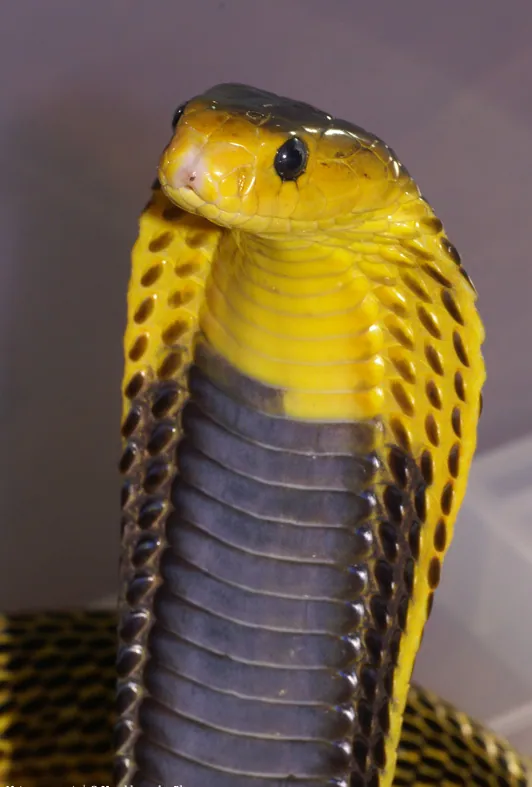
The Samar cobra is a highly venomous spitting cobra from the Visayas and Mindanao island groups of the Philippines. It can grow up to 1.4 metres long. It often lives close to people, where it hunts rats and mice around rice fields.1



 Ho e tseba jwang
- Colour varies from black and yellow to green.1
- Can grow up to 1.4 metres (4.6 ft) long.1
- Has 17 to 25 scale rows around the hood.1
- Is quick to strike and to spray venom, usually aiming for the face and eyes.1
Hangata e ferekanngwa le: It is often compared with its northern relative, the Northern Philippines cobra. The Samar cobra is more reluctant to spit venom than that species.1
Matla a chefo
Chefo e tswa ka meno a yona a chefo (fangs) kapa ka meno a mang ha e loma.
Chefo ya yona (eo e e kenyang ka ho loma kapa ho hlaba) e etsang?
Its venom is dominated by three-finger toxins, which make up about 90% of the venom proteins. This is the highest three-finger toxin level recorded in any snake venom. The venom also contains snake venom metalloproteinases and phospholipases A2, which damage tissue. If venom gets in the eyes, it causes extreme pain and mechanical damage to the eyeball, and can cause permanent blindness if not properly flushed out.1
E kotsi hakae ho batho?
Kotsi ho batho: E kotsi haholoE ka bolaya motho ya sa fumaneng kalafo.It is described as highly venomous. Its bite and spitting venom are both dangerous, and its habit of living near people means it often comes into conflict with them.1
E etsang ha e tshohile?
It is nervous and quick to strike, and it sprays venom at the face and eyes when threatened.1
 Haeba e loma kapa e tshwela
- If venom gets in the eyes, it must be flushed out thoroughly with lots of clean water, as incomplete flushing can lead to permanent blindness. Any bite needs urgent hospital care.1
- Boloka motho a sa sisinyehe ebile a kgutsitse, tlosa mesale le dintho tse tiileng, mme o mo ise sepetlele kapele: antivenom ke yona kalafo.
- Haeba chefo e tshwetswe mahlong, a hlatswe ka metsi a mangata a hlwekileng hang-hang.
Kamehla letsetsa nomoro ya tshohanyetso pele (112, 000, 911). Ena ke tataiso e akaretsang ya thuso ya pele, hase keletso ya bongaka. Metheo ya thuso ya pele
 Dula o bolokehile
- O se ke wa ama, wa tshwara kapa wa tena phoofolo ya naheng, leha e le e nyenyane, le leha e shebahala e robetse kapa e shwele.
- E fe sebaka. Ha o kopana le yona, dula o kgutsitse, kgutlela morao butle mme o e tlohele e tsamaye ka tsela ya yona.
- Haeba e nngwe e o loma kapa e o tshwela chefo mahlong: dula o kgutsitse, o se ke wa sisinyeha, letsetsa nomoro ya tshohanyetso (112, 000, 911) kapa o ye sepetlele kapele. Hopola hore e ne e shebahala jwang, foto e a thusa.
Ha e o batle. E sebedisa chefo ya yona ho tshwara dijo kapa ho itshireletsa, mme e kgetha ho ipata. Ho eketsehileng ka ho dula o bolokehile
Hokae lefatsheng?
E kgolo hakae?
E telele hakae?
 e telele jwaloka dikatse tsa lapeng tse 3 ho tloha nkong ho isa mohatleng
 e telele jwaloka dibanana tse 8 tse latellanang
 e ka matha metara e 100 ka metsotswana e 52 (motho ya potlakang ka ho fetisisa o hloka 9,6)
Samar cobra e kgolo hakae ha e bapiswa le WENA?
Ke dipalo feela ka hara sebatli sa hao. Ha ho letho le bolokwang kapa le romelwang kae kapa kae.
E potlaka hakae?


Dintlha
Three-finger toxins make up about 90% of its venom, the highest such level recorded in snake venom.1
It often comes into conflict with people because the rodents it hunts are drawn to rice paddies and human settlements.1
Its venom has a unique makeup, and it is the easternmost known spread of Naja cobras.1
Moo dintlha di tswang teng
- Samar cobra (Wikipedia (CC BY-SA 4.0))
- Naja samarensis (iNaturalist): mabitso le tlhophiso.
- Venom Wiki: boemo ba kotsi, boholo bo tlwaelehileng le kakanyo ya lebelo ke tsa rona. Bona kamoo re di balang ka teng: Kamoo re lekanyang kotsi ka teng.
Taba e nngwe le e nngwe leqepheng lena e na le nomoro e bontshang mohlodi wa yona. Haeba re entse phoso, re kopa tshwarelo, re barati ba diphoofolo, hase makasine wa saense. Re bolelle ho [email protected] mme re tla e lokisa.
 Phepheng e lapile! Venom Wiki ke projeke ya motho a le mong: ke mahala, ha e na dipapatso ebile ha e na di-tracker. Thuso e nyenyane ya tjhelete e e boloka e ntse e le inthaneteng.Fepa phepheng
Tse ding tsa sehlopha se le seng: Di-cobra, di-mamba le di-krait
 Indian cobraDi-cobra, di-mamba le di-kraitE a bolaya
 King cobraDi-cobra, di-mamba le di-kraitE a bolaya
 Caspian cobraDi-cobra, di-mamba le di-kraitE a bolaya
 Common kraitDi-cobra, di-mamba le di-kraitE a bolaya
 Malayan kraitDi-cobra, di-mamba le di-kraitE a bolaya
 Many-banded kraitDi-cobra, di-mamba le di-kraitE a bolaya
 Deathstalker
 Indian saw-scaled viper
 Puff adder
 Noha ea Russell
 Asian giant hornet
 Komodo dragon