
 Afrika
 Asia
Asia Yuropa
 Amerika Borwa
 Australia le Oceania
 Antarctica
 Lewatle la Pacific
 Lewatle la Atlantic
 Lewatle la India
 Lewatle la Arctic
 Lewatle la Mediterranean
 Lewatle le Lefubedu
 Lewatle la Caribbean
 Lewatle la Coral
 Lewatle la China Borwa
 Lewatle la Philippine
 Lewatle la Andaman
 Lewatle la Leboya
 Lewatle la Timor le Arafura
 Kgwohlo ya Bengal
 Kgwohlo ya California
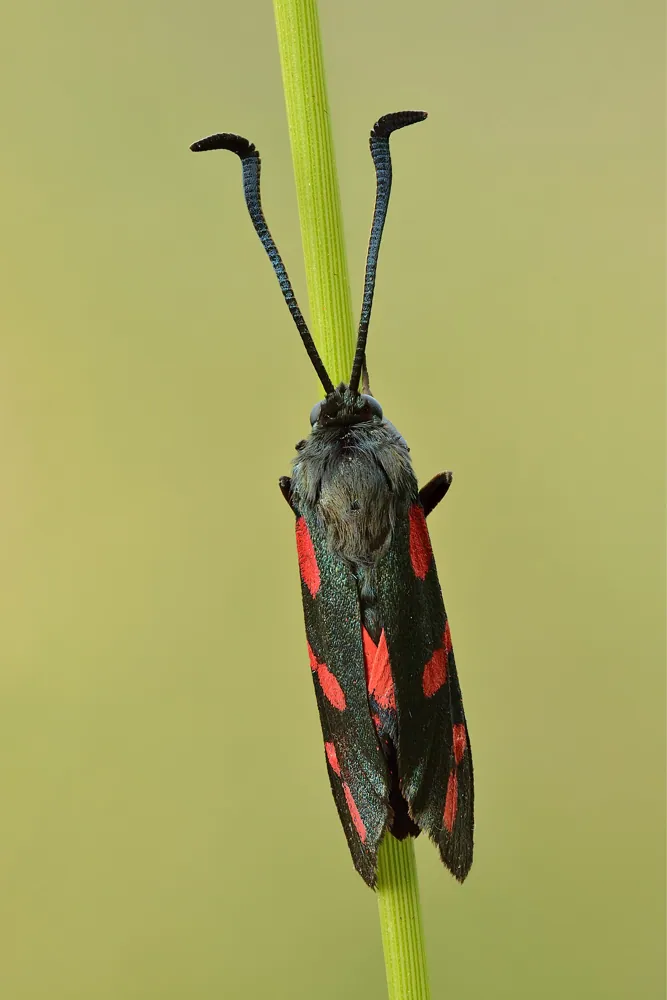
Six-spot burnet
 E a chefa ha e jewa
The six-spot burnet is a day-flying moth with dark green wings marked by six bright red spots. It lives in meadows and grassy places across much of Europe and parts of Asia. Its bright colours warn birds and lizards that it is toxic.1



 Ho e tseba jwang
- Forewings are dark metallic green with six vivid red spots1
- Sometimes the spots are merged together, or they are yellow or black1
- Hindwings are red with a blackish fringe1
- Wingspan is 30 to 40 mm, and the sexes look similar1
- Adults fly on hot, sunny days from June to August1
- Larva is plump and hairy, usually pale green with rows of black spots1
Hangata e ferekanngwa le: It can be confused with the five-spot burnet, especially when the spots on its forewings have merged together.1
Matla a chefo
E kotsi feela haeba ho na le se e jang.
E kotsi hakae ho batho?
Kotsi ho batho: E bobebeJwaloka ho hlajwa ke notshi kapa ho fetang moo. Ha e na kotsi ho batho.E etsang ha e tshohile?
When attacked, it releases a liquid containing cyanide, and its bright colours warn predators such as birds and lizards that it is toxic.1
 Haeba motho a e amme kapa a e jele
- Haeba motho a e jele kapa a na le matshwao ka mora ho e ja: letsetsa nomoro ya tshohanyetso kapa setsi sa chefo (poison centre) hang-hang.
Kamehla letsetsa nomoro ya tshohanyetso pele (112, 000, 911). Ena ke tataiso e akaretsang ya thuso ya pele, hase keletso ya bongaka. Metheo ya thuso ya pele
 Dula o bolokehile
- O se ke wa ama, wa tshwara kapa wa tena phoofolo ya naheng, leha e le e nyenyane, le leha e shebahala e robetse kapa e shwele.
- E fe sebaka. Ha o kopana le yona, dula o kgutsitse, kgutlela morao butle mme o e tlohele e tsamaye ka tsela ya yona.
- Haeba o e amme kapa o e jele: o se ke wa hohla mahlo kapa molomo, hlatswa matsoho mme o fumane thuso ya bongaka.
Ha e o batle. Chefo ya yona e teng feela hore ho se be le letho le e jang. Ho eketsehileng ka ho dula o bolokehile
Hokae lefatsheng?
E kgolo hakae?
E telele hakae?
 e telele jwaloka klipi ya pampiri
Six-spot burnet e kgolo hakae ha e bapiswa le WENA?
Ke dipalo feela ka hara sebatli sa hao. Ha ho letho le bolokwang kapa le romelwang kae kapa kae.
E potlaka hakae?


_-_Kulna.jpg)
Dintlha
Bakeng sa ditsebi tsa chefo
Moo dintlha di tswang teng
- Six-spot burnet (Wikipedia (CC BY-SA 4.0))
- Zygaena filipendulae (iNaturalist): mabitso le tlhophiso.
- Venom Wiki: boemo ba kotsi, boholo bo tlwaelehileng le kakanyo ya lebelo ke tsa rona. Bona kamoo re di balang ka teng: Kamoo re lekanyang kotsi ka teng.
Taba e nngwe le e nngwe leqepheng lena e na le nomoro e bontshang mohlodi wa yona. Haeba re entse phoso, re kopa tshwarelo, re barati ba diphoofolo, hase makasine wa saense. Re bolelle ho [email protected] mme re tla e lokisa.
 Phepheng e lapile! Venom Wiki ke projeke ya motho a le mong: ke mahala, ha e na dipapatso ebile ha e na di-tracker. Thuso e nyenyane ya tjhelete e e boloka e ntse e le inthaneteng.Fepa phepheng
Tse ding tsa sehlopha se le seng: Diphoofolo tse ding tse chefang
 Spanish flyDiphoofolo tse ding tse chefangE hloka ngakaO se ke wa ama
 Common quailDiphoofolo tse ding tse chefangE utlwisa bohloko feela
 Cinnabar mothDiphoofolo tse ding tse chefangHa e na kotsi
 Black oil beetleDiphoofolo tse ding tse chefangE utlwisa bohloko feelaO se ke wa ama
 Red-striped oil beetleDiphoofolo tse ding tse chefangE utlwisa bohloko feelaO se ke wa ama
 Japanese pufferfishDiphoofolo tse ding tse chefangE a bolaya
E boetse e phela: Yuropa
 Common European adderDi-viper le di-adderE hloka ngaka
 Common waspDinotshi, di-wasp le di-hornetE utlwisa bohloko feela
 European hornetDinotshi, di-wasp le di-hornetE utlwisa bohloko feela
 Fire salamanderDihoho tse chefang, mampotsana le di-newtE utlwisa bohloko feelaO se ke wa ama
 Western honey beeDinotshi, di-wasp le di-hornetE utlwisa bohloko feela
 Blunt-nosed viperDi-viper le di-adderE ka bolaya