
 Afrika
 Asia
Asia Yuropa
 Amerika Borwa
 Australia le Oceania
 Antarctica
 Lewatle la Pacific
 Lewatle la Atlantic
 Lewatle la India
 Lewatle la Arctic
 Lewatle la Mediterranean
 Lewatle le Lefubedu
 Lewatle la Caribbean
 Lewatle la Coral
 Lewatle la China Borwa
 Lewatle la Philippine
 Lewatle la Andaman
 Lewatle la Leboya
 Lewatle la Timor le Arafura
 Kgwohlo ya Bengal
 Kgwohlo ya California
Toxic zoanthid
 Chefo letlalong la yona
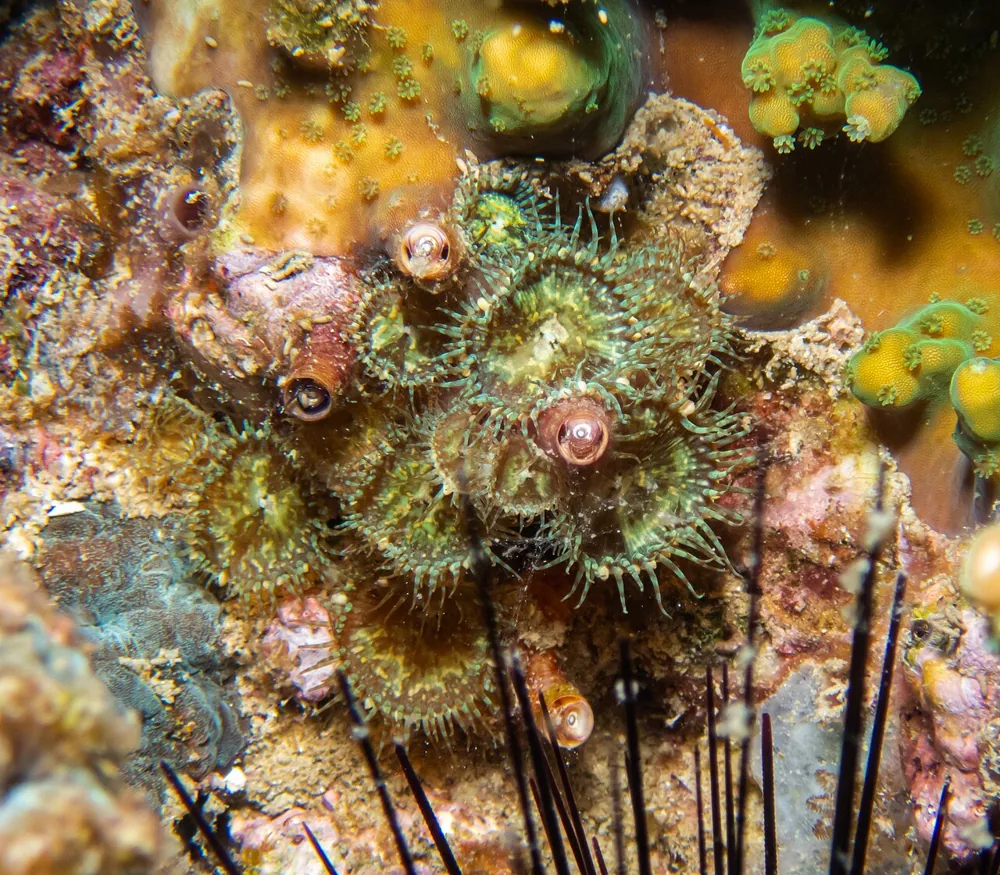
Palythoa toxica is a small, crust-like sea animal, called a zoanthid, that grows on rocks. It lives in Hawaii and is special because it is the species from which the very poisonous substance palytoxin was first discovered and isolated.1
 Ho e tseba jwang
- It grows as a flat, encrusting layer over rock.1
- It has a firm, tough outer covering.1
- Its polyps are partly sunk into a cushiony mat that spreads across the rock and contains sand grains and bits of debris.1
- Each polyp has a broad mouth disc with a fringe of tentacles.1
- Its colour varies but is usually cream, grey or pale brown.1
Matla a chefo
Letlalo la yona le a chefa. Ho kotsi ho e ama, ho e nyeka kapa ho e ja.
Chefo ya yona (e chefang ha o e ama kapa o e ja) e etsang?
It is not venomous in the sense of injecting venom with a bite or sting. It contains palytoxin, one of the most poisonous substances known.1
E kotsi hakae ho batho?
Kotsi ho batho: E kotsi haholoE ka bolaya motho ya sa fumaneng kalafo.Palytoxin is one of the most poisonous substances known, and people have been poisoned by handling this animal in reef aquariums.1
 Haeba motho a e amme kapa a e jele
- Haeba motho a e jele kapa a na le matshwao ka mora ho e ja: letsetsa nomoro ya tshohanyetso kapa setsi sa chefo (poison centre) hang-hang.
Kamehla letsetsa nomoro ya tshohanyetso pele (112, 000, 911). Ena ke tataiso e akaretsang ya thuso ya pele, hase keletso ya bongaka. Metheo ya thuso ya pele
 Dula o bolokehile
- O se ke wa ama, wa tshwara kapa wa tena phoofolo ya naheng, leha e le e nyenyane, le leha e shebahala e robetse kapa e shwele.
- E fe sebaka. Ha o kopana le yona, dula o kgutsitse, kgutlela morao butle mme o e tlohele e tsamaye ka tsela ya yona.
- Haeba o e amme kapa o e jele: o se ke wa hohla mahlo kapa molomo, hlatswa matsoho mme o fumane thuso ya bongaka.
Ha e o batle. Chefo ya yona e teng feela hore ho se be le letho le e jang. Ho eketsehileng ka ho dula o bolokehile
Hokae lefatsheng?
E kgolo hakae?
E telele hakae?
 e kgutshwane ho feta monwana wa hao o monyenyane
Toxic zoanthid e kgolo hakae ha e bapiswa le WENA?
Ke dipalo feela ka hara sebatli sa hao. Ha ho letho le bolokwang kapa le romelwang kae kapa kae.
E potlaka hakae?


Dintlha
Early Hawaiians used this animal to poison the tips of their weapons, and a legend says warriors could break a taboo and dip their spear tips into its pool when under severe threat.1
In 1961 researchers took specimens from the pool despite local advice, and the laboratories of the Hawaiian Institute of Marine Biology on Coconut Island were destroyed by fire on that same day.1
Palythoa toxica is the species in which palytoxin was first discovered and first isolated.1
Unlike a related species, P. toxica is equally toxic all year round rather than changing with the seasons.1
Palytoxin has also been found in other Palythoa species, some algae, and certain crabs and fish, and it has been suggested that a dinoflagellate in the genus Ostreopsis produces the toxin.1
Moo dintlha di tswang teng
- Palythoa toxica (Wikipedia (CC BY-SA 4.0))
- Palythoa toxica (iNaturalist): mabitso le tlhophiso.
- Venom Wiki: boemo ba kotsi, boholo bo tlwaelehileng le kakanyo ya lebelo ke tsa rona. Bona kamoo re di balang ka teng: Kamoo re lekanyang kotsi ka teng.
Taba e nngwe le e nngwe leqepheng lena e na le nomoro e bontshang mohlodi wa yona. Haeba re entse phoso, re kopa tshwarelo, re barati ba diphoofolo, hase makasine wa saense. Re bolelle ho [email protected] mme re tla e lokisa.
 Phepheng e lapile! Venom Wiki ke projeke ya motho a le mong: ke mahala, ha e na dipapatso ebile ha e na di-tracker. Thuso e nyenyane ya tjhelete e e boloka e ntse e le inthaneteng.Fepa phepheng
Tse ding tsa sehlopha se le seng: Diphoofolo tse ding tse chefang
 Japanese pufferfishDiphoofolo tse ding tse chefangE a bolaya
 Hawksbill sea turtleDiphoofolo tse ding tse chefangE ka bolaya
 Greenland sharkDiphoofolo tse ding tse chefangE utlwisa bohloko feela
 Silver-cheeked toadfishDiphoofolo tse ding tse chefangE a bolaya
 Blackspotted pufferDiphoofolo tse ding tse chefangE ka bolaya
 White-spotted pufferDiphoofolo tse ding tse chefangE ka bolaya
E boetse e phela: Lewatle la Pacific
 Australian box jellyfishDi-jellyfish le diphoofolo tsa lewatle tse hlabangE a bolayaO se ke wa ama
 Geography coneDikgofu tsa cone le di-octopusE a bolaya
 Greater blue-ringed octopusDikgofu tsa cone le di-octopusE a bolaya
 Southern blue-ringed octopusDikgofu tsa cone le di-octopusE a bolaya
 Irukandji jellyfishDi-jellyfish le diphoofolo tsa lewatle tse hlabangE ka bolayaO se ke wa ama
 Reef stonefishDitlhapi tse nang le chefoE ka bolayaO se ke wa ama