
 Afrika
 Asia
Asia Yuropa
 Amerika Borwa
 Australia le Oceania
 Antarctica
 Lewatle la Pacific
 Lewatle la Atlantic
 Lewatle la India
 Lewatle la Arctic
 Lewatle la Mediterranean
 Lewatle le Lefubedu
 Lewatle la Caribbean
 Lewatle la Coral
 Lewatle la China Borwa
 Lewatle la Philippine
 Lewatle la Andaman
 Lewatle la Leboya
 Lewatle la Timor le Arafura
 Kgwohlo ya Bengal
 Kgwohlo ya California
Wagler's pit viper
 Ho loma
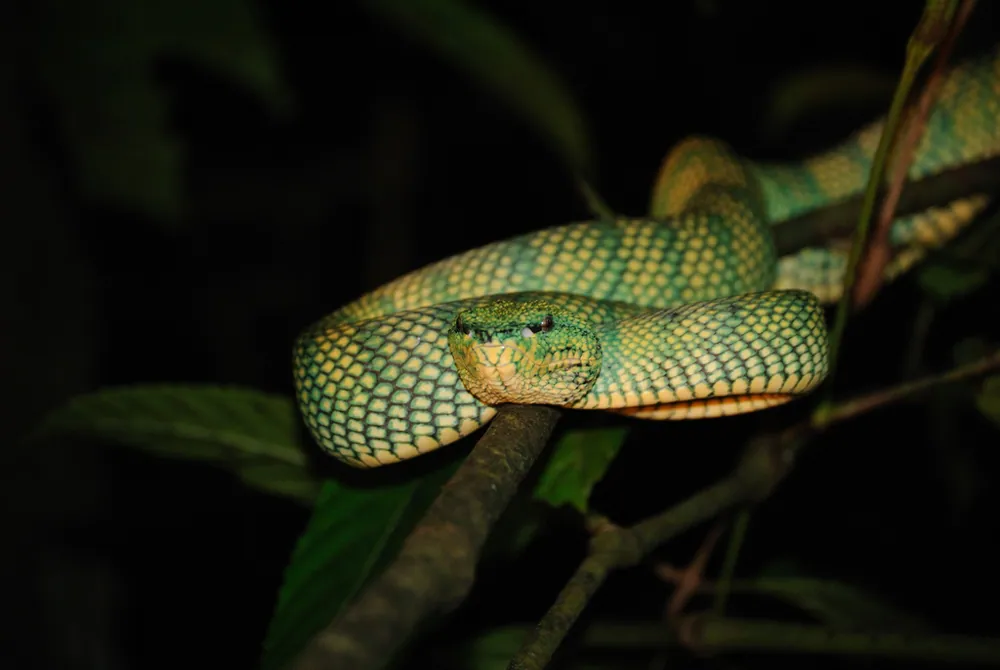
Wagler's pit viper is a venomous snake that lives in the forests of Southeast Asia. It spends most of its life in trees and is sometimes called the temple viper, because it is common around the Temple of the Azure Cloud in Malaysia. Its venom has also been used in scientific research.1



 Ho e tseba jwang
- Females can reach about 1 m (39 in) in total length, including the tail, and are black with yellow stripes.1
- Males typically do not exceed 75 cm (29.5 in). They have large triangular heads and relatively thin green bodies.1
- The species has many colour forms. Some are black or brown with orange and yellow banding, and others are light green with yellow or orange banding.1
- It is nocturnal, so it is active at night, and it often stays still for long periods.1
Matla a chefo
Chefo e tswa ka meno a yona a chefo (fangs) kapa ka meno a mang ha e loma.
Chefo ya yona (eo e e kenyang ka ho loma kapa ho hlaba) e etsang?
The venom contains four peptides (small protein chains) called waglerins. In studies on mice, waglerin-1 blocked signals passing from nerves to muscles. Waglerins caused fatal breathing paralysis in adult mice.1
E kotsi hakae ho batho?
Kotsi ho batho: E tebilengHo longwa ho hloka ngaka. Lefu le etsahala ka seoelo haholo.E etsang ha e tshohile?
When disturbed, it can strike quickly.1
 Haeba e loma
- Boloka motho a sa sisinyehe ebile a kgutsitse, boloka setho se lomilweng se lekana le bophahamo ba pelo, tlosa mesale le dintho tse tiileng, mme o mo ise sepetlele kapele.
Kamehla letsetsa nomoro ya tshohanyetso pele (112, 000, 911). Ena ke tataiso e akaretsang ya thuso ya pele, hase keletso ya bongaka. Metheo ya thuso ya pele
 Dula o bolokehile
- O se ke wa ama, wa tshwara kapa wa tena phoofolo ya naheng, leha e le e nyenyane, le leha e shebahala e robetse kapa e shwele.
- E fe sebaka. Ha o kopana le yona, dula o kgutsitse, kgutlela morao butle mme o e tlohele e tsamaye ka tsela ya yona.
- Haeba e nngwe e o loma: dula o kgutsitse, o se ke wa sisinyeha, letsetsa nomoro ya tshohanyetso (112, 000, 911) kapa o ye sepetlele kapele. Hopola hore e ne e shebahala jwang, foto e a thusa.
Ha e o batle. E sebedisa chefo ya yona ho tshwara dijo kapa ho itshireletsa, mme e kgetha ho ipata. Ho eketsehileng ka ho dula o bolokehile
Hokae lefatsheng?
E kgolo hakae?
E telele hakae?
 e telele jwaloka dikatse tsa lapeng tse 2 ho tloha nkong ho isa mohatleng
 e telele jwaloka dibanana tse 6 tse latellanang
 e ka matha metara e 100 ka metsotswana e 100 (motho ya potlakang ka ho fetisisa o hloka 9,6)
Wagler's pit viper e kgolo hakae ha e bapiswa le WENA?
Ke dipalo feela ka hara sebatli sa hao. Ha ho letho le bolokwang kapa le romelwang kae kapa kae.
E potlaka hakae?


Dintlha
Its pits can detect temperature differences as small as 0.003 °C (0.0054 °F).1
Waglerins, the peptides in its venom, are useful tools for studying how nerves and muscles connect.1
Females and males look very different, so the sexes were once hard to tell apart as one animal.1
Its many colour forms, called phases, were once thought by some researchers to be separate subspecies.1
Ho senya ditshomo
Tshomo: Waglerin-1 smooths wrinkles, so it is safe to use in skin creams for that purpose.
Nnete: Waglerin-1 is included in some skin creams marketed as wrinkle removers, but there is no scientific evidence that it relaxes the muscles that cause wrinkles.1
Bakeng sa ditsebi tsa chefo
Moo dintlha di tswang teng
- Tropidolaemus wagleri (Wikipedia (CC BY-SA 4.0))
- Tropidolaemus wagleri (iNaturalist): mabitso le tlhophiso.
- Venom Wiki: boemo ba kotsi, boholo bo tlwaelehileng le kakanyo ya lebelo ke tsa rona. Bona kamoo re di balang ka teng: Kamoo re lekanyang kotsi ka teng.
Taba e nngwe le e nngwe leqepheng lena e na le nomoro e bontshang mohlodi wa yona. Haeba re entse phoso, re kopa tshwarelo, re barati ba diphoofolo, hase makasine wa saense. Re bolelle ho [email protected] mme re tla e lokisa.
 Phepheng e lapile! Venom Wiki ke projeke ya motho a le mong: ke mahala, ha e na dipapatso ebile ha e na di-tracker. Thuso e nyenyane ya tjhelete e e boloka e ntse e le inthaneteng.Fepa phepheng
 Brown spotted pit viper
 Habu
Habu Hump-nosed viper
 Hundred-pace viper
 Malayan pit viper
 Mamushi
 Deathstalker
 Indian cobra
 Indian saw-scaled viper
 King cobra
 Puff adder
 Noha ea Russell