
 Afrika
 Asia
Asia Ulaya
Ulaya Amerika Kusini
 Australia na Oceania
 Antaktika
 Bahari ya Pasifiki
 Bahari ya Atlantiki
 Bahari ya Hindi
 Bahari ya Aktiki
 Bahari ya Mediterania
 Bahari ya Shamu
 Bahari ya Karibi
 Bahari ya Matumbawe
 Bahari ya Kusini ya China
 Bahari ya Ufilipino
 Bahari ya Andaman
 Bahari ya Kaskazini
 Bahari ya Timor na Arafura
 Ghuba ya Bengal
 Ghuba ya California
Egg-yolk jellyfish
 Mikono inayodunga
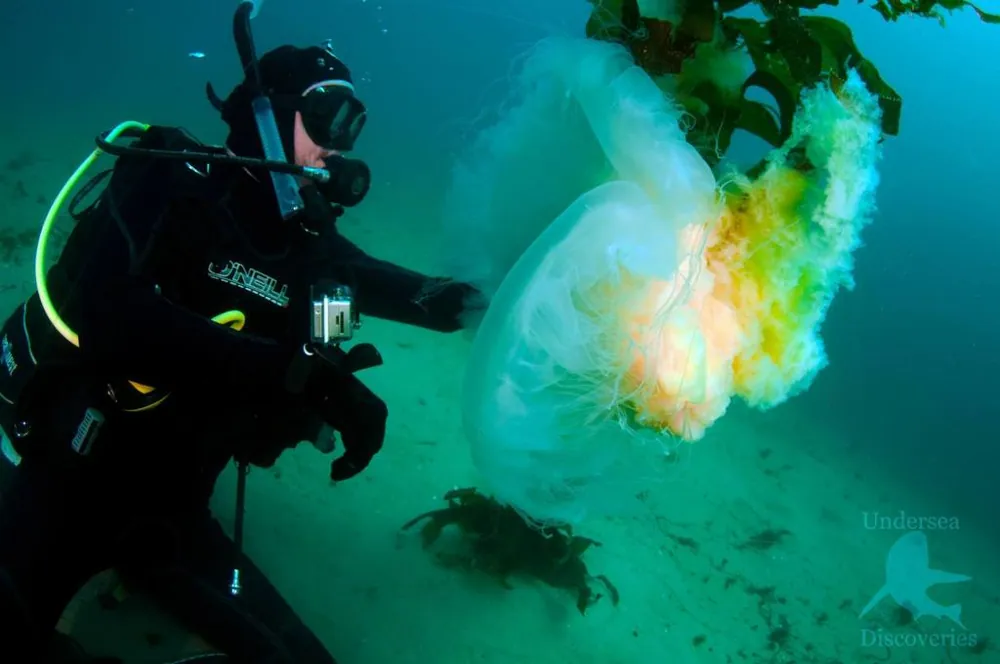
The egg-yolk jellyfish is a very large jellyfish with a bright yellow centre that looks like a fried egg. It lives in cool seas across most of the world's oceans and is most common in the Northern Pacific. It is special because it can grow very large, and it is one of the few jellyfish that can survive in low-oxygen water.1



 Jinsi ya kumtambua
- A yellow centre that looks like a broken egg yolk, surrounded by opaque white tissue1
- A large bell, sometimes close to 60 cm across1
- 16 clusters of tentacles, each with up to a few dozen tentacles, and each tentacle up to 6 m long1
- Broad, curtain-like oral arms1
- Mostly drifts with the current, with only limited movement1
Mara nyingi huchanganywa na: The lion's mane jellyfish (Cyanea capillata) is sometimes confused with this species. The smaller Cotylorhiza tuberculata, which is found mainly in warmer water, especially in the Mediterranean Sea, is also called a fried egg jellyfish.1
Nguvu ya sumu
Maelfu ya seli ndogo za kudunga hufyatuka kitu kikizigusa.
Sumu yake hufanya nini?
Its tentacles contain nematocysts, stinging cells that help it catch prey. Its sting is weak, which allows some small animals to ride on its bell and steal food from its arms and tentacles.1
Ana hatari gani kwa watu?
Hatari kwa watu: HafifuKama kudungwa na nyuki au chini ya hapo. Kimsingi hana madhara kwa watu.Its sting is weak.1
Hufanya nini akiogopa?
Its tentacles contain nematocysts, which also help protect it from predators.1
 Akidunga
- Toka majini na uondoe vipande vya mikono iliyonata (kwa glavu au kitambaa).
- Kwa yavuyavu sanduku wa kitropiki: mimina siki kwenye sehemu zilizodungwa kwa angalau sekunde 30, omba msaada na uwe tayari kufanya CPR. Kwa mabotoli ya bluu na wengine wengi: suuza kwa maji ya bahari, kisha maji ya moto kupunguza maumivu.
Daima piga namba ya dharura kwanza (112, 000, 911). Huu ni mwongozo wa jumla wa huduma ya kwanza, si ushauri wa kitabibu. Misingi ya huduma ya kwanza
 Kaa salama
- Kamwe usimguse, kumkamata wala kumchokoza mnyama wa porini, hata akiwa mdogo, na hata akionekana amelala au amekufa.
- Mpe nafasi. Ukikutana naye, tulia, rudi nyuma polepole na umwache aende zake.
- Akikudunga: tulia, usitikisike, piga namba yako ya dharura (112, 000, 911) au nenda hospitali haraka. Kumbuka alivyoonekana, picha husaidia.
Hakuwindi wewe. Hutumia sumu yake kukamata chakula au kujilinda, na hupendelea zaidi kujificha. Zaidi kuhusu kukaa salama
Ana ukubwa gani?
Ana urefu gani?
 urefu sawa na ndizi 3 zilizopangwa mstari
 urefu sawa na matofali 18 ya kuchezea yaliyopangwa mstari
 angeweza kuogelea urefu wa bwawa kubwa (m 50) kwa sekunde 140
Egg-yolk jellyfish ana ukubwa gani ukilinganisha na WEWE?
Ni hesabu tu kwenye kivinjari chako. Hakuna kinachohifadhiwa wala kutumwa popote.
Ana kasi gani?

Ukweli
Its tentacles can reach up to 6 m long, which is far longer than its bell.1
It has no gills, lungs or circulatory system. It takes in oxygen through its thin body surface instead.1
The giant deep-sea octopus Haliphron atlanticus clings to this jellyfish and eats its oral arms and stomach.1
It can survive in low-oxygen water for several hours at a time, and it sometimes dives into these zones during the day to avoid competition.1
Small crabs and an amphipod called Hyperia medusarum can live on its bell, and some feed on the parasites that infest the jellyfish.1
Kwa wataalamu wa sumu
- Jina la kisayansi
- Phacellophora camtschatica
- Kundi
- Yavuyavu na wadungaji wa baharini
- Familia
- Phacellophoridae2
- Mpangilio
- Semaeostomeae
- Mabara
- Bahari ya Pasifiki, Bahari kuu
- Watoto
- Eggs are fertilised and develop into swimming larvae called planulae. These settle on the seabed and grow into polyps, which later release young jellyfish called ephyrae.1
- Hatari kwa watu
- 1 / 5: Hafifu3
Ukweli unatoka wapi
- Phacellophora (Wikipedia (CC BY-SA 4.0))
- Phacellophora camtschatica (iNaturalist): majina na uainishaji.
- Venom Wiki: kiwango cha hatari, ukubwa wa kawaida na makadirio ya kasi ni yetu wenyewe. Ona jinsi tunavyovipata: Jinsi tunavyopima hatari.
Kila ukweli kwenye ukurasa huu una namba inayoonyesha chanzo chake. Kama tumekosea kitu, samahani, sisi ni wapenzi wa wanyama, si jarida la kisayansi. Tuambie kupitia [email protected] nasi tutarekebisha.
 Nge ana njaa! Venom Wiki ni mradi wa mtu mmoja: bure, bila matangazo na bila vifuatiliaji. Mchango mdogo husaidia kuiweka hewani.Mlishe nge
Zaidi kutoka kundi hilohilo: Yavuyavu na wadungaji wa baharini
 Australian box jellyfishYavuyavu na wadungaji wa bahariniAnauaUsiguse
 Irukandji jellyfishYavuyavu na wadungaji wa bahariniAnaweza kuuaUsiguse
 Portuguese man o' warYavuyavu na wadungaji wa bahariniAnahitaji daktariUsiguse
 Lion's mane jellyfishYavuyavu na wadungaji wa bahariniInauma tuUsiguse
 Moon jellyfishYavuyavu na wadungaji wa bahariniHana madhara
 Common kingslayerYavuyavu na wadungaji wa bahariniAnaweza kuuaUsiguse
Pia anaishi: Bahari ya Pasifiki
 Geography coneKonokono koni na pwezaAnaua
 Greater blue-ringed octopusKonokono koni na pwezaAnaua
 Japanese pufferfishWanyama wengine wenye sumu ya kugusa au kulaAnaua
 Southern blue-ringed octopusKonokono koni na pwezaAnaua
 Hawksbill sea turtleWanyama wengine wenye sumu ya kugusa au kulaAnaweza kuua
 Reef stonefishSamaki wenye sumuAnaweza kuuaUsiguse