
 Afrika
 Asia
Asia Ulaya
Ulaya Amerika Kusini
 Australia na Oceania
 Antaktika
 Bahari ya Pasifiki
 Bahari ya Atlantiki
 Bahari ya Hindi
 Bahari ya Aktiki
 Bahari ya Mediterania
 Bahari ya Shamu
 Bahari ya Karibi
 Bahari ya Matumbawe
 Bahari ya Kusini ya China
 Bahari ya Ufilipino
 Bahari ya Andaman
 Bahari ya Kaskazini
 Bahari ya Timor na Arafura
 Ghuba ya Bengal
 Ghuba ya California
Yellow-bellied sea snake
 Kuumwa
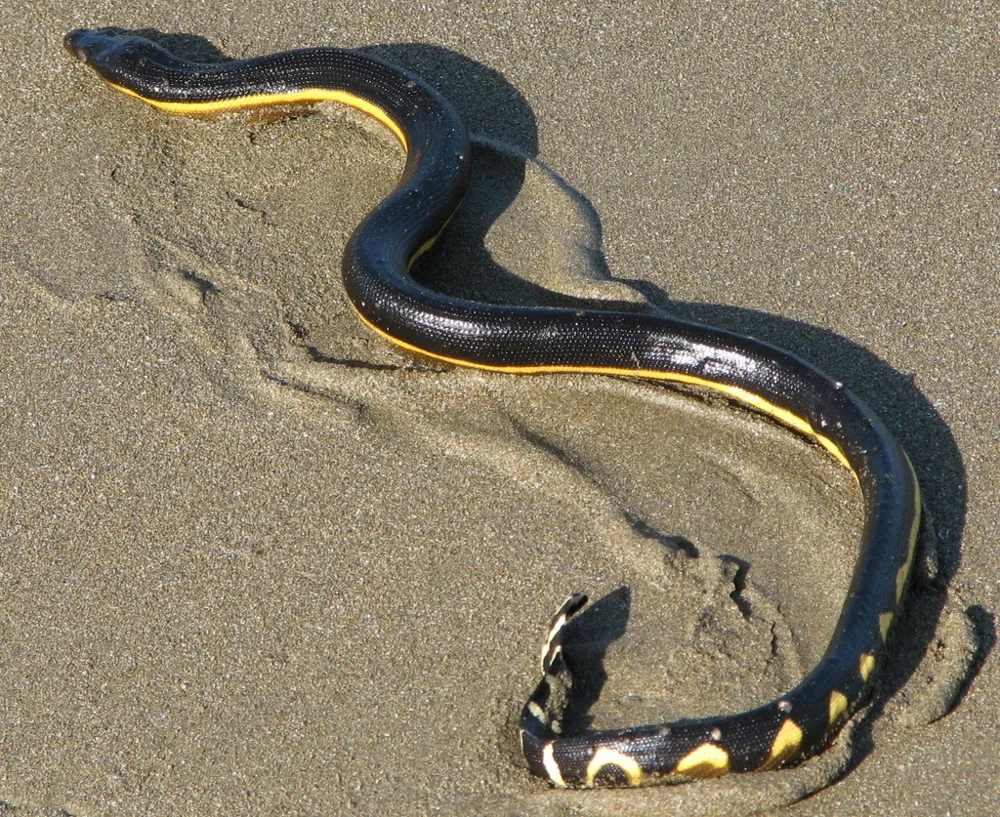
The yellow-bellied sea snake is a sea snake with a strongly venomous bite. It lives in warm tropical oceans and spends its whole life at sea, floating on the surface. Its yellow belly and brown back make it easy to tell apart from most other sea snakes.1

 Jinsi ya kumtambua
- Sharply bicoloured: black or dark brown on the back, with a yellow or brown underside.1
- The yellow belly may have black spots, bars or crossbars, or a narrow black stripe along the back.1
- Has a flattened, paddle-shaped tail for swimming.1
- Adults are usually up to about 72 cm (males) or 88 cm (females) long.1
Nguvu ya sumu
Sumu hutoka kupitia meno yake ya sumu au meno anapouma.
Sumu yake hufanya nini?
The venom is highly potent and contains several different neurotoxins, which attack the nerves, along with two other isotoxins. Sea snake venom can damage skeletal muscle, which may release myoglobin into the urine (myoglobinuria), and can cause neuromuscular paralysis or direct kidney damage. Juvenile venom is on average less concentrated than adult venom.1
Ana hatari gani kwa watu?
Hatari kwa watu: MbayaKuumwa kunahitaji daktari. Vifo ni nadra sana.Bites are rare. The most common victims are fishermen who try to remove the snakes from fishing nets. No deaths have been recorded from bites in Australian waters.1
 Habari njema: madaktari wana dawa (ya kuzuia sumu) au matibabu ya hili.1
Hufanya nini akiogopa?
It is not considered aggressive but will defend itself if threatened.1
 Akiuma
- The venom is neutralised with sea snake antivenom (Enhydrina schistosa). If that is not available, tiger snake or polyvalent antivenom should be used.1
- Kubana na kutotikisa: funga bandeji nyororo kwa nguvu juu ya jeraha kisha mguu au mkono mzima, weka banzi, na umweke mtu bila kutikisika kabisa hadi msaada ufike.
- Mtoe mtu majini na umpeleke hospitali haraka.
Daima piga namba ya dharura kwanza (112, 000, 911). Huu ni mwongozo wa jumla wa huduma ya kwanza, si ushauri wa kitabibu. Misingi ya huduma ya kwanza
 Kaa salama
- Kamwe usimguse, kumkamata wala kumchokoza mnyama wa porini, hata akiwa mdogo, na hata akionekana amelala au amekufa.
- Mpe nafasi. Ukikutana naye, tulia, rudi nyuma polepole na umwache aende zake.
- Akikuuma: tulia, usitikisike, piga namba yako ya dharura (112, 000, 911) au nenda hospitali haraka. Kumbuka alivyoonekana, picha husaidia.
Hakuwindi wewe. Hutumia sumu yake kukamata chakula au kujilinda, na hupendelea zaidi kujificha. Zaidi kuhusu kukaa salama
Wapi duniani?
Ana ukubwa gani?
Ana urefu gani?
 urefu sawa na paka wa nyumbani 2 kutoka pua hadi mkia
 urefu sawa na ndizi 5 zilizopangwa mstari
 angeweza kuogelea urefu wa bwawa kubwa (m 50) kwa sekunde 49
Yellow-bellied sea snake ana ukubwa gani ukilinganisha na WEWE?
Ni hesabu tu kwenye kivinjari chako. Hakuna kinachohifadhiwa wala kutumwa popote.
Ana kasi gani?
Ukweli
It can swim backwards, which is an unusual ability and a distinguishing feature of this species.1
It breathes partly through its skin, taking oxygen from seawater while diving and swimming at the surface.1
It can survive severe dehydration for up to 7 months during seasonal drought.1
Large groups of thousands have been seen floating together on the surface in oceanic drift lines.1
It is the only sea snake known to have reached the Hawaiian Islands.1
Strays wash up so often on New Zealand's coasts that it is considered native to the country and protected under the Wildlife Act 1953.1
Kuvunja dhana potofu
Dhana potofu: Sea snakes drink seawater and filter out the salt through a special salt gland in the lower jaw.
Ukweli: Sea snakes drink only fresh water. The salt gland was once thought to filter salt, but it is not used for that purpose. The yellow-bellied sea snake likely drinks from freshwater lenses that form on the sea surface after heavy rain.1
Kwa wataalamu wa sumu
- Jina la kisayansi
- Hydrophis platurus
- Kundi
- Nyoka wa baharini
- Familia
- Elapidae2
- Mpangilio
- Squamata
- Mabara
- Bahari ya Pasifiki, Bahari ya Hindi, Bahari ya Matumbawe, Bahari ya Kusini ya China, Bahari ya Ufilipino, Bahari ya Andaman, Bahari ya Arabia na Ghuba ya Uajemi, Bahari ya Timor na Arafura, Ghuba ya Bengal, Ghuba ya California, Bahari kuu
- Watoto
- It gives birth to live young (ovoviviparous) after a gestation period of around 6 months, and females bear them in tidal pools.1
- Hatari kwa watu
- 3 / 5: Mbaya3
Ukweli unatoka wapi
- Yellow-bellied sea snake (Wikipedia (CC BY-SA 4.0))
- Hydrophis platurus (iNaturalist): majina na uainishaji.
- Venom Wiki: kiwango cha hatari, ukubwa wa kawaida na makadirio ya kasi ni yetu wenyewe. Ona jinsi tunavyovipata: Jinsi tunavyopima hatari.
Kila ukweli kwenye ukurasa huu una namba inayoonyesha chanzo chake. Kama tumekosea kitu, samahani, sisi ni wapenzi wa wanyama, si jarida la kisayansi. Tuambie kupitia [email protected] nasi tutarekebisha.
 Nge ana njaa! Venom Wiki ni mradi wa mtu mmoja: bure, bila matangazo na bila vifuatiliaji. Mchango mdogo husaidia kuiweka hewani.Mlishe nge
Zaidi kutoka kundi hilohilo: Nyoka wa baharini
 Beaked sea snake
 Belcher's sea snake
 Black-banded sea krait
 Blue-lipped sea krait
 Dubois' sea snake
 Olive sea snake
Pia anaishi: Bahari ya Pasifiki
 Australian box jellyfishYavuyavu na wadungaji wa bahariniAnauaUsiguse
 Geography coneKonokono koni na pwezaAnaua
 Greater blue-ringed octopusKonokono koni na pwezaAnaua
 Japanese pufferfishWanyama wengine wenye sumu ya kugusa au kulaAnaua
 Southern blue-ringed octopusKonokono koni na pwezaAnaua
 Hawksbill sea turtleWanyama wengine wenye sumu ya kugusa au kulaAnaweza kuua