
 Aforika
 Asia
Asia Yuropa
 Amerika Borwa
 Australia le Oceania
 Antarctica
 Lewatle la Pacific
 Lewatle la Atlantic
 Lewatle la India
 Lewatle la Arctic
 Lewatle la Mediterranean
 Lewatle le Lehibidu
 Lewatle la Caribbean
 Lewatle la Coral
 Lewatle la China Borwa
 Lewatle la Philippines
 Lewatle la Andaman
 Lewatle la Bokone
 Lewatle la Timor le la Arafura
 Kou ya Bengal
 Gulf ya California
Patagonian bumblebee
 Go tlhaba
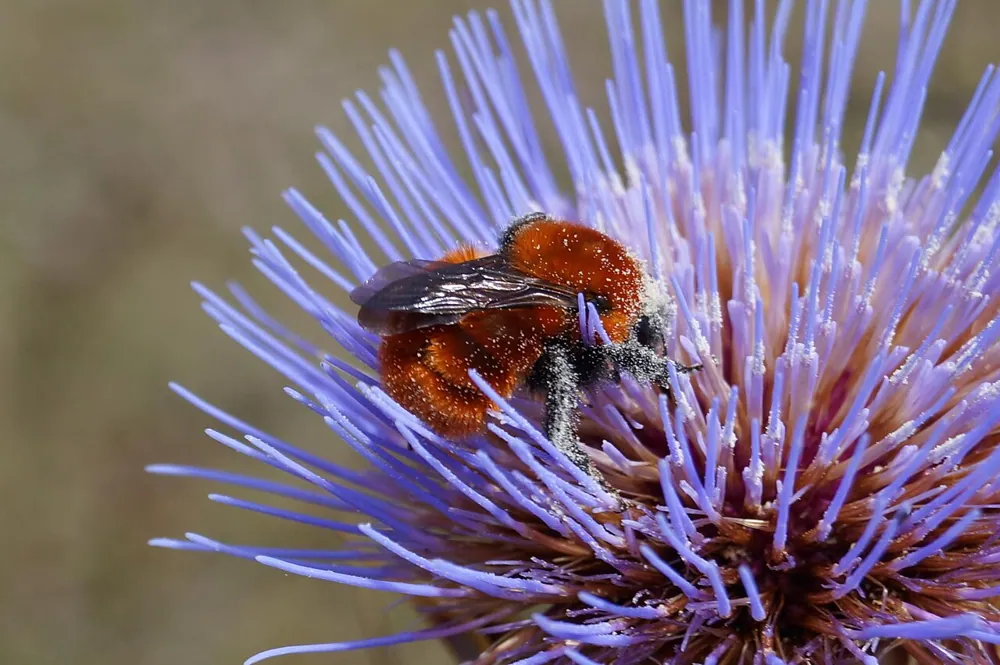
The Patagonian bumblebee is a large, furry bee that lives naturally only in the temperate forests of southern South America. Its queens are among the biggest bumblebees in the world. Its numbers have fallen since other bumblebee species were brought into the region to pollinate crops.1



 Tsela ya go e lemoga
- Mostly red-orange in colour, with a completely red-orange thorax.1
- The abdomen is a lighter orange, fading slightly towards the end, and has a rounded tip.1
- The head, wings and legs are distinctly black.1
- Long bristles cover most of the body, giving it a very furry look.1
- Queens can reach up to 4 cm from head to tail and weigh around 0.5 to 1.5 grams.1
Gantsi e tlhakanngwa le: The syrphid fly Aneriophora aureorufa looks very similar to this bumblebee. The two have similar colour and size and can be hard to tell apart in the wild because of their similar flight.1
Maatla a botlhole
Botlhole bo tswa ka lemao le le tlhabang.
E kotsi go le kae go batho?
Kotsi go batho: Kotsi e nnyeJaaka go tlhabiwa ke notshe kgotsa go le kwa tlase. Ga e na kotsi go batho. Fa e tlhaba
- Ntsha lemao la notshe ka go le kgwaratla, mme o tsidifatse lefelo leo.
- Fa motho a hema ka bothata, sefatlhego kgotsa mometso o ruruga, kgotsa a ikutlwa a tla idibala, ke tshoganyetso ya aletshi: leletsa nomoro ya gago ya tshoganyetso mme o dirise pene ya gagwe ya adrenaline fa a na le yone.
Ka gale leletsa nomoro ya gago ya tshoganyetso pele (112, 000, 911). Se ke kaelo e e akaretsang ya thuso ya ntlha, ga se kgakololo ya bongaka. Motheo wa thuso ya ntlha
 Nna o babalesegile
- O se ka wa ama, wa tshwara kgotsa wa tshwenya phologolo ya naga, le fa e le e nnye, le fa e lebega e robetse kgotsa e sule.
- E fe sebaka. Fa o kopana le yone, ritibala, boela morago ka bonya mme o e tlogele e tsamaye ka tsela ya yone.
- Fa e nngwe e go tlhaba: ritibala, o se ka wa tshikinyega, leletsa nomoro ya gago ya tshoganyetso (112, 000, 911) kgotsa o ye bookelong ka bonako. Gopola gore e ne e lebega jang, setshwantsho se a thusa.
Ga e go batle. E dirisa botlhole jwa yone go tshwara dijo kgotsa go itshireletsa, mme e rata go iphitlha go feta. Go le gontsi ka go nna o babalesegile
Kae mo lefatsheng?
E kgolo go le kae?
E telele go le kae?
E kima go le kae?
 e ka nna boleele jo bo lekanang le jwa kelipi ya pampiri
 bofefo mo o ka se e utlweng mo seatleng sa gago
 e ka fofa go kgabaganya lebala lotlhe la kgwele ya dinao ka metsotswana e le 10
Patagonian bumblebee e kgolo go le kae fa e bapisiwa le WENA?
Ke dipalo fela mo sefetleng sa gago (browser). Ga go sepe se se bolokwang kgotsa se se romelwang gope.
E bonako go le kae?


Dintlha
It is one of the largest bee species in the world, and its furry look has earned it the nickname 'flying mouse'.1
It often visits red flowers, which most bees avoid. It can detect red through a specific receptor system.1
A syrphid fly in Patagonia, Aneriophora aureorufa, has evolved to look and fly much like this bumblebee, which may help it avoid predators.1
In the Maulino forest of central Chile, individuals living in fragmented forest have longer wings relative to their body size, because they need to fly longer distances between patches.1
Its populations began to decline after non-native bumblebees were introduced into Chile to pollinate crops.1
It is the only native bumblebee species in southern South America.1
Ya baitseanape ba botlhole
- Leina la saense
- Bombus dahlbomii
- Setlhopha
- Dinotshe, diwasepe le dihonete
- Lelapa
- Apidae2
- Lekoko
- Hymenoptera
- Dikontinente
- Amerika Borwa
- Masea
- Queens lay their first eggs in a structure made of pollen and wax inside an underground cavity. The first brood becomes workers after a couple of months, and nests can hold more than 100 workers.1
- Kotsi go batho
- 1 / 5: Kotsi e nnye3
Kwa dintlha di tswang teng
- Bombus dahlbomii (Wikipedia (CC BY-SA 4.0))
- Bombus dahlbomii (iNaturalist): maina le thulaganyo ya mefuta.
- Venom Wiki: seelo sa kotsi, bogolo jo bo tlwaelegileng le kakanyo ya lebelo ke tsa rona. Bona kafa re di balang ka teng: Kafa re lekanyang kotsi ka teng.
Ntlha nngwe le nngwe mo tsebeng e e na le nomoro e e supang motswedi wa yone. Fa re dirile phoso, maitshwarelo, re barati ba diphologolo, e seng kgatiso ya saense. Re bolelele kwa [email protected] mme re tla e baakanya.
 Phepheng e tshwerwe ke tlala! Venom Wiki ke porojeke ya motho a le mongwe: ke mahala, ga e na dipapatso le ditraka. Mpho e nnye e thusa go e tshegetsa mo inthaneteng.Fepa phepheng
Tse dingwe tsa setlhopha se se tshwanang: Dinotshe, diwasepe le dihonete
 Tarantula hawkDinotshe, diwasepe le dihoneteE utlwisa botlhoko fela
 Executioner waspDinotshe, diwasepe le dihoneteE tlhoka ngaka
 Warrior waspDinotshe, diwasepe le dihoneteE tlhoka ngaka
 Armadillo waspDinotshe, diwasepe le dihoneteE tlhoka ngaka
 Giant tarantula hawkDinotshe, diwasepe le dihoneteE utlwisa botlhoko fela
 Paulista waspDinotshe, diwasepe le dihoneteE utlwisa botlhoko fela
E tshela gape kwa: Amerika Borwa
 Golden poison frogDigwagwa tsa botlhole, digwagwa tse dingwe le dinewtE a bolayaO se ka wa ama
 TerciopeloDivaepara tsa mesima (pit vipers)E a bolaya
 Brazilian wandering spiderDigokgoE ka bolaya
 Eyelash viperDivaepara tsa mesima (pit vipers)E ka bolaya
 Golden lanceheadDivaepara tsa mesima (pit vipers)E ka bolaya
 South American bushmasterDivaepara tsa mesima (pit vipers)E ka bolaya