
 Châu Phi
 Châu Á
 Châu Âu
 Nam Mỹ
 Úc và châu Đại Dương
 Châu Nam Cực
 Thái Bình Dương
 Đại Tây Dương
 Ấn Độ Dương
 Bắc Băng Dương
 Địa Trung Hải
 Biển Đỏ
 Biển Caribe
 Biển San Hô
 Biển Đông
 Biển Philippines
 Biển Andaman
 Biển Bắc
 Biển Timor và Arafura
 Vịnh Bengal
 Vịnh California
House centipede
 Vết cắn
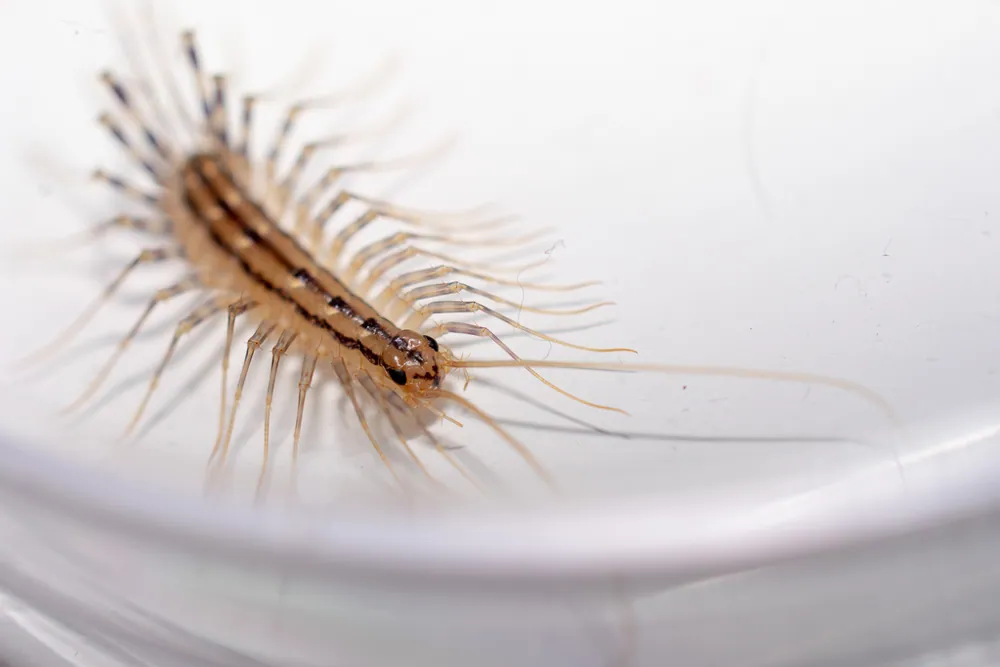
The house centipede is a long-legged, yellowish-grey centipede that often shares homes with people. It comes from the Mediterranean region and has spread across much of the world. It is fast, has very long legs, and eats household pests, so it is useful to have around.1
 Cách nhận biết
- Typically yellowish-grey, with three dark stripes running down the length of its body.1
- Up to 15 pairs of long legs, which also have dark stripes.1
- Body is typically 25 to 35 mm long. With its legs and antennae, it looks about 75 to 100 mm long.1
- Runs very quickly across floors, up walls and along ceilings, and can stop suddenly and stay still.1
- Has well-developed eyes, unlike most other centipedes.1
Sức mạnh nọc độc
Nọc độc thoát ra qua răng nanh hoặc răng khi nó cắn.
Nọc độc của nó gây ra gì?
It has a mild venom, which it injects through small claw-like structures called forcipules. Its venom is used mainly to subdue prey. In a bite on a person, the effect is limited to mild pain and swelling in the local area, similar to a bee sting.1
Nó nguy hiểm thế nào với con người?
Nguy hiểm với con người: NhẹNhư bị ong đốt hoặc nhẹ hơn. Gần như vô hại với con người.House centipedes pose essentially no threat to people. They are not aggressive and usually flee when disturbed. Stings are rare and usually happen only when the centipede is cornered or handled roughly. Their forcipules have difficulty penetrating human skin. Allergic reactions have been reported but are rare, and nearly all successful bites heal quickly without complications.1
Nó làm gì khi sợ?
When disturbed, it usually runs away quickly, and it can detach any legs that have become trapped.1
 Nếu nó cắn
- Rửa vết cắn, làm mát hoặc ngâm nước ấm để giảm đau, và đi khám nếu nặng hơn.
Luôn gọi số khẩn cấp trước tiên (112, 000, 911). Đây là hướng dẫn sơ cứu chung, không phải lời khuyên y tế. Sơ cứu cơ bản
 Giữ an toàn
- Đừng bao giờ chạm, bắt hay trêu chọc động vật hoang dã, dù nó nhỏ, và dù trông như đang ngủ hay đã chết.
- Chừa khoảng cách cho nó. Nếu gặp, hãy bình tĩnh, lùi lại từ từ và để nó đi.
- Nếu nó cắn bạn: bình tĩnh, nằm yên, gọi số khẩn cấp (112, 000, 911) hoặc đến bệnh viện thật nhanh. Hãy nhớ hình dạng nó, có ảnh càng tốt.
Nó không nhắm vào bạn. Nó dùng nọc để bắt mồi hoặc tự vệ, và nó thích trốn hơn nhiều. Thêm về cách giữ an toàn
Nó to cỡ nào?
Nó dài bao nhiêu?
 dài khoảng bằng một chiếc kẹp giấy
 có thể chạy 100 mét trong 260 giây (người nhanh nhất cần 9,6)
House centipede to cỡ nào so với BẠN?
Chỉ là phép tính trong trình duyệt của bạn. Không có gì được lưu hay gửi đi đâu cả.
Nó nhanh cỡ nào?


Thông tin
It can detach its own legs if they become trapped, which helps it escape danger.1
It can tell harmful prey from safe prey, and it changes how it feeds depending on the danger. With wasps, it retreats after stinging to let the venom take effect.1
Its tail-like hind legs look like antennae, so when it is at rest it is hard to tell its head end from its tail end.1
Unlike most centipedes, it has well-developed faceted eyes, although it hunts mostly by smell and touch through its antennae.1
Its blood contains proteins that carry oxygen, which is unusual among centipedes.1
It can live its whole life inside a building, usually on the ground floor of homes.1
Phá tan lời đồn
Lời đồn: House centipedes are dangerous and likely to attack people.
Sự thật: They are not aggressive and usually run away. Their stings are rare and cause only mild, local pain and swelling.1
Cho chuyên gia về nọc độc
- Tên khoa học
- Scutigera coleoptrata
- Nhóm
- Rết
- Gia đình
- Scutigeridae2
- Thứ tự
- Scutigeromorpha
- Các châu lục
- Châu Âu, Châu Á, Châu Phi
- Con non
- They lay eggs in spring. In a laboratory study of 24 females, the average was 63 eggs and the maximum was 151. The young hatch with four pairs of legs and gain more with each moult until they reach 15 pairs.1
- Tuổi thọ
- khoảng 7 năm1
- Nguy hiểm với con người
- 1 / 5: Nhẹ3
Thông tin lấy từ đâu
- Scutigera coleoptrata (Wikipedia (CC BY-SA 4.0))
- Scutigera coleoptrata (iNaturalist): tên gọi và phân loại.
- Venom Wiki: mức nguy hiểm, kích thước điển hình và tốc độ ước đoán là của chúng tôi. Xem cách chúng tôi tính: Cách chúng tôi đánh giá nguy hiểm.
Mỗi thông tin trên trang này có một con số dẫn đến nguồn của nó. Nếu chúng tôi sai điều gì, xin lỗi nhé, chúng tôi là người mê động vật, không phải tạp chí khoa học. Hãy báo cho chúng tôi qua [email protected] và chúng tôi sẽ sửa.
 Bọ cạp đói rồi! Venom Wiki là dự án của một người: miễn phí, không quảng cáo, không theo dõi. Một chút tiền tip giúp trang tiếp tục hoạt động.Cho bọ cạp ăn
Cùng nhóm: Rết
 Chinese red-headed centipede
 Giant Australian centipede
 Mediterranean banded centipede
 Vietnamese giant centipede
 African blue-ring centipede
 Indian tiger centipede
Cũng sống ở: Châu Âu
 Common European adderRắn lụcCần đi khám
 Spanish flyCác loài có độc khácCần đi khámĐừng chạm vào
 Common waspOng, ong bắp cày và ong vò vẽChỉ đau thôi
 European hornetOng, ong bắp cày và ong vò vẽChỉ đau thôi
 Fire salamanderẾch độc, cóc và sa giôngChỉ đau thôiĐừng chạm vào
 Western honey beeOng, ong bắp cày và ong vò vẽChỉ đau thôi