
 Afrig
Afrig Asi
Asi Tugal
Tugal Amerig gu Bëj-saalum
 Ostarali ak Oseyani
 Antarktig
 Mbàmbulaanu Pasifik
 Mbàmbulaanu Atlantig
 Mbàmbulaanu End
 Mbàmbulaanu Arktik
 Géeju Mediteraane
 Géej gu Xonq
 Géeju Karayib
 Géeju Koraay
 Géeju Siin gu Bëj-saalum
 Géeju Filipin
 Géeju Andaman
 Géeju Bëj-gànnaar
 Géeju Timor ak Arafura
 Golfu Bengal
 Golfu Kaliforni
Estuarine stonefish
 Dag yu am daŋar
The estuarine stonefish is a fish that looks like a stone lying on the seabed. It lives in shallow reefs and estuaries across the Indo-Pacific, including northern Australia. It is considered one of the most dangerous venomous fish in the world, so it is important to know what it looks like.1



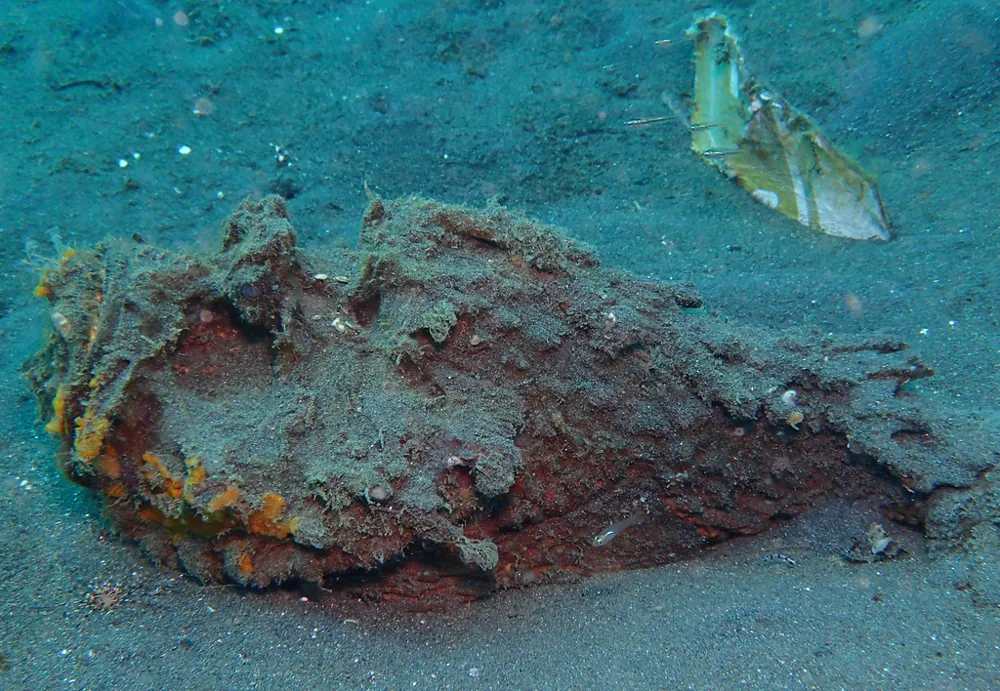
 Ni ngay ko xàmmee
- Drab brownish-grey, reddish or greenish-brown colour1
- Skin has no scales and is covered in warts, often with filamentous algae growing on it1
- Head is flattened, with small eyes set high and pointing upwards, and a deep pit behind and under each eye1
- Large, almost vertical mouth with fringing cirri on the lips1
- Camouflaged to look like a stone resting on the bottom; it has no bright warning colours1
- Grows to a maximum of 60 cm1
Kàttanu daŋar
Ay dag yu ñaw ñoo yor daŋar bi. Teg tànk ci kawam walla jàpp ko dafay metti.
Lan la daŋar biy sóob di def?
Each fin spine has two venom-producing glands. The venom affects the cardiovascular and neuromuscular systems. The sting is extremely painful and has been known to be lethal.1
Ni mu lore nit ñi?
Musiba ci nit: Am na musiba loolMën na rey nit ku ñu fajul.It is considered one of the most dangerous venomous fishes. Stings are extremely painful and have been known to be fatal. Since European settlement, there have been no recorded deaths in Australia from stonefish venom, but deaths have been recorded elsewhere in its range.1
 Xibaar bu baax: doktoor yi am nañu garab (sérum antivenimeux) walla ab paj ngir lii.1
Lan lay def bu tiitee?
When disturbed, it erects its venomous spines, which inject venom if the fish is stepped on.1
 Su ay dagam jamee la
- Antivenom can be given after envenomation. Immersing the sting wound in hot water can be used to denature the venom.1
- Teg gaañu-gaañu bi ci ndox mu tàng, lu nit ki mën a muñ waaye bu dul ko lakk (seetal ko ak sa loxo), diir bu dale 30 ba 90 minit. Wutal ndimbal doktoor, rawatina ci jënu-doj ak raie.
Saa su nekk, woo jëkk sa nimerob urgence (112, 000, 911). Lii ay ndigal yu yaatu ci ndimbal yu jëkk la, du ndigalu doktoor. Li war a xam ci ndimbal yu jëkk
 Sàmmal sa bopp
- Bul laal mukk, bul jàpp, bul sonal ab rab bu àll, doonte bu ndaw la, te doonte dafa mel ni dafa nelaw walla dafa dee.
- May ko bérab. Su nga ko gisee, dalal, dellu ginnaaw ndànk-ndànk te bàyyi ko mu dem yoonam.
- Su ay dagam jamee la: dalal, bul yëngu, woo sa nimerob urgence (112, 000, 911) walla dem lopitaan ci gaaw. Bul fàtte ni mu meloon, ab nataal dina dimbali.
Du la wut. Dafay jëfandikoo daŋaram ngir jàpp lu muy lekk walla ngir aar boppam, te nëbbu moo ko gën a neex. Yeneen ci ni ngay sàmme sa bopp
Fan ci àddina?
Ni mu réye?
Ni mu guddoo?
 guddu na ni 3 banaana yu ñu toftale
 mën na féey guddaayu pisin bu réy (50 m) ci 90 segond
Estuarine stonefish ni mu réye ci wetu YOW?
Ay waññ rekk ci sa navigateur. Dara du denc te dara du yónnee fenn.
Ni mu gaawe?

Xibaar
It can tolerate being out of the water for up to 24 hours.1
It scoops out a shallow hollow in the seabed with its large pectoral fins and curls its tail around its body to hide.1
It is camouflaged to look like a stone, unlike many venomous animals that use bright warning colours.1
Females are larger than males.1
Tasukatu léeb
Xalaat bu juum: The species name horrida refers to its dangerous spines.
Dëgg: The name means "dreadful" or "frightful" and alludes to its appearance, not its venomous spines.1
Fa xibaar yi jóge
- Synanceia horrida (Wikipedia (CC BY-SA 4.0))
- Synanceia horrida (iNaturalist): tur ak ni ñu leen séddale.
- Venom Wiki: tolluwaayu musiba bi, réyaay bu yem bi ak xalaatu gaawaay bi, nun ñoo leen defar. Seetal ni nu leen waññe: Ni nuy natte musiba.
Xibaar bu nekk ci xët wii am na ab nimero buy won fa mu jóge. Su nu juumee, baal nu, nun ay nit ñu bëgg rab lanu, du ab jurnaalu xam-xam. Wax nu ko ci [email protected] te dinanu ko jubbanti.
 Jiit bi dafa xiif! Venom Wiki ab liggéeyu kenn la: amul pay, amul piblisite te amul traceur. Ab may bu tuuti dafay dimbali ngir mu des ci internet.Leel jiit bi
Yeneen ci mbooloo mi: Jën yu am daŋar
 Reef stonefish
 Red lionfish
 Short-tail stingray
 Striped eel catfish
 Bluespotted ribbontail ray
 Common stingray
Dafay dund itam ci: Mbàmbulaanu End
 Australian box jellyfishMéduse ak mbindeefi géej yuy jamMën a reyBul laal
 Geography coneCône ak pieuvreMën a rey
 Greater blue-ringed octopusCône ak pieuvreMën a rey
 Southern blue-ringed octopusCône ak pieuvreMën a rey
 Hawksbill sea turtleYeneen rab yu am daŋar ci seen yaramMën na rey
 Irukandji jellyfishMéduse ak mbindeefi géej yuy jamMën na reyBul laal