
 Afrig
Afrig Asi
Asi Tugal
Tugal Amerig gu Bëj-saalum
 Ostarali ak Oseyani
 Antarktig
 Mbàmbulaanu Pasifik
 Mbàmbulaanu Atlantig
 Mbàmbulaanu End
 Mbàmbulaanu Arktik
 Géeju Mediteraane
 Géej gu Xonq
 Géeju Karayib
 Géeju Koraay
 Géeju Siin gu Bëj-saalum
 Géeju Filipin
 Géeju Andaman
 Géeju Bëj-gànnaar
 Géeju Timor ak Arafura
 Golfu Bengal
 Golfu Kaliforni
Short-tail stingray
 Dafay jam
The short-tail stingray is one of the largest stingrays in the world. It lives in temperate seas off southern Africa, southern Australia and New Zealand, mostly on or near the sea floor. It is not aggressive, but its long venomous sting can cause a serious wound if the ray is startled.1



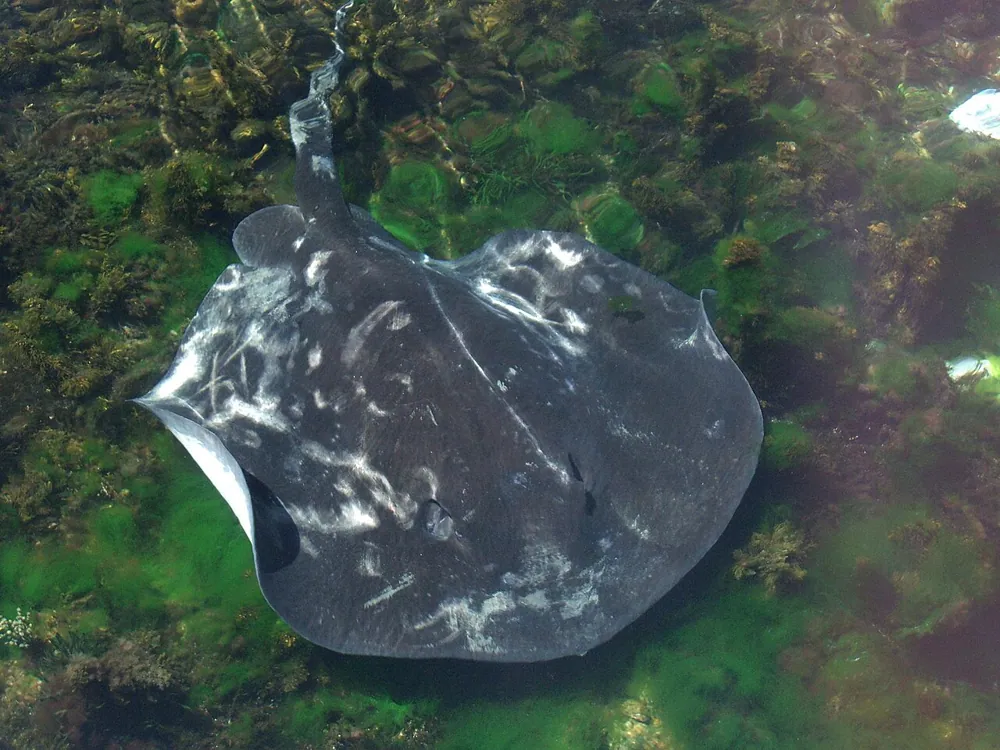
 Ni ngay ko xàmmee
- Diamond-shaped, heavy disc that is smooth, with no scales (dermal denticles) on the disc even in adults1
- Plain grey-brown back, darkening towards the tail and above the eyes, with a line of white pores on either side of the head1
- Whitish underside, darkening towards the edges of the fins1
- Tail usually shorter than the disc, thick at the base, with one or two serrated stinging spines about halfway along it1
- Adults have a row of large, spear-like thorns in front of the sting1
Ñu ngi koy faral di jaxasoo ak: The pitted stingray (Dasyatis matsubarai) of the northwestern Pacific looks similar but is smaller. Records of this species from northern Australia and Thailand are thought to be other rays that were misidentified.1
Kàttanu daŋar
Daŋar bi dafay génn ci ab dag buy jam.
Lan la daŋar biy sóob di def?
Its sting is venomous. The mucous sheath covering the sting contains a toxin that causes necrosis, which means the death of body tissue. The most dangerous injuries involve damage to a vital organ, heavy blood loss, or secondary infection (sepsis) or tetanus.1
Ni mu lore nit ñi?
Musiba ci nit: Am na musiba loolMën na rey nit ku ñu fajul.The short-tail stingray is not aggressive, but if startled or harassed it can inflict a serious and even fatal wound. Its sting can be over 30 cm long and can penetrate most footwear, including kevlar bootees. It is responsible for most stingray injuries off New Zealand, including the death of Australian naturalist Steve Irwin, who was pierced in the chest by its barbed tail.1
Lan lay def bu tiitee?
When threatened, it raises its tail over its back like a scorpion, and a startled ray can leap through the water and strike with its tail.1
 Su jamee
- Teg gaañu-gaañu bi ci ndox mu tàng, lu nit ki mën a muñ waaye bu dul ko lakk (seetal ko ak sa loxo), diir bu dale 30 ba 90 minit. Wutal ndimbal doktoor, rawatina ci jënu-doj ak raie.
Saa su nekk, woo jëkk sa nimerob urgence (112, 000, 911). Lii ay ndigal yu yaatu ci ndimbal yu jëkk la, du ndigalu doktoor. Li war a xam ci ndimbal yu jëkk
 Sàmmal sa bopp
- Bul laal mukk, bul jàpp, bul sonal ab rab bu àll, doonte bu ndaw la, te doonte dafa mel ni dafa nelaw walla dafa dee.
- May ko bérab. Su nga ko gisee, dalal, dellu ginnaaw ndànk-ndànk te bàyyi ko mu dem yoonam.
- Su benn jamee la: dalal, bul yëngu, woo sa nimerob urgence (112, 000, 911) walla dem lopitaan ci gaaw. Bul fàtte ni mu meloon, ab nataal dina dimbali.
Du la wut. Dafay jëfandikoo daŋaram ngir jàpp lu muy lekk walla ngir aar boppam, te nëbbu moo ko gën a neex. Yeneen ci ni ngay sàmme sa bopp
Fan ci àddina?
Ni mu réye?
Ni mu guddoo?
Ni mu diise?
 guddu na ni 4 xaj, bakkan ba geen
 guddu na ni 24 banaana yu ñu toftale
 mën na féey guddaayu pisin bu réy (50 m) ci 6 segond
Short-tail stingray ni mu réye ci wetu YOW?
Ay waññ rekk ci sa navigateur. Dara du denc te dara du yónnee fenn.
Ni mu gaawe?


Xibaar
It can flap its pectoral fins with enough force to make a loud audible 'bang' in the water, although it is usually slow-moving.1
It is one of the largest stingrays in the world, and reliable observers off New Zealand have reported individuals almost 3 m across.1
Captive experiments suggest it can detect magnetic fields, which may help it navigate.1
Every summer, large groups gather under the rocky archways of the Poor Knights Islands off New Zealand, where both mating and birthing have been seen.1
Captive females have been observed mating with up to three different males in succession.1
Ngir boroom xam-xam ci daŋar
- Turu xam-xam
- Bathytoshia brevicaudata
- Mbooloo
- Jën yu am daŋar
- Njaboot
- Dasyatidae2
- Toftal
- Myliobatiformes
- Kontinaa yi
- Mbàmbulaanu End, Mbàmbulaanu Pasifik, Géeju Koraay, Mbàmbulaan yi
- Liir yi
- It gives birth to live young. Females usually have litters of 6 to 10 pups in summer, and newborns measure 32 to 36 cm across.1
- Ni mu nekke ci àll bi
- Least Concern (IUCN)1
- Musiba ci nit
- 4 / 5: Am na musiba lool3
Fa xibaar yi jóge
- Short-tail stingray (Wikipedia (CC BY-SA 4.0))
- Bathytoshia brevicaudata (iNaturalist): tur ak ni ñu leen séddale.
- Venom Wiki: tolluwaayu musiba bi, réyaay bu yem bi ak xalaatu gaawaay bi, nun ñoo leen defar. Seetal ni nu leen waññe: Ni nuy natte musiba.
Xibaar bu nekk ci xët wii am na ab nimero buy won fa mu jóge. Su nu juumee, baal nu, nun ay nit ñu bëgg rab lanu, du ab jurnaalu xam-xam. Wax nu ko ci [email protected] te dinanu ko jubbanti.
 Jiit bi dafa xiif! Venom Wiki ab liggéeyu kenn la: amul pay, amul piblisite te amul traceur. Ab may bu tuuti dafay dimbali ngir mu des ci internet.Leel jiit bi
Yeneen ci mbooloo mi: Jën yu am daŋar
 Reef stonefishJën yu am daŋarMën na reyBul laal
 Red lionfishJën yu am daŋarSoxla na doktoorBul laal
 Estuarine stonefishJën yu am daŋarMën na reyBul laal
 Striped eel catfishJën yu am daŋarMën na reyBul laal
 Bluespotted ribbontail rayJën yu am daŋarSoxla na doktoor
 Common stingrayJën yu am daŋarSoxla na doktoor
Dafay dund itam ci: Mbàmbulaanu End
 Australian box jellyfishMéduse ak mbindeefi géej yuy jamMën a reyBul laal
 Geography coneCône ak pieuvreMën a rey
 Greater blue-ringed octopusCône ak pieuvreMën a rey
 Southern blue-ringed octopusCône ak pieuvreMën a rey
 Hawksbill sea turtleYeneen rab yu am daŋar ci seen yaramMën na rey
 Irukandji jellyfishMéduse ak mbindeefi géej yuy jamMën na reyBul laal