
 Afrig
Afrig Asi
Asi Tugal
Tugal Amerig gu Bëj-saalum
 Ostarali ak Oseyani
 Antarktig
 Mbàmbulaanu Pasifik
 Mbàmbulaanu Atlantig
 Mbàmbulaanu End
 Mbàmbulaanu Arktik
 Géeju Mediteraane
 Géej gu Xonq
 Géeju Karayib
 Géeju Koraay
 Géeju Siin gu Bëj-saalum
 Géeju Filipin
 Géeju Andaman
 Géeju Bëj-gànnaar
 Géeju Timor ak Arafura
 Golfu Bengal
 Golfu Kaliforni
False stonefish
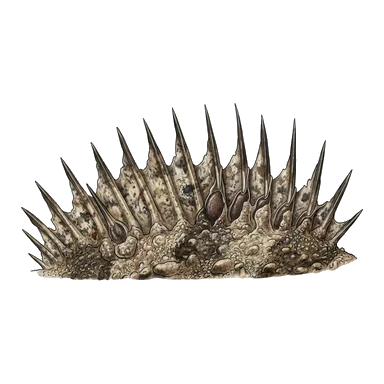 Dag yu am daŋar
The false stonefish is a venomous fish that lives on the seabed in warm seas. It hides among rocks, coral and rubble, where it waits to ambush passing prey. It is worth knowing about because its back spines can give a painful sting.1
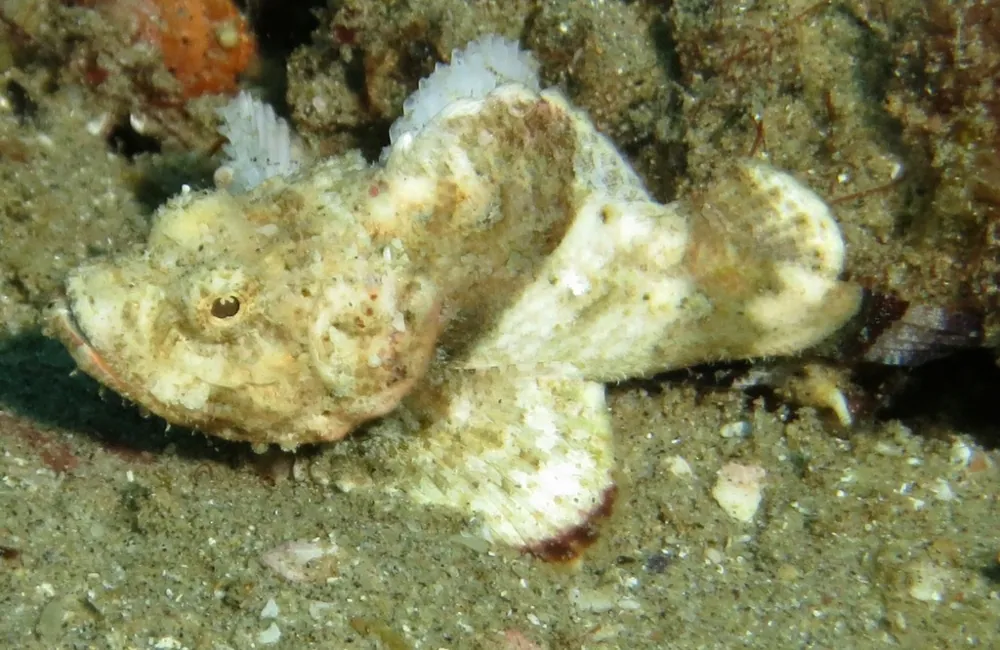
 Ni ngay ko xàmmee
- Broad head with a wide mouth, a humped back and a tapering body1
- Rough skin with low cone-shaped bumps, spines and tassels1
- Mottled grey and white colouring with reddish-brown blotches, which blends in with stones and coral1
- Twelve venomous spines in the dorsal (back) fin1
- Inner sides of the broad pectoral (side) fins show orange, black and white blotches1
Ñu ngi koy faral di jaxasoo ak: It closely resembles the reef stonefish (Synanceia verrucosa), which is why the two are easily confused.1
Kàttanu daŋar
Ay dag yu ñaw ñoo yor daŋar bi. Teg tànk ci kawam walla jàpp ko dafay metti.
Lan la daŋar biy sóob di def?
Its venomous spines are in the dorsal fin on its back. They can inflict a painful wound when a person is pricked by them.1
Ni mu lore nit ñi?
Musiba ci nit: Lu bonSu ay dagam jamee la, demal gis doktoor. Ñi ciy dee dañoo néew lool.An 1829 account by the zoologists Cuvier and Valenciennes says the venom killed two local people in the Moluccas Islands of Indonesia, after what they described as frightful suffering. Local people there avoided the fish because they saw it as a bad omen.1
Lan lay def bu tiitee?
When disturbed by a possible predator, it flares its pectoral fins as a warning.1
 Su ay dagam jamee la
- Teg gaañu-gaañu bi ci ndox mu tàng, lu nit ki mën a muñ waaye bu dul ko lakk (seetal ko ak sa loxo), diir bu dale 30 ba 90 minit. Wutal ndimbal doktoor, rawatina ci jënu-doj ak raie.
Saa su nekk, woo jëkk sa nimerob urgence (112, 000, 911). Lii ay ndigal yu yaatu ci ndimbal yu jëkk la, du ndigalu doktoor. Li war a xam ci ndimbal yu jëkk
 Sàmmal sa bopp
- Bul laal mukk, bul jàpp, bul sonal ab rab bu àll, doonte bu ndaw la, te doonte dafa mel ni dafa nelaw walla dafa dee.
- May ko bérab. Su nga ko gisee, dalal, dellu ginnaaw ndànk-ndànk te bàyyi ko mu dem yoonam.
- Su ay dagam jamee la: dalal, bul yëngu, woo sa nimerob urgence (112, 000, 911) walla dem lopitaan ci gaaw. Bul fàtte ni mu meloon, ab nataal dina dimbali.
Du la wut. Dafay jëfandikoo daŋaram ngir jàpp lu muy lekk walla ngir aar boppam, te nëbbu moo ko gën a neex. Yeneen ci ni ngay sàmme sa bopp
Fan ci àddina?
Ni mu réye?
Ni mu guddoo?
 guddu na ni 9 bloku tabax yu ñu toftale
 mën na féey guddaayu pisin bu réy (50 m) ci 90 segond
False stonefish ni mu réye ci wetu YOW?
Ay waññ rekk ci sa navigateur. Dara du denc te dara du yónnee fenn.
Ni mu gaawe?

Xibaar
When lit by blue or ultraviolet light, it glows red. This is called biofluorescence, and it may help the fish communicate with others of its kind and aid its camouflage.1
It has twelve venomous spines in its dorsal fin, and it is these spines that make it dangerous.1
Its wide mouth and camouflage let it wait for prey to pass close by before it strikes.1
It is sometimes partly covered with sediment, which helps it stay hidden on the seabed.1
Ngir boroom xam-xam ci daŋar
Fa xibaar yi jóge
- Scorpaenopsis diabolus (Wikipedia (CC BY-SA 4.0))
- Scorpaenopsis diabolus (iNaturalist): tur ak ni ñu leen séddale.
- Venom Wiki: tolluwaayu musiba bi, réyaay bu yem bi ak xalaatu gaawaay bi, nun ñoo leen defar. Seetal ni nu leen waññe: Ni nuy natte musiba.
Xibaar bu nekk ci xët wii am na ab nimero buy won fa mu jóge. Su nu juumee, baal nu, nun ay nit ñu bëgg rab lanu, du ab jurnaalu xam-xam. Wax nu ko ci [email protected] te dinanu ko jubbanti.
 Jiit bi dafa xiif! Venom Wiki ab liggéeyu kenn la: amul pay, amul piblisite te amul traceur. Ab may bu tuuti dafay dimbali ngir mu des ci internet.Leel jiit bi
Yeneen ci mbooloo mi: Jën yu am daŋar
 Reef stonefishJën yu am daŋarMën na reyBul laal
 Red lionfishJën yu am daŋarSoxla na doktoorBul laal
 Estuarine stonefishJën yu am daŋarMën na reyBul laal
 Short-tail stingrayJën yu am daŋarMën na rey
 Striped eel catfishJën yu am daŋarMën na reyBul laal
 Bluespotted ribbontail rayJën yu am daŋarSoxla na doktoor
Dafay dund itam ci: Mbàmbulaanu End
 Australian box jellyfishMéduse ak mbindeefi géej yuy jamMën a reyBul laal
 Geography coneCône ak pieuvreMën a rey
 Greater blue-ringed octopusCône ak pieuvreMën a rey
 Southern blue-ringed octopusCône ak pieuvreMën a rey
 Hawksbill sea turtleYeneen rab yu am daŋar ci seen yaramMën na rey
 Irukandji jellyfishMéduse ak mbindeefi géej yuy jamMën na reyBul laal