
 Afrig
Afrig Asi
Asi Tugal
Tugal Amerig gu Bëj-saalum
 Ostarali ak Oseyani
 Antarktig
 Mbàmbulaanu Pasifik
 Mbàmbulaanu Atlantig
 Mbàmbulaanu End
 Mbàmbulaanu Arktik
 Géeju Mediteraane
 Géej gu Xonq
 Géeju Karayib
 Géeju Koraay
 Géeju Siin gu Bëj-saalum
 Géeju Filipin
 Géeju Andaman
 Géeju Bëj-gànnaar
 Géeju Timor ak Arafura
 Golfu Bengal
 Golfu Kaliforni
Himalayan giant honey bee
 Dafay jam
The Himalayan giant honey bee is the largest honey bee in the world. It lives in the mountains of the Himalayas, where it builds huge nests on steep cliff faces. It is special because it is highly adapted to life at high altitude.1
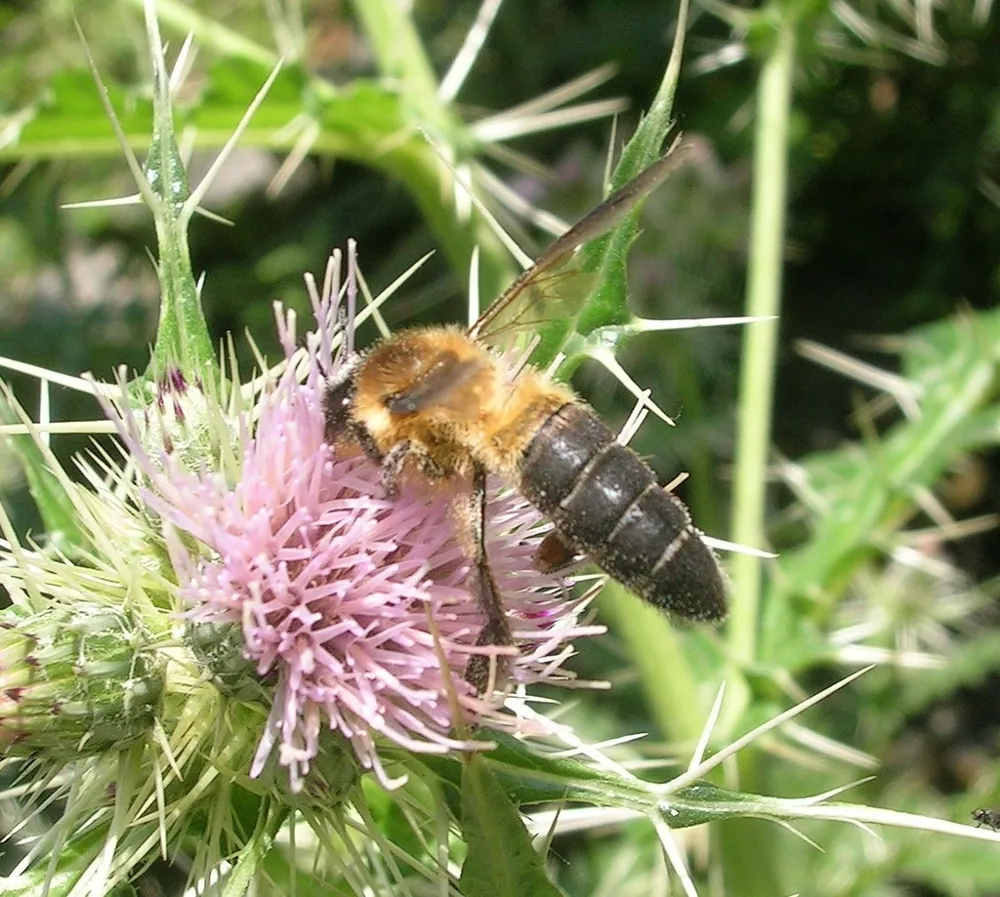
 Ni ngay ko xàmmee
- It is the largest honey bee in the world, with single adults measuring up to 3.0 cm long.1
- It has a darker abdomen (rear body section) than the giant honey bee, Apis dorsata.1
- It has longer hair on the thorax (middle body section) than Apis dorsata.1
- It builds very large nests on the underside of cliff overhangs at high altitude.1
Ñu ngi koy faral di jaxasoo ak: It is often confused with the giant honey bee, Apis dorsata, which it is very similar to in shape. The Himalayan giant honey bee has a darker abdomen, longer thoracic hair, and different nest-keeping and swarming behaviour.1
Kàttanu daŋar
Daŋar bi dafay génn ci ab dag buy jam.
Ni mu lore nit ñi?
Musiba ci nit: Lu bonJam laaj na doktoor. Ñi ciy dee dañoo néew lool. Su jamee
- Xuufal dagu yamb bi ba mu génn, te sedal fa mu jam.
- Su nit ki am jafe-jafe ci noyyi, kanamam walla putam funki, walla mu bëgg a xëm, allergie bu metti la (urgence): woo sa nimerob urgence te jëfandikoo stylo adrénaline bi mu am, su am.
Saa su nekk, woo jëkk sa nimerob urgence (112, 000, 911). Lii ay ndigal yu yaatu ci ndimbal yu jëkk la, du ndigalu doktoor. Li war a xam ci ndimbal yu jëkk
 Sàmmal sa bopp
- Bul laal mukk, bul jàpp, bul sonal ab rab bu àll, doonte bu ndaw la, te doonte dafa mel ni dafa nelaw walla dafa dee.
- May ko bérab. Su nga ko gisee, dalal, dellu ginnaaw ndànk-ndànk te bàyyi ko mu dem yoonam.
- Su benn jamee la: dalal, bul yëngu, woo sa nimerob urgence (112, 000, 911) walla dem lopitaan ci gaaw. Bul fàtte ni mu meloon, ab nataal dina dimbali.
Du la wut. Dafay jëfandikoo daŋaram ngir jàpp lu muy lekk walla ngir aar boppam, te nëbbu moo ko gën a neex. Yeneen ci ni ngay sàmme sa bopp
Ni mu réye?
Ni mu guddoo?
 guddu na lu tollu ci trombone
 mën na naaw ci benn terrain bu futbal bu mat ci 11 segond
Himalayan giant honey bee ni mu réye ci wetu YOW?
Ay waññ rekk ci sa navigateur. Dara du denc te dara du yónnee fenn.
Ni mu gaawe?


Xibaar
Red honey has an intoxicating effect, which is linked to grayanotoxin in nectar from white rhododendrons.1
The Gurung people of Nepal are known for using this mad honey for both medicinal and hallucinogenic purposes.1
A nest of this bee can hold as much as 60 kg of honey.1
Red honey made by this bee is valuable, and wholesale prices are about five times higher than regular honey from the western honey bee or the Asian honey bee.1
The yellow-rumped honeyguide, a small sparrow-like bird, feeds on beeswax and is often seen near colonies of this bee.1
Fa xibaar yi jóge
- Apis laboriosa (Wikipedia (CC BY-SA 4.0))
- Apis laboriosa (iNaturalist): tur ak ni ñu leen séddale.
- Venom Wiki: tolluwaayu musiba bi, réyaay bu yem bi ak xalaatu gaawaay bi, nun ñoo leen defar. Seetal ni nu leen waññe: Ni nuy natte musiba.
Xibaar bu nekk ci xët wii am na ab nimero buy won fa mu jóge. Su nu juumee, baal nu, nun ay nit ñu bëgg rab lanu, du ab jurnaalu xam-xam. Wax nu ko ci [email protected] te dinanu ko jubbanti.
 Jiit bi dafa xiif! Venom Wiki ab liggéeyu kenn la: amul pay, amul piblisite te amul traceur. Ab may bu tuuti dafay dimbali ngir mu des ci internet.Leel jiit bi
Yeneen ci mbooloo mi: Yamb, guêpe ak frelon
 Asian giant hornetYamb, guêpe ak frelonMën na rey
 Common waspYamb, guêpe ak frelonDafay metti rekk
 European hornetYamb, guêpe ak frelonDafay metti rekk
 Western honey beeYamb, guêpe ak frelonDafay metti rekk
 Giant honey beeYamb, guêpe ak frelonSoxla na doktoor
 Asian hornetYamb, guêpe ak frelonDafay metti rekk
 Deathstalker
 Indian cobra
 Indian saw-scaled viper
 King cobra
 Jaan wu ñuul wi (Bitis arietans)
 Jaan wu Russell