
 Afrig
Afrig Asi
Asi Tugal
Tugal Amerig gu Bëj-saalum
 Ostarali ak Oseyani
 Antarktig
 Mbàmbulaanu Pasifik
 Mbàmbulaanu Atlantig
 Mbàmbulaanu End
 Mbàmbulaanu Arktik
 Géeju Mediteraane
 Géej gu Xonq
 Géeju Karayib
 Géeju Koraay
 Géeju Siin gu Bëj-saalum
 Géeju Filipin
 Géeju Andaman
 Géeju Bëj-gànnaar
 Géeju Timor ak Arafura
 Golfu Bengal
 Golfu Kaliforni
Long-spine porcupinefish
 Am daŋar su ñu ko lekkeeDafay lekk: Tuuti ci léppAm daŋar ci yaram, du màtt walla jam
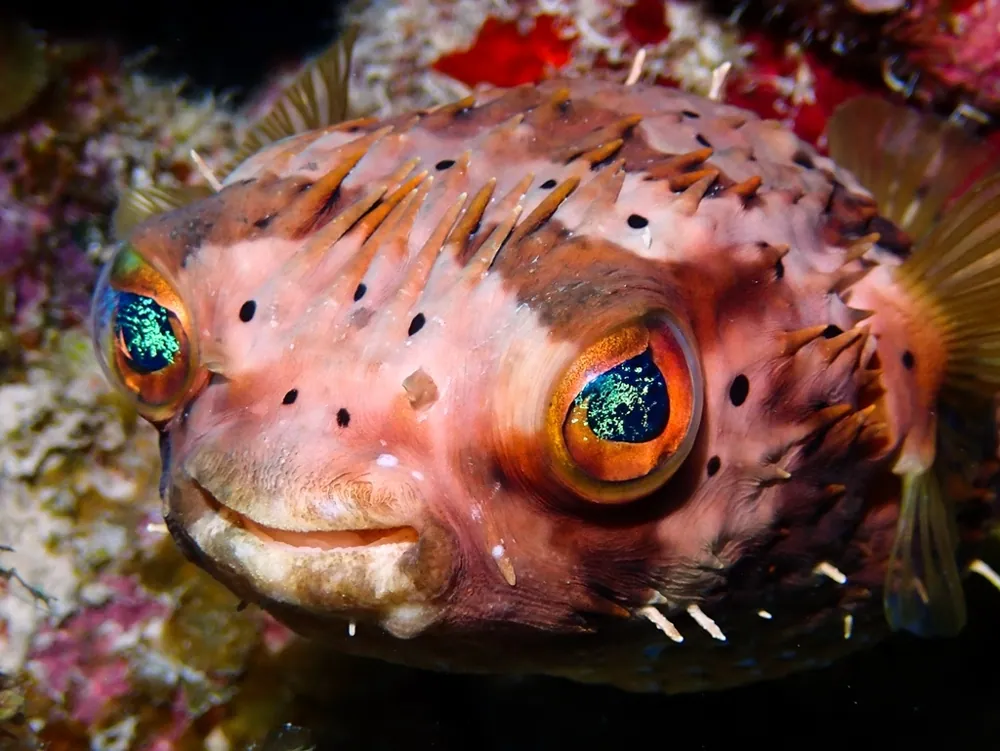
The long-spine porcupinefish is a marine fish covered in long, sharp spines. It lives in warm tropical and subtropical seas around the world, often over muddy seabeds or on reefs. Its beak-like jaws can crush hard prey such as sea urchins and shellfish.1



 Ni ngay ko xàmmee
- Pale in colour, with large black blotches and smaller black spots. The spots become fewer as the fish gets older.1
- Many long spines, each with two roots, which can be raised or lowered. They are especially numerous on the head.1
- The teeth of the two jaws are fused into a parrot-like beak.1
- Adults can reach 50 cm in length.1
Ñu ngi koy faral di jaxasoo ak: The black-blotched porcupinefish (Diodon liturosus) is the only other fish it might be confused with. The long-spine porcupinefish has much longer spines.1
Kàttanu daŋar
Lor na rekk su dara lekkee ko.
Ni mu lore nit ñi?
Musiba ci nit: Lu bonSu kenn lekkee ko, demal gis doktoor. Ñi ciy dee dañoo néew lool. Su kenn laalee ko walla mu lekk ko
- Su kenn lekkee ko walla mu am ay màndarga ginnaaw bi mu ko lekkee: woo sa nimerob urgence walla centre antipoison ci saa si.
Saa su nekk, woo jëkk sa nimerob urgence (112, 000, 911). Lii ay ndigal yu yaatu ci ndimbal yu jëkk la, du ndigalu doktoor. Li war a xam ci ndimbal yu jëkk
 Sàmmal sa bopp
- Bul laal mukk, bul jàpp, bul sonal ab rab bu àll, doonte bu ndaw la, te doonte dafa mel ni dafa nelaw walla dafa dee.
- May ko bérab. Su nga ko gisee, dalal, dellu ginnaaw ndànk-ndànk te bàyyi ko mu dem yoonam.
- Su nga ko laalee walla nga lekk ko: bul moos say bët walla sa gémmiñ, raxas say loxo te wutal ndimbal doktoor.
Du la wut. Daŋaram nekk na rekk ngir kenn bañ ko lekk. Yeneen ci ni ngay sàmme sa bopp
Fan ci àddina?
Ni mu réye?
Ni mu guddoo?
 guddu na ni 3 banaana yu ñu toftale
 guddu na ni 16 bloku tabax yu ñu toftale
 mën na féey guddaayu pisin bu réy (50 m) ci 45 segond
Long-spine porcupinefish ni mu réye ci wetu YOW?
Ay waññ rekk ci sa navigateur. Dara du denc te dara du yónnee fenn.
Ni mu gaawe?
Xibaar
Its jaws are fused into a beak that looks like a parrot's, and it uses it to crack open sea urchins and molluscs.1
Its spines have two roots and can be raised or lowered.1
The black spots on its pale body become fewer as it ages.1
Young fish are found in groups, and they stay in open water until they reach about 7 cm.1
Ngir boroom xam-xam ci daŋar
- Turu xam-xam
- Diodon holocanthus
- Mbooloo
- Yeneen rab yu am daŋar ci seen yaram
- Njaboot
- Diodontidae2
- Toftal
- Tetraodontiformes
- Kontinaa yi
- Mbàmbulaanu Pasifik, Mbàmbulaanu Atlantig, Mbàmbulaanu End, Géej gu Xonq, Géeju Karayib, Géeju Koraay, Géeju Filipin, Géeju Siin gu Bëj-saalum, Golfu Meksik, Géeju Timor ak Arafura, Golfu Bengal, Golfu Kaliforni, Mbàmbulaan yi
- Liir yi
- It spawns at the surface at dawn or dusk, in pairs or in groups of males with one female. The young stay pelagic (living in open water) until they are at least 7 cm long.1
- Musiba ci nit
- 3 / 5: Lu bon3
Fa xibaar yi jóge
- Long-spine porcupinefish (Wikipedia (CC BY-SA 4.0))
- Diodon holocanthus (iNaturalist): tur ak ni ñu leen séddale.
- Venom Wiki: tolluwaayu musiba bi, réyaay bu yem bi ak xalaatu gaawaay bi, nun ñoo leen defar. Seetal ni nu leen waññe: Ni nuy natte musiba.
Xibaar bu nekk ci xët wii am na ab nimero buy won fa mu jóge. Su nu juumee, baal nu, nun ay nit ñu bëgg rab lanu, du ab jurnaalu xam-xam. Wax nu ko ci [email protected] te dinanu ko jubbanti.
 Jiit bi dafa xiif! Venom Wiki ab liggéeyu kenn la: amul pay, amul piblisite te amul traceur. Ab may bu tuuti dafay dimbali ngir mu des ci internet.Leel jiit bi
Yeneen ci mbooloo mi: Yeneen rab yu am daŋar ci seen yaram
 Japanese pufferfishYeneen rab yu am daŋar ci seen yaramMën a rey
 Hawksbill sea turtleYeneen rab yu am daŋar ci seen yaramMën na rey
 Greenland sharkYeneen rab yu am daŋar ci seen yaramDafay metti rekk
 Silver-cheeked toadfishYeneen rab yu am daŋar ci seen yaramMën a rey
 Blackspotted pufferYeneen rab yu am daŋar ci seen yaramMën na rey
 White-spotted pufferYeneen rab yu am daŋar ci seen yaramMën na rey
Dafay dund itam ci: Mbàmbulaanu Pasifik
 Australian box jellyfishMéduse ak mbindeefi géej yuy jamMën a reyBul laal
 Geography coneCône ak pieuvreMën a rey
 Greater blue-ringed octopusCône ak pieuvreMën a rey
 Southern blue-ringed octopusCône ak pieuvreMën a rey
 Irukandji jellyfishMéduse ak mbindeefi géej yuy jamMën na reyBul laal
 Reef stonefishJën yu am daŋarMën na reyBul laal