
 Afrig
Afrig Asi
Asi Tugal
Tugal Amerig gu Bëj-saalum
 Ostarali ak Oseyani
 Antarktig
 Mbàmbulaanu Pasifik
 Mbàmbulaanu Atlantig
 Mbàmbulaanu End
 Mbàmbulaanu Arktik
 Géeju Mediteraane
 Géej gu Xonq
 Géeju Karayib
 Géeju Koraay
 Géeju Siin gu Bëj-saalum
 Géeju Filipin
 Géeju Andaman
 Géeju Bëj-gànnaar
 Géeju Timor ak Arafura
 Golfu Bengal
 Golfu Kaliforni
Pelagic stingray
 Dafay jam
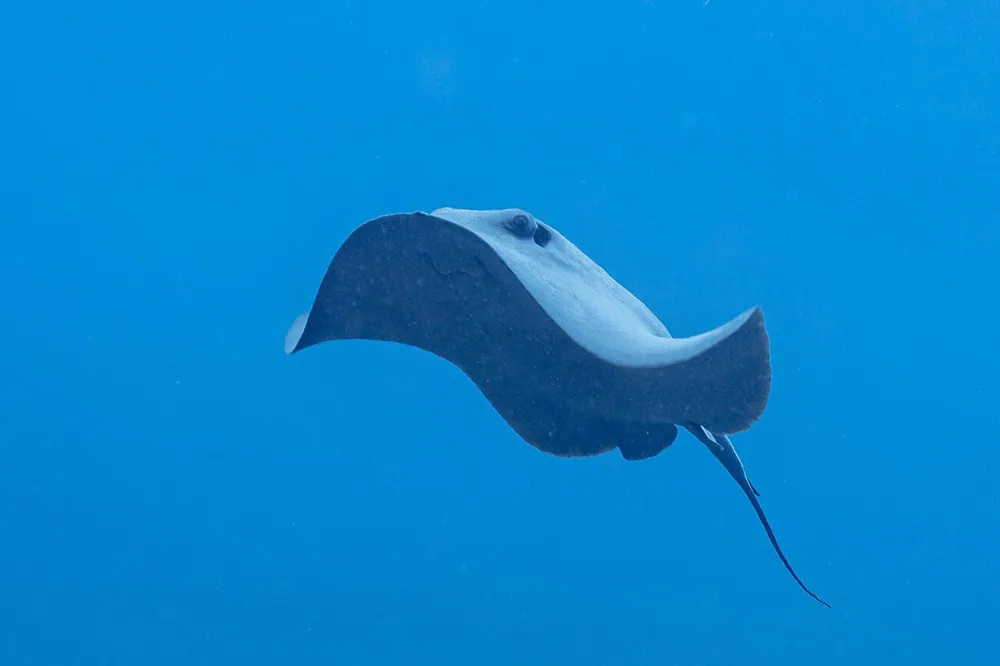
The pelagic stingray is a ray that lives in the open ocean rather than on the sea floor, which sets it apart from almost all other stingrays. It is found in warm waters around much of the world. It can give a severe sting with its tail spine, so it matters most to people who work on fishing boats.1



 Ni ngay ko xàmmee
- The pectoral fin disc is a thick, wedge-shaped wing that is about one-third wider than it is long.1
- It is a plain dark purple to blue-green above, with a slightly lighter shade below.1
- The tail is whip-like, up to twice as long as the disc, with an extremely long, serrated spine about a third to halfway along it.1
- Young rays are smooth-skinned, and small prickles and thorns appear with age.1
Kàttanu daŋar
Daŋar bi dafay génn ci ab dag buy jam.
Lan la daŋar biy sóob di def?
The venom is on the tail spine and is quite potent, which is why other fishes avoid it.1
Ni mu lore nit ñi?
Musiba ci nit: Lu bonJam laaj na doktoor. Ñi ciy dee dañoo néew lool.It is rarely encountered except by fishery workers. Its tail spine can inflict a severe wound that can be fatal.1
Lan lay def bu tiitee?
When captured and handled, it releases a thick black mucus that covers its body, and its tail spine delivers venom.1
 Su jamee
- Teg gaañu-gaañu bi ci ndox mu tàng, lu nit ki mën a muñ waaye bu dul ko lakk (seetal ko ak sa loxo), diir bu dale 30 ba 90 minit. Wutal ndimbal doktoor, rawatina ci jënu-doj ak raie.
Saa su nekk, woo jëkk sa nimerob urgence (112, 000, 911). Lii ay ndigal yu yaatu ci ndimbal yu jëkk la, du ndigalu doktoor. Li war a xam ci ndimbal yu jëkk
 Sàmmal sa bopp
- Bul laal mukk, bul jàpp, bul sonal ab rab bu àll, doonte bu ndaw la, te doonte dafa mel ni dafa nelaw walla dafa dee.
- May ko bérab. Su nga ko gisee, dalal, dellu ginnaaw ndànk-ndànk te bàyyi ko mu dem yoonam.
- Su benn jamee la: dalal, bul yëngu, woo sa nimerob urgence (112, 000, 911) walla dem lopitaan ci gaaw. Bul fàtte ni mu meloon, ab nataal dina dimbali.
Du la wut. Dafay jëfandikoo daŋaram ngir jàpp lu muy lekk walla ngir aar boppam, te nëbbu moo ko gën a neex. Yeneen ci ni ngay sàmme sa bopp
Fan ci àddina?
Ni mu réye?
Ni mu guddoo?
Ni mu diise?

 guddu na ni 2,5 muusu kër, bakkan ba geen
 guddu na ni 7 banaana yu ñu toftale
 mën na féey guddaayu pisin bu réy (50 m) ci 8,6 segond
Pelagic stingray ni mu réye ci wetu YOW?
Ay waññ rekk ci sa navigateur. Dara du denc te dara du yónnee fenn.
Ni mu gaawe?

,_Cabo_de_Palos,_Espa%C3%B1a,_2022-07-16,_DD_68.jpg)
Xibaar
It is the only stingray that almost exclusively lives in the open ocean rather than on the sea floor.1
Instead of rippling the edges of its disc like other stingrays, it swims by flapping its pectoral fins, similar to eagle rays.1
Both sexes have pointed teeth, which is unusual among stingrays. Only the teeth of adult males are longer and sharper.1
Females can store sperm inside their bodies for more than a year, waiting for good conditions before their young develop.1
A captive female reached 94 cm across and 49 kg, the largest individual on record from a rearing experiment.1
Oceanic whitetip sharks, great white sharks and toothed whales prey on it.1
Ngir boroom xam-xam ci daŋar
- Turu xam-xam
- Pteroplatytrygon violacea
- Mbooloo
- Jën yu am daŋar
- Njaboot
- Dasyatidae2
- Toftal
- Myliobatiformes
- Kontinaa yi
- Mbàmbulaanu Atlantig, Mbàmbulaanu Pasifik, Mbàmbulaanu End, Géeju Mediteraane, Géeju Karayib, Mbàmbulaan yi
- Liir yi
- It gives birth to live young. Females may bear two litters of 4 to 13 pups per year after a gestation of 2 to 4 months.1
- Ni mu nekke ci àll bi
- Least Concern1
- Musiba ci nit
- 3 / 5: Lu bon3
Fa xibaar yi jóge
- Pelagic stingray (Wikipedia (CC BY-SA 4.0))
- Pteroplatytrygon violacea (iNaturalist): tur ak ni ñu leen séddale.
- Venom Wiki: tolluwaayu musiba bi, réyaay bu yem bi ak xalaatu gaawaay bi, nun ñoo leen defar. Seetal ni nu leen waññe: Ni nuy natte musiba.
Xibaar bu nekk ci xët wii am na ab nimero buy won fa mu jóge. Su nu juumee, baal nu, nun ay nit ñu bëgg rab lanu, du ab jurnaalu xam-xam. Wax nu ko ci [email protected] te dinanu ko jubbanti.
 Jiit bi dafa xiif! Venom Wiki ab liggéeyu kenn la: amul pay, amul piblisite te amul traceur. Ab may bu tuuti dafay dimbali ngir mu des ci internet.Leel jiit bi
Yeneen ci mbooloo mi: Jën yu am daŋar
 Reef stonefishJën yu am daŋarMën na reyBul laal
 Red lionfishJën yu am daŋarSoxla na doktoorBul laal
 Estuarine stonefishJën yu am daŋarMën na reyBul laal
 Short-tail stingrayJën yu am daŋarMën na rey
 Striped eel catfishJën yu am daŋarMën na reyBul laal
 Bluespotted ribbontail rayJën yu am daŋarSoxla na doktoor
Dafay dund itam ci: Mbàmbulaanu Atlantig
 Hawksbill sea turtleYeneen rab yu am daŋar ci seen yaramMën na rey
 Portuguese man o' warMéduse ak mbindeefi géej yuy jamSoxla na doktoorBul laal
 Blue sea dragonCône ak pieuvreDafay metti rekk
 Greenland sharkYeneen rab yu am daŋar ci seen yaramDafay metti rekk
 Lion's mane jellyfishMéduse ak mbindeefi géej yuy jamDafay metti rekkBul laal
 Common octopusCône ak pieuvreAmul lor