
 Afrig
Afrig Asi
Asi Tugal
Tugal Amerig gu Bëj-saalum
 Ostarali ak Oseyani
 Antarktig
 Mbàmbulaanu Pasifik
 Mbàmbulaanu Atlantig
 Mbàmbulaanu End
 Mbàmbulaanu Arktik
 Géeju Mediteraane
 Géej gu Xonq
 Géeju Karayib
 Géeju Koraay
 Géeju Siin gu Bëj-saalum
 Géeju Filipin
 Géeju Andaman
 Géeju Bëj-gànnaar
 Géeju Timor ak Arafura
 Golfu Bengal
 Golfu Kaliforni
Port Jackson shark
 Dag yu am daŋar
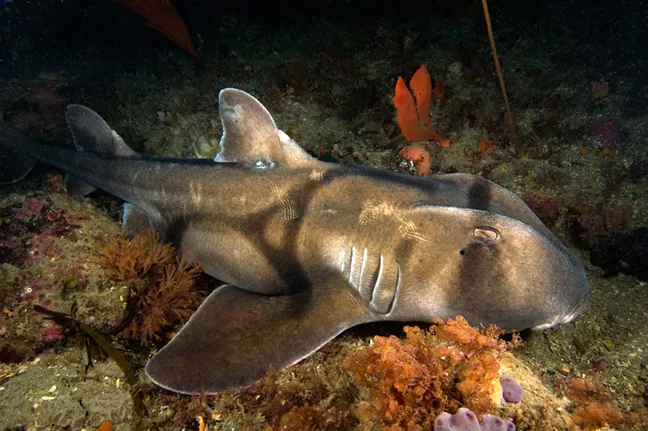
The Port Jackson shark is a bottom-dwelling shark that lives in the cool coastal waters of southern Australia. It is active mostly at night, when it hunts shellfish, sea urchins and fish. It is harmless to people, though its spines have a reputation that is not confirmed.1



 Ni ngay ko xàmmee
- Grey-brown body with dark brown, harness-like bands, including one that runs across the eyes.1
- Large, blunt, flat head with raised ridges above the eyes.1
- A spine at the front edge of each of its two dorsal fins, which are nearly equal in size.1
- Front teeth are small and pointed, while back teeth are flat and blunt.1
- Adults can grow up to 1.65 metres long.1
Kàttanu daŋar
Ay dag yu ñaw ñoo yor daŋar bi. Teg tànk ci kawam walla jàpp ko dafay metti.
Ni mu lore nit ñi?
Musiba ci nit: WoyofNi jamu yamb walla lu ko yées. Lu jege, amul lor ci nit.The shark poses no danger to humans. In October 2011, a man was bitten at Elwood Beach near Melbourne, but the bite did not pierce the skin and he was able to swim away while the shark was still attached to his calf.1
 Su ay dagam jamee la
- Teg gaañu-gaañu bi ci ndox mu tàng, lu nit ki mën a muñ waaye bu dul ko lakk (seetal ko ak sa loxo), diir bu dale 30 ba 90 minit. Wutal ndimbal doktoor, rawatina ci jënu-doj ak raie.
Saa su nekk, woo jëkk sa nimerob urgence (112, 000, 911). Lii ay ndigal yu yaatu ci ndimbal yu jëkk la, du ndigalu doktoor. Li war a xam ci ndimbal yu jëkk
 Sàmmal sa bopp
- Bul laal mukk, bul jàpp, bul sonal ab rab bu àll, doonte bu ndaw la, te doonte dafa mel ni dafa nelaw walla dafa dee.
- May ko bérab. Su nga ko gisee, dalal, dellu ginnaaw ndànk-ndànk te bàyyi ko mu dem yoonam.
- Su ay dagam jamee la: dalal, bul yëngu, woo sa nimerob urgence (112, 000, 911) walla dem lopitaan ci gaaw. Bul fàtte ni mu meloon, ab nataal dina dimbali.
Du la wut. Dafay jëfandikoo daŋaram ngir jàpp lu muy lekk walla ngir aar boppam, te nëbbu moo ko gën a neex. Yeneen ci ni ngay sàmme sa bopp
Fan ci àddina?
Ni mu réye?
Ni mu guddoo?
 guddu na ni 3 muusu kër, bakkan ba geen
 guddu na ni 9 banaana yu ñu toftale
 mën na féey guddaayu pisin bu réy (50 m) ci 8,2 segond
Port Jackson shark ni mu réye ci wetu YOW?
Ay waññ rekk ci sa navigateur. Dara du denc te dara du yónnee fenn.
Ni mu gaawe?


Xibaar
It can turn its stomach inside out and spit out unwanted contents.1
It can breathe while lying still on the bottom. It pumps water in through its first gill slit and out through the others, so it does not need to swim with its mouth open.1
Juveniles have individual personalities. Some are bolder than others when exploring new places, and they respond differently to stress.1
Juveniles can learn to link bubbles, lights or sounds with food, and they can learn by watching other sharks.1
Adults are often seen resting together in caves, but juveniles do not seem to be social.1
Each year it migrates south in summer and returns north to breed in winter.1
Tasukatu léeb
Xalaat bu juum: Port Jackson sharks are dangerous to people.
Dëgg: The shark poses no danger to humans. Its spines are rumoured to be venomous, but this has not been confirmed.1
Ngir boroom xam-xam ci daŋar
- Turu xam-xam
- Heterodontus portusjacksoni
- Mbooloo
- Jën yu am daŋar
- Njaboot
- Heterodontidae2
- Toftal
- Heterodontiformes
- Kontinaa yi
- Mbàmbulaanu End, Mbàmbulaanu Bëj-saalum, Antarktig, Mbàmbulaan yi
- Liir yi
- It lays eggs rather than giving birth to live young. From late August to mid-November, the female lays pairs of eggs every 8 to 17 days, up to eight pairs in total, and the eggs take 10 to 11 months to hatch.1
- Ni mu nekke ci àll bi
- Least Concern (IUCN Red List)1
- Musiba ci nit
- 1 / 5: Woyof3
Fa xibaar yi jóge
- Port Jackson shark (Wikipedia (CC BY-SA 4.0))
- Heterodontus portusjacksoni (iNaturalist): tur ak ni ñu leen séddale.
- Venom Wiki: tolluwaayu musiba bi, réyaay bu yem bi ak xalaatu gaawaay bi, nun ñoo leen defar. Seetal ni nu leen waññe: Ni nuy natte musiba.
Xibaar bu nekk ci xët wii am na ab nimero buy won fa mu jóge. Su nu juumee, baal nu, nun ay nit ñu bëgg rab lanu, du ab jurnaalu xam-xam. Wax nu ko ci [email protected] te dinanu ko jubbanti.
 Jiit bi dafa xiif! Venom Wiki ab liggéeyu kenn la: amul pay, amul piblisite te amul traceur. Ab may bu tuuti dafay dimbali ngir mu des ci internet.Leel jiit bi
Yeneen ci mbooloo mi: Jën yu am daŋar
 Reef stonefishJën yu am daŋarMën na reyBul laal
 Red lionfishJën yu am daŋarSoxla na doktoorBul laal
 Estuarine stonefishJën yu am daŋarMën na reyBul laal
 Short-tail stingrayJën yu am daŋarMën na rey
 Striped eel catfishJën yu am daŋarMën na reyBul laal
 Bluespotted ribbontail rayJën yu am daŋarSoxla na doktoor
Dafay dund itam ci: Mbàmbulaanu End
 Australian box jellyfishMéduse ak mbindeefi géej yuy jamMën a reyBul laal
 Geography coneCône ak pieuvreMën a rey
 Greater blue-ringed octopusCône ak pieuvreMën a rey
 Southern blue-ringed octopusCône ak pieuvreMën a rey
 Hawksbill sea turtleYeneen rab yu am daŋar ci seen yaramMën na rey
 Irukandji jellyfishMéduse ak mbindeefi géej yuy jamMën na reyBul laal