
 IAfrika
 IAsiya
 IYurophu
 uMzantsi Melika
 IOstreliya neOceania
 IAntarctica
 uLwandlekazi lwePasifiki
 uLwandlekazi lweAtlantiki
 uLwandlekazi lwaseIndiya
 uLwandlekazi lweArctic
 uLwandle lweMeditera
 uLwandle oluBomvu
 uLwandle lweKharibhiya
 uLwandle lweCoral
 uLwandle lwaseMzantsi China
 uLwandle lwePhilippines
 uLwandle lweAndaman
 uLwandle lwaseMntla (North Sea)
 uLwandle lweTimor ne-Arafura
 iBhayi yaseBengal
 iGulf yaseCalifornia
Crown-of-thorns starfish
 Amava anetyhefu
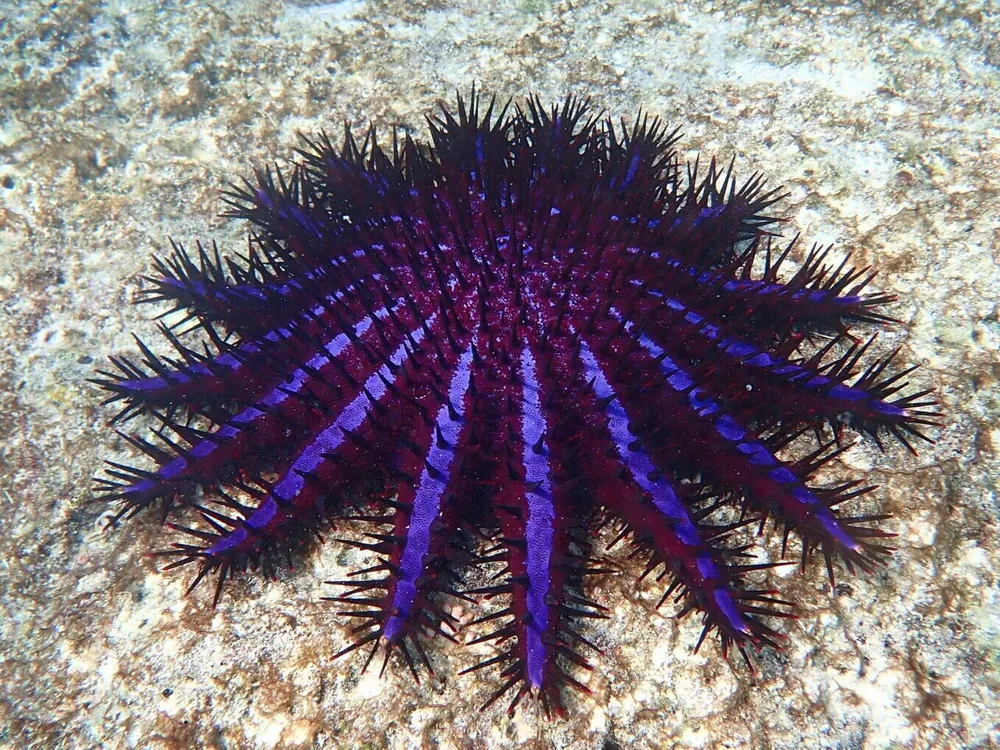
The crown-of-thorns starfish is a large starfish with long, sharp spines that look like a crown of thorns. It lives on coral reefs across the Indo-Pacific, from the Red Sea to the west coast of Central America, and it is most common around Australia. It feeds on hard coral, so it can change the reefs it lives on.1

 Indlela yokusiqaphela
- Adults are normally 25 to 35 cm across.1
- Up to 21 arms, with long, stiff, very sharp spines that are 4 to 5 cm long on the top and sides of the arms.1
- Colour varies with diet or region: purple, purple-blue, reddish grey or brown with red spine tips, or green with yellow spine tips.1
- The body is flexible and can bend and twist around coral surfaces.1
Sidla ngokubhidaniswa no: A close relative, Acanthaster brevispinus, lives on soft sea floors at moderate depths rather than on coral reefs. The two are considered sibling species.1
Amandla etyhefu yokuluma nokuhlaba
Amava abukhali aphethe ityhefu. Ukusinyathela okanye ukusibamba kubuhlungu.
Ityhefu yaso yokuluma okanye yokuhlaba yenza ntoni?
The spines do not inject venom. When they pierce skin, tissue containing saponins (detergent-like chemicals) is left in the wound. In humans this causes a sharp, stinging pain that can last several hours, persistent bleeding, and nausea and swelling that may last a week or more.1
Siyingozi kangakanani ebantwini?
Ingozi ebantwini: Kubi kakhuluUkuba amava aso ayakugwaza, yiya kugqirha. Ukufa kunqabe kakhulu.The spines can cause sharp pain, long-lasting bleeding, nausea and swelling. Brittle spines can break off and stay in the tissue.1
 Ukuba amava aso ayakugwaza
- Spines that become embedded in the tissue must be removed surgically.1
- Faka inxeba emanzini ashushu, ashushu kangangoko umntu angakwazi ukunyamezela ngaphandle kokutshiswa, kwaye ufumane uncedo lwezonyango ukuze kususwe amava. Musa ukuwemba ngokwakho.
Soloko utsalela inombolo kaxakeka kuqala (112, 000, 911). Esi sisikhokelo soncedo lokuqala ngokubanzi, asilocebiso lwezonyango. Iziseko zoncedo lokuqala
 Hlala ukhuselekile
- Ungaze uchukumise, ubambe okanye uqhule isilwanyana sasendle, nokuba sincinci, kwaye nokuba sibonakala silele okanye sifile.
- Sinike indawo. Ukuba udibana naso, hlala uzolile, buyela umva kancinci kwaye usiyeke sihambe ngendlela yaso.
- Ukuba amava aso ayakugwaza: hlala uzolile, musa ukushukuma, tsalela inombolo kaxakeka (112, 000, 911) okanye uye esibhedlele ngokukhawuleza. Khumbula ukuba sasikhangeleka njani, ifoto iyanceda.
Asikuzingeli. Sisebenzisa ityhefu yaso ukubamba ukutya okanye ukuzikhusela, kwaye singakhetha ukuzimela. Okungakumbi malunga nokuhlala ukhuselekile
Phi emhlabeni?
Sikhulu kangakanani?
Side kangakanani?
 ubude obulingana neebhloko zokudlala zokwakha eziyi-11 zilandelelana
 sicotha kunenkumba yasegadini
U-Crown-of-thorns starfish mkhulu kangakanani xa uthelekisa NAWE?
Zizibalo nje kwibhrawuza yakho. Akukho nto igcinwayo okanye ithunyelwa naphi na.
Sikhawuleza kangakanani?

.jpg)
Iinyaniso
An individual starfish can consume up to 6 square metres of living coral reef per year.1
When taken out of water, its soft body ruptures and collapses, but its spines can recover their shape if it is put back in the water while still alive.1
Its body contains detergent-like saponins, so keeping starfish in small volumes of water with aeration produces large amounts of foam.1
It is one of the largest starfish in the world.1
It has lost the usual five-fold symmetry of starfish as it grew more arms, although it begins life with five-fold symmetry.1
Umqhekezi weentsomi
Intsomi: Its spines inject venom like a snake or stinging animal.
Inyaniso: It has no mechanism for injecting toxin. Its spines pierce skin and leave saponin-containing tissue in the wound.1
Kwiingcali zetyhefu
- Igama lenzululwazi
- Acanthaster planci
- Iqela
- Ii-sea urchin, iinkwenkwezi zolwandle neentshulube
- Usapho
- Acanthasteridae2
- Ucwangco
- Valvatida
- Amazwekazi
- uLwandlekazi lwaseIndiya, uLwandlekazi lwePasifiki, uLwandle oluBomvu, uLwandle lweCoral, uLwandle lwePhilippines, uLwandle lwaseMzantsi China, uLwandle lweAndaman, uLwandle lwaseArabhiya neGulf yasePersi, uLwandle lweTimor ne-Arafura, iBhayi yaseBengal, Iilwandlekazi
- Iintsana
- It releases vast amounts of eggs and sperm (gametes) during mass spawning events in summer, and the eggs contain saponins similar to those in adults.1
- Ingozi ebantwini
- 3 / 5: Kubi kakhulu3
Apho iinyaniso zivela khona
- Crown-of-thorns starfish (Wikipedia (CC BY-SA 4.0))
- Acanthaster planci (iNaturalist): amagama nokuhlelwa.
- Venom Wiki: inqanaba lengozi, ubungakanani obuqhelekileyo noqikelelo lwesantya zezethu. Bona indlela esizifumana ngayo: Indlela esilinganisa ngayo ingozi.
Inyaniso nganye kweli phepha inenombolo ebonisa umthombo wayo. Ukuba senze impazamo, uxolo, sithanda izilwanyana, asiyomagazini yenzululwazi. Sixelele ku-[email protected] kwaye siza kuyilungisa.
 Unomadudwane ulambile! I-Venom Wiki yiprojekthi yomntu omnye: isimahla, ayinazibhengezo kwaye ayinazilandeli. Isipho esincinci sinceda ukuyigcina ikwi-intanethi.Yondla unomadudwane
Okungakumbi kwiqela elinye: Ii-sea urchin, iinkwenkwezi zolwandle neentshulube
 Flower urchinIi-sea urchin, iinkwenkwezi zolwandle neentshulubeSinokubulala
 Fire urchinIi-sea urchin, iinkwenkwezi zolwandle neentshulubeKufuna ugqirhaMusa ukuchukumisa
 Bearded firewormIi-sea urchin, iinkwenkwezi zolwandle neentshulubeKubuhlungu njeMusa ukuchukumisa
 Black long-spined urchinIi-sea urchin, iinkwenkwezi zolwandle neentshulubeKubuhlungu njeMusa ukuchukumisa
 BloodwormIi-sea urchin, iinkwenkwezi zolwandle neentshulubeKubuhlungu nje
 Bobbit wormIi-sea urchin, iinkwenkwezi zolwandle neentshulubeKubuhlungu nje
Sikwahlala: uLwandlekazi lwaseIndiya
 Australian box jellyfishIijelifishi nezinye izilwanyana zaselwandle ezihlabayoSiyabulalaMusa ukuchukumisa
 Geography coneIinkumba ze-cone neengwaneSiyabulala
 Greater blue-ringed octopusIinkumba ze-cone neengwaneSiyabulala
 Southern blue-ringed octopusIinkumba ze-cone neengwaneSiyabulala
 Hawksbill sea turtleEzinye izilwanyana ezityhefayoSinokubulala
 Irukandji jellyfishIijelifishi nezinye izilwanyana zaselwandle ezihlabayoSinokubulalaMusa ukuchukumisa