
 IAfrika
 IAsiya
 IYurophu
 uMzantsi Melika
 IOstreliya neOceania
 IAntarctica
 uLwandlekazi lwePasifiki
 uLwandlekazi lweAtlantiki
 uLwandlekazi lwaseIndiya
 uLwandlekazi lweArctic
 uLwandle lweMeditera
 uLwandle oluBomvu
 uLwandle lweKharibhiya
 uLwandle lweCoral
 uLwandle lwaseMzantsi China
 uLwandle lwePhilippines
 uLwandle lweAndaman
 uLwandle lwaseMntla (North Sea)
 uLwandle lweTimor ne-Arafura
 iBhayi yaseBengal
 iGulf yaseCalifornia
Green-head ant
 Ukuhlaba
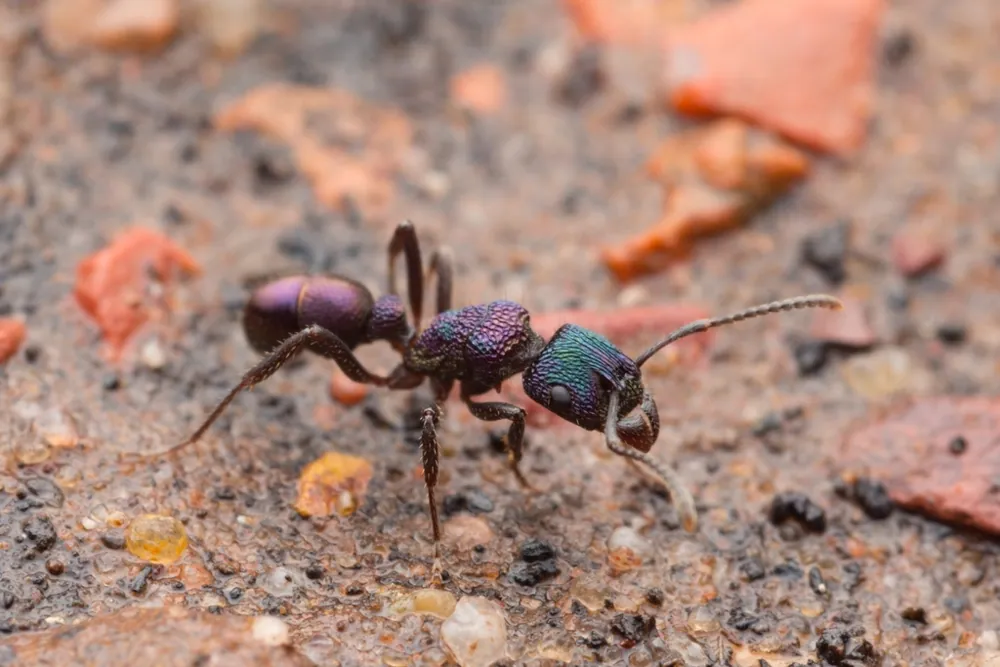
The green-head ant is a small, shiny ant that lives in Australia. It has a metallic colour that can look green, purple or reddish-violet. It is one of the most widespread insects in Australia, and it can give a painful, venomous sting.1


 Indlela yokusiqaphela
- Measures 5 to 7 mm long.1
- Metallic colour that varies by region, from green to purple or reddish-violet.1
- Hard, heavily armoured body with a single-segmented waist.1
- Queens and workers look similar and differ mainly in size. Males are the smallest and look black and dark.1
Sidla ngokubhidaniswa no: Residents of northern Queensland use the name 'green ant' for the green-tree ant (Oecophylla smaragdina), so the two can be confused by name. The name 'green-head ant' is more specific.1
Amandla etyhefu yokuluma nokuhlaba
Ityhefu iphuma ngenaliti yokuhlaba.
Ityhefu yaso yokuluma okanye yokuhlaba yenza ntoni?
The sting is painful and venomous. It can cause anaphylactic shock, a severe allergic reaction, in people who are sensitive to it.1
Siyingozi kangakanani ebantwini?
Ingozi ebantwini: KubuhlunguKunokuba buhlungu ngokwenene, kodwa phantse akusoze kube kubi kakhulu.The sting can cause anaphylactic shock in sensitive people. Ordinary stings are described as painful.1
 Ukuba siyahlaba
- Hlamba uze upholise iindawo ezihlatyiweyo.
- Ukuba umntu uphefumla kanzima, ubuso okanye umqala wakhe uyadumba, okanye uziva ngathi uza kufa isiqaqa, yimeko kaxakeka ye-aleji: tsalela inombolo kaxakeka.
Soloko utsalela inombolo kaxakeka kuqala (112, 000, 911). Esi sisikhokelo soncedo lokuqala ngokubanzi, asilocebiso lwezonyango. Iziseko zoncedo lokuqala
 Hlala ukhuselekile
- Ungaze uchukumise, ubambe okanye uqhule isilwanyana sasendle, nokuba sincinci, kwaye nokuba sibonakala silele okanye sifile.
- Sinike indawo. Ukuba udibana naso, hlala uzolile, buyela umva kancinci kwaye usiyeke sihambe ngendlela yaso.
- Ukuba siyakuhlaba: hlala uzolile, musa ukushukuma, tsalela inombolo kaxakeka (112, 000, 911) okanye uye esibhedlele ngokukhawuleza. Khumbula ukuba sasikhangeleka njani, ifoto iyanceda.
Asikuzingeli. Sisebenzisa ityhefu yaso ukubamba ukutya okanye ukuzikhusela, kwaye singakhetha ukuzimela. Okungakumbi malunga nokuhlala ukhuselekile
Sikhulu kangakanani?
Side kangakanani?
 sincinci kangangokuba singahlala eluzipheni lwakho
U-Green-head ant mkhulu kangakanani xa uthelekisa NAWE?
Zizibalo nje kwibhrawuza yakho. Akukho nto igcinwayo okanye ithunyelwa naphi na.
Sikhawuleza kangakanani?


Iinyaniso
Green-head ants are among the first insects to appear in burnt-off areas, arriving once the embers have stopped smouldering.1
Workers can reproduce with winged males, so queens are rarely produced in colonies.1
They are useful to farmers because they prey on agricultural pests such as beetles, moths and termites.1
They help plants by scattering and eating seeds from a variety of species, which plays an important role in seed dispersal.1
The short-beaked echidna and a number of bird species prey on them.1
The ant was introduced to New Zealand, where it was first seen in 1959, probably on cargoes of timber.1
Umqhekezi weentsomi
Intsomi: The name 'green ant' always means the green-head ant.
Inyaniso: In northern Queensland, residents use the name 'green ant' for the green-tree ant, so the shortened name can cause confusion.1
Apho iinyaniso zivela khona
- Green-head ant (Wikipedia (CC BY-SA 4.0))
- Rhytidoponera metallica (iNaturalist): amagama nokuhlelwa.
- Venom Wiki: inqanaba lengozi, ubungakanani obuqhelekileyo noqikelelo lwesantya zezethu. Bona indlela esizifumana ngayo: Indlela esilinganisa ngayo ingozi.
Inyaniso nganye kweli phepha inenombolo ebonisa umthombo wayo. Ukuba senze impazamo, uxolo, sithanda izilwanyana, asiyomagazini yenzululwazi. Sixelele ku-[email protected] kwaye siza kuyilungisa.
 Unomadudwane ulambile! I-Venom Wiki yiprojekthi yomntu omnye: isimahla, ayinazibhengezo kwaye ayinazilandeli. Isipho esincinci sinceda ukuyigcina ikwi-intanethi.Yondla unomadudwane
Okungakumbi kwiqela elinye: Iimbovane
 Bulldog ant
 Jack jumper ant
 Green weaver ant
 Black-banded jumper ant
 Giant bull ant
 Inchman ant
Sikwahlala: IOstreliya neOceania
 Coastal taipanIinyoka zaseOstreliyaSiyabulala
 Common death adderIinyoka zaseOstreliyaSiyabulala
 Eastern brown snakeIinyoka zaseOstreliyaSiyabulala
 Inyoka ityhefu yaseOstreliya (Inland taipan)Iinyoka zaseOstreliyaSiyabulala
 Sydney funnel-web spiderIi-tarantula nee-funnel-webSiyabulala
 Inyoka yengweIinyoka zaseOstreliyaSiyabulala