
 Áfíríkà
 Éṣíà
Éṣíà Yúróòpù
 Gúúsù Amẹ́ríkà
 Ọsirélíà àti Òṣéáníà
 Antáktíkà
 Òkun Pàsífíìkì
 Òkun Àtìláńtíìkì
 Òkun Íńdíà
 Òkun Áktíkì
 Òkun Mẹditaréníà
 Òkun Pupa
 Òkun Káríbíànù
 Òkun Coral
 Òkun Gúúsù Ṣáínà
 Òkun Fílípínì
 Òkun Andaman
 Òkun Àríwá
 Òkun Tímọ̀ àti Òkun Àráfúrà
 Ìyawọlẹ̀ Òkun Bẹ̀ngál
 Ìyawọlẹ̀ Òkun Kalifọ́níà
King cobra
 Ìbùjẹ
ÌbùjẹThe king cobra is a large venomous snake of tropical Asia. It is the world's longest venomous snake, and it mostly eats other snakes. It is widely spread across its range, but people do not often see it.1



 Bí o ṣe lè dá a mọ̀
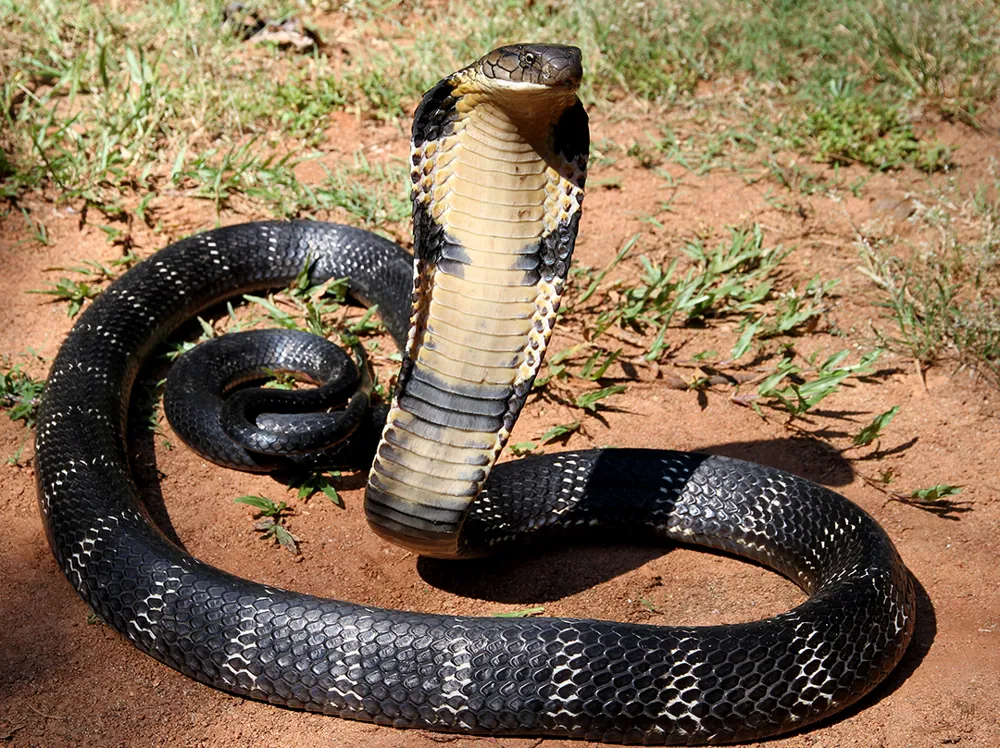
- Adults are olive green with black and white bands across the trunk that run towards the head.1
- The head has 15 drab-coloured shields that are edged in black.1
- The hood is oval, with two black spots between the two lowest scales.1
- Juveniles are black with chevron-shaped white, yellow or buff bars that point towards the head.1
- The tail is yellowish green and marked with black.1
A sábà máa ń ṣì í mọ̀ sí: Despite its common name and some resemblance, it is not a true cobra: it belongs to its own genus.1
Agbára oró
Oró ń jáde láti inú eyín oró tàbí eyín rẹ̀ nígbà tí ó bá bùjẹ.
Kí ni oró rẹ̀ máa ń ṣe?
The venom is neurotoxic, which means it attacks the nerves, and cytotoxic, which means it damages cells. Symptoms can start rapidly after a bite. The cobra can strike at a considerable range and height, and it has an immense venom yield.1
Báwo ló ṣe léwu tó fún ènìyàn?
Ewu fún ènìyàn: ApaniỌ̀kan lára àwọn ẹranko tó léwu jùlọ ní ayé.The king cobra is not considered aggressive and usually avoids humans. Attacks usually happen when an individual is cornered or accidentally exposes itself, or when people come close by chance.1
 Ìròyìn ayọ̀: àwọn dókítà ní oògùn (antivenom) tàbí ìtọ́jú fún èyí.1
Kí ni ó máa ń ṣe nígbà tí ẹ̀rù bá bà á?
When threatened, it spreads its neck flap, raises its head, hisses or growls loudly, and sometimes charges.1
 Bí ó bá bùjẹ
- After a bite, prompt antivenom is needed, so get to medical care as fast as possible.1
- Jẹ́ kí ẹni náà wà láìmira kí ó sì farabalẹ̀, yọ òrùka àti àwọn nǹkan tó há, kí ẹ sì lọ sí ilé ìwòsàn kíákíá: oògùn apa-oró (antivenom) ni ìtọ́jú rẹ̀.
Máa kọ́kọ́ pe nọ́ńbà pàjáwìrì rẹ nígbà gbogbo (112, 000, 911). Èyí jẹ́ ìtọ́sọ́nà ìtọ́jú àkọ́kọ́ gbogbogbò, kì í ṣe ìmọ̀ràn ìṣègùn. Ìpìlẹ̀ ìtọ́jú àkọ́kọ́
 Wà láìléwu
- Má ṣe fọwọ́ kan, mú tàbí yọ ẹranko igbó lẹ́nu láéláé, kódà bí ó bá kéré, kódà bí ó bá dà bí ẹni pé ó ń sùn tàbí ó ti kú.
- Fún un ní àyè. Bí o bá pàdé ọ̀kan, farabalẹ̀, sẹ́yìn díẹ̀díẹ̀ kí o sì jẹ́ kí ó máa bá ọ̀nà rẹ̀ lọ.
- Bí ọ̀kan bá bù ọ́ jẹ: farabalẹ̀, má ṣe mira, pe nọ́ńbà pàjáwìrì rẹ (112, 000, 911) tàbí lọ sí ilé ìwòsàn kíákíá. Rántí bí ó ṣe rí, fọ́tò máa ń ṣèrànwọ́.
Kò wá ọ kiri láti ṣe ọ́ léṣe. Ó ń lo oró rẹ̀ láti mú oúnjẹ tàbí láti dáàbò bo ara rẹ̀, ó sì fẹ́ràn láti farapamọ́ jù. Sí i nípa wíwà láìléwu
Báwo ló ṣe tóbi tó?
Báwo ló ṣe gùn tó?
Báwo ló ṣe wúwo tó?

 ó gùn tó ajá 6 láti imú dé ìrù
 ó gùn tó ọ̀gẹ̀dẹ̀ 32 tí a tò tẹ̀léra
 lè sáré mítà 100 ní ìṣẹ́jú-àáyá 36 (ènìyàn tó yára jùlọ nílò 9.6)
Báwo ni King cobra ṣe tóbi tó tí a bá fi wé ÌWỌ?
Ìṣirò nìkan nínú bráwúsà rẹ. A kò fi ohunkóhun pamọ́, a kò sì fi ránṣẹ́ sí ibikíbi.
Báwo ló ṣe yára tó?


Òtítọ́
Its growl is much lower than most snakes' hisses, with a dominant frequency near 600 Hz, which is closer to a human voice.1
It is dominant over all other snakes except large pythons.1
It can swallow prey much larger than its head because of its flexible jaws.1
It can go many months without another meal after a large meal because its metabolism is slow.1
It is considered the national reptile of India and has an important place in the mythology and folk traditions of India, Bangladesh, Sri Lanka and Myanmar.1
Its common name 'hamadryad' is still used in older books.1
Olùfọ́ àròsọ
Àròsọ: King cobras are aggressive and attack people on sight.
Òtítọ́: The king cobra is not considered aggressive and usually avoids humans. It defends its eggs fiercely and may strike if it is cornered or accidentally exposed.1
Fún àwọn amòye oró
- Orúkọ sáyẹ́ǹsì
- Ophiophagus hannah
- Ẹgbẹ́
- Ṣèbé, mamba àti krait
- Ìdílé
- Elapidae2
- Ètò
- Squamata
- Àwọn kọ́ńtínẹ́ńtì
- Éṣíà
- Àwọn ọmọ
- It lays eggs. The female builds a nest of dry leaf litter and guards the eggs through the incubation period.1
- Bí ó ṣe ń ṣe nínú igbó
- Vulnerable (IUCN Red List, since 2010)1
- Ewu fún ènìyàn
- 5 / 5: Apani3
Ibi tí àwọn òtítọ́ ti wá
- King cobra (Wikipedia (CC BY-SA 4.0))
- Ophiophagus hannah (iNaturalist): orúkọ àti ìpínsísọ̀rí.
- Venom Wiki: ìpele ewu, ìtóbi déédé àti àfojúbù ìyára jẹ́ tiwa. Wo bí a ṣe ń ṣírò wọn: Bí a ṣe ń díwọ̀n ewu.
Gbogbo òtítọ́ ojú-ìwé yìí ní nọ́ńbà tó tọ́ka sí orísun rẹ̀. Bí a bá ṣe àṣìṣe, má bínú, olólùfẹ́ ẹranko ni wá, kì í ṣe ìwé ìròyìn sáyẹ́ǹsì. Sọ fún wa ní [email protected] a ó sì tún un ṣe.
 Ebi ń pa àkekèé! Iṣẹ́ akanṣe ẹnì kan ṣoṣo ni Venom Wiki: ọ̀fẹ́ ni, kò sí ìpolówó, kò sì sí olùtọpinpin. Ẹ̀bùn kékeré ń ràn án lọ́wọ́ láti wà lórí íńtánẹ́ẹ̀tì.Bọ́ àkekèé
 Indian cobra
 Caspian cobra
 Common krait
 Malayan krait
 Many-banded krait
 Monocled cobra
 Deathstalker
 Indian saw-scaled viper
 Puff adder
 Paramọlẹ Russell
 Asian giant hornet
 Komodo dragon