
 I-Afrika
 I-Asia
 I-Yurophu
 INingizimu Melika
 I-Australia ne-Oceania
 I-Antarctica
 ULwandlekazi iPacific
 ULwandlekazi i-Atlantic
 ULwandlekazi i-India
 ULwandlekazi i-Arctic
 Ulwandle iMediterranean
 Ulwandle Olubomvu
 Ulwandle iCaribbean
 Ulwandle iCoral
 Ulwandle lwaseNingizimu China
 Ulwandle lwasePhilippines
 Ulwandle i-Andaman
 Ulwandle i-North Sea
 Ulwandle lwaseTimor ne-Arafura
 Ichweba laseBengal
 Ichweba laseCalifornia
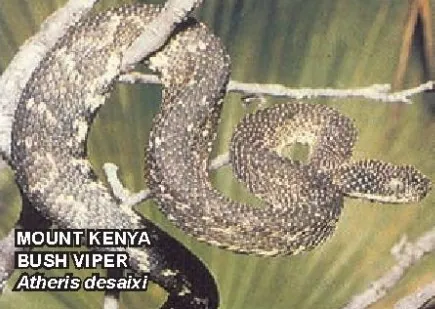
Mount Kenya bush viper
 Ukuluma
The Mount Kenya bush viper is a venomous snake with a striking black and yellow pattern. It lives only in Kenya, in two small, separate areas of forest. Its bite can cause serious swelling and bleeding problems, so it is important to know it.1



 Indlela yokusibona
- Ground colour is greenish-black to charcoal-black, with each scale tipped in yellow or yellowish-green, giving a speckled look.1
- Some scales form a series of loops along the sides, which may join into zigzag patterns towards the back.1
- The underside is yellow near the front, fading to purplish-black towards the rear and under the tail.1
- Young snakes are mainly yellow with a white-tipped tail. They darken as they grow and reach adult colours at about 30 cm.1
- Adults are usually 40 to 60 cm long, including the tail.1
Amandla obuthi
Ubuthi buphuma ngamazinyo aso obuthi noma ngamazinyo uma siluma.
Ubuthi baso benzani?
Its venom contains powerful anticoagulants, which are substances that stop blood from clotting properly. A bite causes significant swelling and pain. Poor clotting may be severe enough to need blood transfusions.1
Siyingozi kangakanani ebantwini?
Ingozi ebantwini: Kubi kakhuluUkulunywa kudinga udokotela. Ukufa kuyivelakancane kakhulu.In the one recorded bite, a Kenyan collector was bitten on a finger by an adult snake. The bite caused significant swelling and pain, and he made a full recovery. The snakes are relatively large for their genus, so a bite should be taken seriously.1
Senzani uma sesabile?
When captured, it strikes readily and struggles vigorously. It may also give a threat display, rubbing its coils and keeled scales together to make a loud hiss.1
 Uma siluma
- Because the venom can stop blood clotting, any bite should be treated as serious and needs urgent medical care. In the one recorded bite, a tourniquet was applied and an unknown antivenin was given, but the antivenin probably made no difference.1
- Gcina umuntu engashukumi futhi ezolile, gcina isitho esilunyiwe sisezingeni lenhliziyo, khipha izindandatho nezinto eziqinile, bese umusa esibhedlela ngokushesha.
Njalo shayela kuqala inombolo yezimo eziphuthumayo (112, 000, 911). Lokhu kuyiseluleko sosizo lokuqala esijwayelekile, akusona iseluleko sezokwelapha. Izisekelo zosizo lokuqala
 Hlala uphephile
- Ungalokothi uthinte, ubambe noma ugcone isilwane sasendle, ngisho noma sincane, futhi ngisho noma sibukeka silele noma sifile.
- Sinike isikhala. Uma uhlangana naso, hlala uzolile, uhlehle kancane bese usiyeka sihambe ngendlela yaso.
- Uma sikuluma: hlala uzolile, ungashukumi, shayela inombolo yezimo eziphuthumayo (112, 000, 911) noma uye esibhedlela ngokushesha. Khumbula ukuthi besibukeka kanjani, isithombe siyasiza.
Asikuzingeli wena. Sisebenzisa ubuthi baso ukuze sibambe ukudla noma ukuzivikela, futhi singancamela ukucasha. Okwengeziwe mayelana nokuhlala uphephile
Sikhulu kangakanani?
Side kangakanani?
 side njengobhanana abangu-4 abalandelanayo
 singahamba amamitha ali-100 ngemizuzwana engu-110 (umuntu oshesha kunabo bonke udinga engu-9,6)
Mount Kenya bush viper mkhulu kangakanani uma uqhathanisa NAWE?
Yizibalo nje kusiphequluli sakho. Akukho okulondolozwayo noma okuthunyelwa ndawo.
Sishesha kangakanani?


Amaqiniso
Its coloration gives it excellent camouflage in the forest, so it is very hard to spot.1
Its speckled, looped pattern changes from juvenile yellow to adult black and yellow as it grows.1
It is arboreal, which means it lives in trees and bushes, moving slowly and deliberately among the branches.1
Captive snakes soon calm down, and their threat display disappears.1
Okongoti bobuthi
- Igama lesayensi
- Atheris desaixi
- Iqembu
- Ama-viper namabululu
- Umndeni
- Viperidae2
- Ukuhleleka
- Squamata
- Amazwekazi
- I-Afrika
- Izinsana
- It gives birth to live young. One recorded female gave birth to 13 offspring in August, each measuring 17 to 21 cm.1
- Simo saso endle
- Endangered on the IUCN Red List (as of 2019). Listed in Appendix II of CITES, so international trade is regulated by permit.1
- Ingozi ebantwini
- 3 / 5: Kubi kakhulu3
Lapho amaqiniso evela khona
- Atheris desaixi (Wikipedia (CC BY-SA 4.0))
- Atheris desaixi (iNaturalist): amagama nokuhlelwa ngezigaba.
- Venom Wiki: izinga lengozi, usayizi ojwayelekile nesiqagela sejubane kungokwethu. Bona ukuthi sikubala kanjani: Indlela esilinganisa ngayo ingozi.
Iqiniso ngalinye kuleli khasi linenombolo ekhomba umthombo walo. Uma senze iphutha, uxolo, singabathandi bezilwane, hhayi iphephabhuku lesayensi. Sitshele ku-[email protected] futhi sizolilungisa.
 Ufezela ulambile! I-Venom Wiki iwumsebenzi womuntu oyedwa: imahhala, ayinazo izikhangiso noma izilandeli. Isipho esincane sisiza ukuyigcina ku-inthanethi.Phakela ufezela
 Ibululu
 Gaboon viper
 Northeast African carpet viper
 West African carpet viper
 Rhinoceros viper
 West African Gaboon viper
 Black mamba
 Deathstalker
 Egyptian cobra
 Boomslang
 Fat-tailed scorpion
 Western honey bee