
 Bitten or stung?
 All animals
 Pick a continent
 Africa
 Asia
 Europe
 South America
 Australia & Oceania
 Antarctica
 Pacific Ocean
 Atlantic Ocean
 Indian Ocean
 Arctic Ocean
 Mediterranean Sea
 Red Sea
 Caribbean Sea
 Coral Sea
 South China Sea
 Philippine Sea
 Andaman Sea
 North Sea
 Timor & Arafura Sea
 Bay of Bengal
 Gulf of California
 Games
 Venom battle
 Animal race
 Field notebook
 Venom TOP lists
 Stay safe
 Surprise me

String jellyfish
 Stinging tentaclesEats: MeatTOP 50 · No. 19: LongestTOP 50 · No. 7: Gentle giants
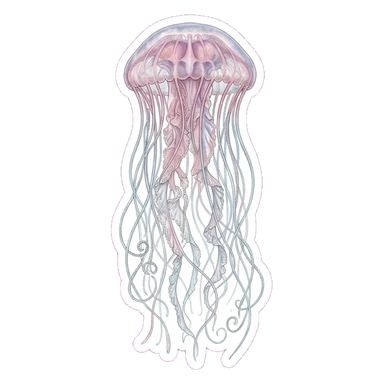
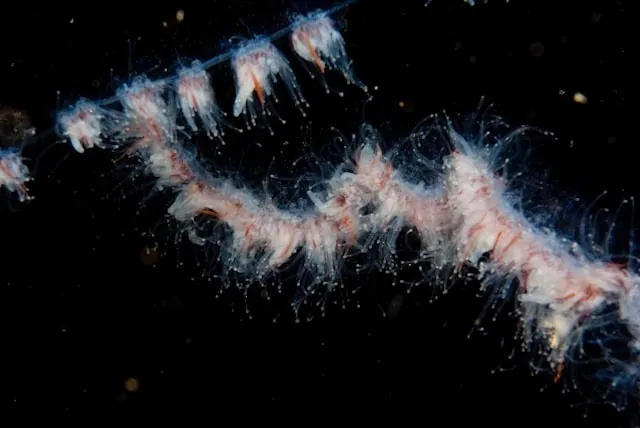
The string jellyfish is not really one animal. It is a colony of tiny linked creatures that look and move like a single long string in the sea. It lives in oceans around the world, and its stinging tentacles can hurt people who touch them.1
 How to recognise it
Venom power
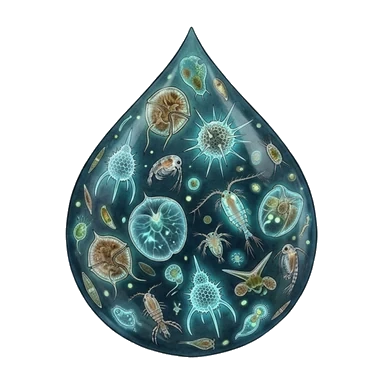
Thousands of tiny stinging cells fire when something touches them.
How dangerous is it to people?
Danger to people: PainfulIt can really hurt, but it is almost never serious.Its tentacles can sting people painfully.1
 If it stings
Call your emergency number at once if the person has trouble breathing, swelling of the face or throat, or feels faint.
- Get out of the water and pick off any tentacles (with gloves or a cloth).
- For tropical box jellyfish: pour vinegar on the stings for at least 30 seconds, call for help and be ready to do CPR. For bluebottles and most others: rinse with seawater, then hot water for the pain.
This is general first aid guidance, not medical advice. Based on the first aid guidelines of the World Health Organization and the Australian Resuscitation Council. Facts come from public sources and may contain mistakes. When in doubt, always get medical help. First aid basics
 Stay safe
- Never touch, catch or tease a wild animal, even a small one, and even if it looks asleep or dead.
- Give it space. If you meet one, stay calm, step back slowly and let it go its own way.
- If it hurts you: wash the spot, stay calm and get medical help if the pain is strong or spreads, or the person feels unwell.
It is not out to get you. It uses its venom to catch food or to protect itself, and it would much rather hide. More about staying safe
Where in the world?
How big is it?
How long is it?
 as long as 3 dogs nose to tail
 as long as 17 bananas end to end
 could swim the length of a big swimming pool (50 m) in 60 seconds
How big is String jellyfish compared to you?
Just maths in your browser. Nothing is saved or sent anywhere.
How fast is it?
Facts
In recent years (as of 2025), string jellyfish have been multiplying in seas around Norway and Scotland, where they have caused mass deaths of farmed salmon.1
Each string jellyfish is a colony of specialised tiny organisms called zooids. They are permanently joined and cannot survive on their own.1
In rough seas, or where there are physical barriers, a colony can break into smaller pieces. These pieces can get into fish cages to reach farmed salmon.1
Rising sea temperatures and waste dumped from fish farms, which the jellyfish feed on, have been blamed for the increase.1
Colonies can be found at the surface and at depths of around 1,000 m.1
In September 2007, string jellyfish were spotted off South Devon and South East Cornwall, and for the first time off Plymouth. Changes in Atlantic ocean currents are the most likely cause.1
Where the facts come from
- Apolemia uvaria (Wikipedia (CC BY-SA 4.0))
- Apolemia uvaria (iNaturalist): names and classification.
- Venom Wiki: the danger level, the typical size and the speed guess are our own. See how we work them out: How we rate danger.
Every fact on this page has a number that points to its source. If we got something wrong, sorry, we are animal fans, not a science journal. Tell us at [email protected] and we will fix it.
Get the Venom Wiki app
Every creature, every picture and the games in your pocket, even without internet.


 Support Venom Wiki Venom Wiki is a one-man project: free, with no ads and no cookies. A small tip helps keep it online.Feed the scorpion
More from the same group: Jellyfish & sea stingers
 Australian box jellyfishJellyfish & sea stingersDeadlyDo not touch
 Irukandji jellyfishJellyfish & sea stingersCan killDo not touch
 Portuguese man o' warJellyfish & sea stingersNeeds a doctorDo not touch
 Lion's mane jellyfishJellyfish & sea stingersPainfulDo not touch
 Moon jellyfishJellyfish & sea stingersMild
 Common kingslayerJellyfish & sea stingersCan killDo not touch
 Hawksbill sea turtle
 Red lionfish
 Blue sea dragon
 Greenland shark
 Common octopus
 Common stingray