
 Afrik
Afrik Aazi
Aazi Orop
Orop Amerik Worgo
 Ostaraali e Oseyaani
 Antarktik
 Geec Pasifik
 Geec Atlantik
 Geec Enndo
 Geec Arktik
 Geec Mediteraane
 Geec Boɗeejo
 Geec Karayib
 Geec Korayl
 Geec Siin Worgo
 Geec Filipiin
 Geec Andaman
 Geec Rewo
 Geec Timor e Arafura
 Gulf Bengal
 Gulf Kaliforni
Emperor newt
 Tooke e nguru mum
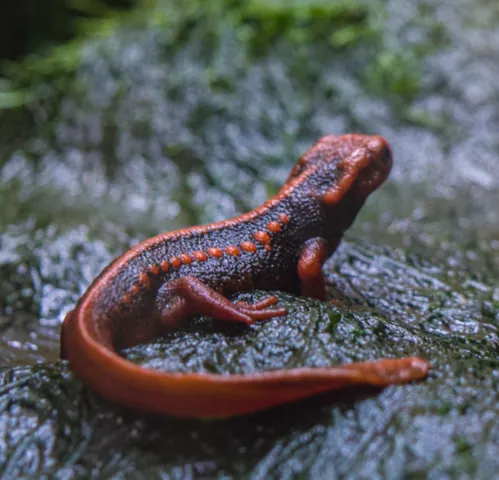
The emperor newt is a small, highly poisonous newt with bright orange bumps along its sides. It lives in pools and slow streams in forests in Yunnan and parts of South China. Its bright colours warn animals that it is toxic.1


 No anndirte ngal
- Ridged orange head with a darker, almost black body1
- A single orange ridge runs down the back to the tail-tip1
- A row of round, orange bumps runs along both sides of the body1
- Tail and legs are orange, though the shade can vary by population, diet and location1
- Moves slowly and is generally nocturnal, so it is hard to find1
Doole tooke ɓanndu
Nguru mum ina jogii tooke. Ina bonna so meemaama, lakkaama walla ñaamaama.
Hol ko tooke ɓanndu mum waɗata?
It has no venom. Its poison is held in glands along its back and sides, and when it is grabbed, the tips of its ribs squeeze the poison out. The poison is harmful if eaten, or if the toxin is taken into the body.1
Hol no bone mum heewiri e yimɓe?
Bone e yimɓe: MuusɗoIna waawi muusde sanne, kono hertaani wonde huunde mawnde.It is poisonous if eaten, but it is generally safe for people to handle when held carefully and gently, and only as often as is absolutely necessary.1
Hol ko ngal waɗata so ina hula?
Its bright orange colour is a warning, and when grabbed it squeezes poison from the glands along its back.1
 So neɗɗo meemii ngal walla ñaamii ngal
- So neɗɗo meemii gooto: loot juuɗe ɗee no moƴƴiri, wota a meem gite walla hunduko. So cukalel walla kullal galle lakkii walla ñaamii gooto: noddu centre antipoison walla nimero urgence.
Adii fof noddu nimero urgence (112, 000, 911). Ɗum ko anndinal ballal adiingal, wonaa saaraangal doktoor. Ko adii e ballal adiingal
 Reen hoore maa
- Wota a meem, wota a nanngu, wota a ñiŋŋu kullal ladde haa abada, hay so ngal ina famɗi, hay so ina nanndi e ɗaaniingal walla maayngal.
- Accu ngal nokku. So a fotti e ngal, deƴƴu, ruttu ɓaawo seeɗa seeɗa, accu ngal yaha laawol mum.
- So a meemii ngal walla a ñaamii ngal: wota a moomtu gite maa walla hunduko maa, loot juuɗe maa, heɓ ballal cafrol.
Ngal faalaaka gaañde ma. Tooke mum woni tan ngam wota huunde ñaam ngal. Ɓeydu anndude no reentortoo
Hol to e aduna?
Hol no mawniri?
Hol no juutiri?
 juutde no kaaɗe mahirɗe 6 ɗaɓɓondiraaɗe
Hol no Emperor newt mawniri, so fooɗondiraama e AN?
Limgal tan e navigatoor maa. Alaa ko danndetee walla ko neldetee.
Hol no yaawiri?


Humpito
Feññinoowo fenaande
Fenaande: Its slow, unhurried movements make it easy prey.
Goonga: Its bright orange colour warns predators that it is poisonous, so most larger animals avoid it.1
Ɗo humpito iwri
- Tylototriton shanjing (Wikipedia (CC BY-SA 4.0))
- Tylototriton shanjing (iNaturalist): inɗe e ceergal.
- Venom Wiki: tolno bone, mawnude heewnde e miijo yaawde ko amen. Yiy no men keɓirta ɗum: No men tolnirta bone.
Kala humpito e ngoo hello ina jogii limoore hollirnde iwdi mum. So men juumii, yaafo, men ko yiɗɓe kulle, wonaa jaaynde ganndal. Wiy men e [email protected], men feewnita.
 Yaare nden ina weelaa! Venom Wiki ko golle neɗɗo gooto: yoɓetaake, alaa ko jeeyetee, alaa rewɓe. Ndokkal seeɗa ina walla ngam heddude e enternet.Ñaam yaare nden
Goɗɗe e nder fedde wootere: Ñaari tooke, ñaari e newts
 Japanese fire-bellied newtÑaari tooke, ñaari e newtsIna sokli doktoorWota a meem
 Common toadÑaari tooke, ñaari e newtsIna muusi tanWota a meem
 Oriental fire-bellied toadÑaari tooke, ñaari e newtsAlaa bone
 Asian common toadÑaari tooke, ñaari e newtsIna sokli doktoorWota a meem
 Asiatic toadÑaari tooke, ñaari e newtsIna muusi tanWota a meem
 Himalayan newtÑaari tooke, ñaari e newtsIna muusi tanWota a meem
 Yaare oolnde maayde
 Kobra Enndo
 Wipeer cerkeeje siy Enndo
 Kobra laamɗo
 Mbaa-ndiyam (Puff adder)
 Ladde Russell