
 Afrik
Afrik Aazi
Aazi Orop
Orop Amerik Worgo
 Ostaraali e Oseyaani
 Antarktik
 Geec Pasifik
 Geec Atlantik
 Geec Enndo
 Geec Arktik
 Geec Mediteraane
 Geec Boɗeejo
 Geec Karayib
 Geec Korayl
 Geec Siin Worgo
 Geec Filipiin
 Geec Andaman
 Geec Rewo
 Geec Timor e Arafura
 Gulf Bengal
 Gulf Kaliforni
Green cat snake
 Ŋatgol
The green cat snake is a slim, bright green snake that lives mostly in trees. It is found in South Asia, China and South-east Asia, mainly in forests. It is a rear-fanged snake that is only mildly venomous to people.1



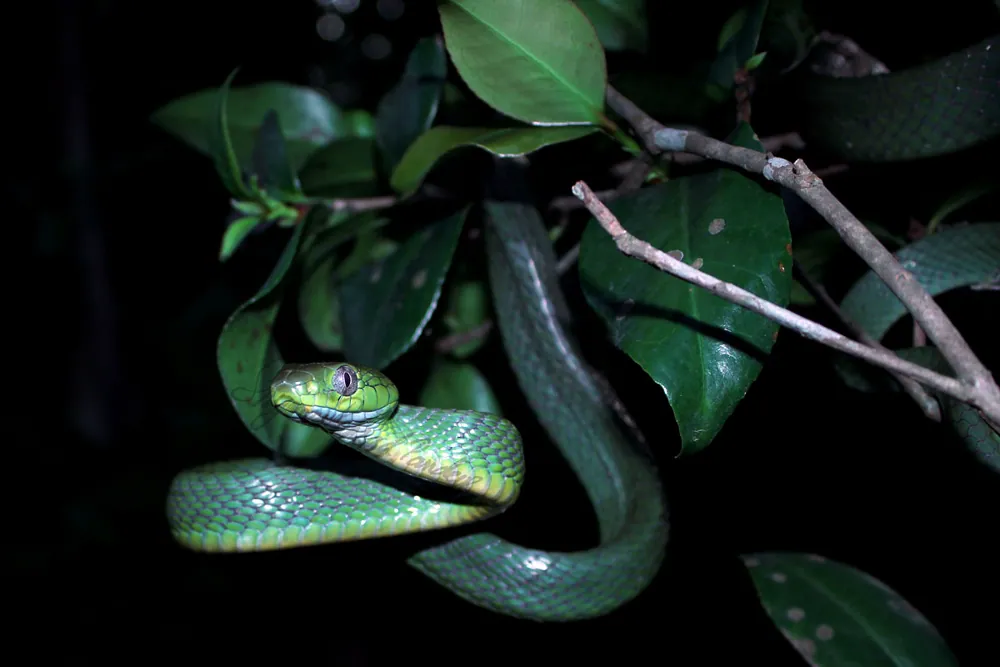
 No anndirte ngal
- Uniform green back, or green mixed with grey or blue1
- Greenish or yellowish white belly1
- Large eyes with vertical, cat-like pupils, and golden brown irises1
- Yellowish upper lip, with most head scales edged in black1
- Hatchlings are reddish brown with a green head, and begin to turn green at about 8 to 9 months old1
Doole tooke
Tooke ngal ina yaltira ñiiƴe mum so ina ŋata.
Hol ko tooke ŋatgol mum waɗata?
This is a rear-fanged snake, meaning its fangs are at the back of the mouth, and it is described as mildly venomous. Its venom can paralyse small prey. Bites are expected to cause only mild to moderate local swelling and pain, with occasional bruising, numbness, redness or bleeding, but no tissue death (necrosis) and no whole-body (systemic) effects.1
Hol no bone mum heewiri e yimɓe?
Bone e yimɓe: MuusɗoIna waawi muusde sanne, kono hertaani wonde huunde mawnde.Bites are not expected to cause medically significant effects. Most cases are minor, but some are more severe and need hospital admission and treatment.1
Hol ko ngal waɗata so ina hula?
Usually sluggish and hard to provoke into striking, it may become hostile when threatened and display with its mouth wide open.1
 So ina ŋata
- Bites usually need no treatment beyond checking for infection and making sure tetanus protection is up to date. Anyone who develops local symptoms, such as signs of infection, should return for medical review. Some bites are more severe and need hospital care, so a careful assessment is needed before discharge.1
- Loot nokku ŋataaɗo oo, deƴƴin neɗɗo oo, heɓ ballal cafrol. Noone goɗɗe (ko wayi no boomslang) ina mbaawi warde caggal waktuuji.
Adii fof noddu nimero urgence (112, 000, 911). Ɗum ko anndinal ballal adiingal, wonaa saaraangal doktoor. Ko adii e ballal adiingal
 Reen hoore maa
- Wota a meem, wota a nanngu, wota a ñiŋŋu kullal ladde haa abada, hay so ngal ina famɗi, hay so ina nanndi e ɗaaniingal walla maayngal.
- Accu ngal nokku. So a fotti e ngal, deƴƴu, ruttu ɓaawo seeɗa seeɗa, accu ngal yaha laawol mum.
- So gooto ŋatii ma: deƴƴu, wota a dillu, noddu nimero urgence (112, 000, 911) walla yahu opitaal law. Jogo e hakkille no ngal nanndi, natal ina walla.
Ngal faalaaka gaañde ma. Ina huutoroo tooke mum ngam nanngude ñaamdu walla reenaade, ina ɓuri yiɗde suuɗaade. Ɓeydu anndude no reentortoo
Hol to e aduna?
Hol no mawniri?
Hol no juutiri?
 juutde no ulluuɗi galle 4, hinere haa lawol
 juutde no banaanaaji 11 sammondiraaɗi
 ina waawi taƴde 100 meeteer e segonde 60 (neɗɗo ɓurɗo yaawde ina sokli 9,6)
Hol no Green cat snake mawniri, so fooɗondiraama e AN?
Limgal tan e navigatoor maa. Alaa ko danndetee walla ko neldetee.
Hol no yaawiri?


Humpito
It is one of the rear-fanged snakes, and its venom is used to paralyse small prey.1
Its long, grasping tail lets it live entirely in trees, so it is described as purely arboreal.1
Despite its size, it is sluggish and makes no attempt to escape when handled.1
Hatchlings look very different from adults, being reddish brown with a green head.1
It hunts at night and rests during the day, coiled among the branches.1
A female lays between 7 and 14 eggs, which take about 85 days to hatch.1
Ɗo humpito iwri
- Boiga cyanea (Wikipedia (CC BY-SA 4.0))
- Boiga cyanea (iNaturalist): inɗe e ceergal.
- Venom Wiki: tolno bone, mawnude heewnde e miijo yaawde ko amen. Yiy no men keɓirta ɗum: No men tolnirta bone.
Kala humpito e ngoo hello ina jogii limoore hollirnde iwdi mum. So men juumii, yaafo, men ko yiɗɓe kulle, wonaa jaaynde ganndal. Wiy men e [email protected], men feewnita.
 Yaare nden ina weelaa! Venom Wiki ko golle neɗɗo gooto: yoɓetaake, alaa ko jeeyetee, alaa rewɓe. Ndokkal seeɗa ina walla ngam heddude e enternet.Ñaam yaare nden
 Brown tree snake
 Tiger keelback
 Red-necked keelback
 Mangrove snake
 Asian vine snake
 Golden tree snake
 Yaare oolnde maayde
 Kobra Enndo
 Wipeer cerkeeje siy Enndo
 Kobra laamɗo
 Mbaa-ndiyam (Puff adder)
 Ladde Russell