
 Africa
 Asia
Asia Ulaya
Ulaya Amereka ya Kumwera
 Australia ndi Oceania
 Antarctica
 Nyanja ya Pacific
 Nyanja ya Atlantic
 Nyanja ya Indian
 Nyanja ya Arctic
 Nyanja ya Mediterranean
 Nyanja Yofiira
 Nyanja ya Caribbean
 Nyanja ya Coral
 Nyanja ya South China
 Nyanja ya Philippine
 Nyanja ya Andaman
 Nyanja ya Kumpoto (North Sea)
 Nyanja ya Timor ndi Arafura
 Nyanja ya Bengal
 Gulf ya California
Brazilian lancehead
 Imaluma
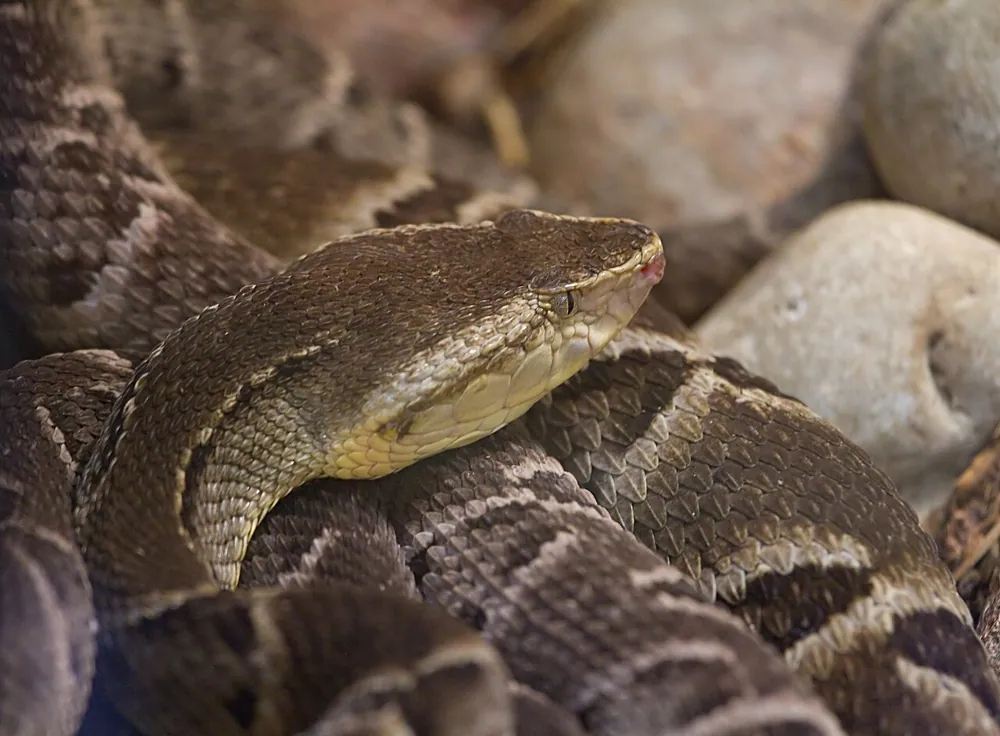
The Brazilian lancehead is a highly venomous snake, a type of pit viper, found in South America. It lives in forests and open woodland in Brazil and nearby countries, and it hunts mostly at night. Its venom damages muscle and blood, so bites need urgent medical care.1



 Mmene ungaizindikirire
- Tan, grey-brown or olive-grey body with 14–21 trapezoidal side markings that are dark grey or black.1
- Belly is usually white or cream, with scattered dark grey spots.1
- Broad head is flattened into a lance shape when seen from above, and is distinct from the narrow neck.1
- Eyes have vertically elliptical (cat-like) pupils.1
- Juveniles have a white tail.1
Mphamvu ya ululu
Ululu umatuluka kudzera m'mano ake ikaluma.
Ululu wake umachita chiyani?
Its venom is haemolytic (it breaks down red blood cells) and proteolytic (it breaks down proteins). A muscle-damaging component causes necrosis, meaning the muscle tissue dies, and the venom also stops blood from clotting. Symptoms may include intense local pain, swelling and muscle death, and the venom can cause severe bleeding and strokes.1
Ndi yoopsa bwanji kwa anthu?
Ngozi kwa anthu: Yoopsa kwambiriIngathe kupha munthu amene sanalandire chithandizo.This snake is highly venomous. Its venom can cause severe haemorrhage (serious bleeding) and strokes.1
Imachita chiyani ikachita mantha?
It is considered very defensive.1
 Ikaluma
- Munthuyo akhale chete ndi wodekha, chiwalo cholumidwacho chikhale pamlingo wa mtima, chotsa mphete ndi zinthu zothina, ndipo mufikitse kuchipatala mwachangu.
Nthawi zonse yamba wayimbira nambala yadzidzidzi (112, 000, 911). Awa ndi malangizo wamba a chithandizo choyamba, osati malangizo a dokotala. Zoyambira za chithandizo choyamba
 Khala wotetezeka
- Usakhudze, kugwira kapena kuseweretsa nyama yakuthengo, ngakhale yaing'ono, ndipo ngakhale ikuoneka ngati yagona kapena yafa.
- Ipatse malo. Ukakumana nayo, khala chete, bwerera m'mbuyo pang'onopang'ono ndipo uilole ipite njira yake.
- Ikakuluma: khala chete, usasunthe, imbira nambala yadzidzidzi (112, 000, 911) kapena pita kuchipatala mwachangu. Kumbukira m'mene inkaonekera, chithunzi chimathandiza.
Sikufuna kukuvulaza. Imagwiritsa ntchito ululu wake kugwira chakudya kapena kudziteteza, ndipo imakonda kwambiri kubisala. Zambiri za kukhala wotetezeka
Kuti padziko lapansi?
Ndi yaikulu bwanji?
Ndi yaitali bwanji?
 yaitali ngati amphaka apakhomo 5 mphuno ndi mchira motsatizana
 yaitali ngati nthochi 13 zoyalidwa motsatizana
 ingathamange mamita 100 m'masekondi 90 (munthu wothamanga kwambiri amafunika 9.6)
Brazilian lancehead ndi yaikulu bwanji poyerekeza ndi IWE?
Ndi masamu chabe mu msakatuli wako. Palibe chomwe chimasungidwa kapena kutumizidwa kwina.
Imathamanga bwanji?


Mfundo
The venom contains a clotting-related enzyme that can trigger disseminated intravascular coagulation, a serious condition where blood clots and bleeds at the same time.1
Its venom contains a wide range of enzymes, including a muscle-damaging myotoxin.1
The venom yield of adult females averages 335 mg, while newborns average 63 mg.1
It is one of several pit vipers with heat-sensing pits, which help it find prey in the dark.1
It is nocturnal, so it is most active at night.1
Za akatswiri a ululu
- Dzina la sayansi
- Bothrops moojeni
- Gulu
- Njoka za pit viper
- Banja
- Viperidae2
- Dongosolo
- Squamata
- Makontinenti
- Amereka ya Kumwera
- Ana akhanda
- It gives birth to live young (viviparous). Gestation lasts around four months, it happens once a year, and a litter is usually 12–14 newborns.1
- Kutalika kwa moyo
- pafupifupi zaka 151
- Ngozi kwa anthu
- 4 / 5: Yoopsa kwambiri3
Kumene mfundo zimachokera
- Bothrops moojeni (Wikipedia (CC BY-SA 4.0))
- Bothrops moojeni (iNaturalist): mayina ndi magulu a sayansi.
- Venom Wiki: mlingo wa ngozi, kukula wamba ndi kuyerekeza kwa liwiro ndi zathu. Ona mmene timazipezera: Mmene timayezera ngozi.
Mfundo iliyonse patsamba lino ili ndi nambala yosonyeza kochokera. Ngati talakwitsa, pepani, ndife okonda nyama, osati magazini a sayansi. Tiuze pa [email protected] ndipo tikonza.
 Chinkhanira chili ndi njala! Venom Wiki ndi ntchito ya munthu mmodzi: yaulere, yopanda zotsatsa ndi zokutsatira. Mphatso yaing'ono imathandiza kuti ikhalebe pa intaneti.Dyetsa chinkhanira
Zina za gulu lomwelo: Njoka za pit viper
 Terciopelo
 Eyelash viper
 Golden lancehead
 South American bushmaster
 Common lancehead
 Jararaca
Imakhalanso ku: Amereka ya Kumwera
 Golden poison frogAchule a poizoni, achule a mphini (toads) ndi ma newtYakuphaUsakhudze
 Brazilian wandering spiderAkangaudeIngathe kupha
 Cane toadAchule a poizoni, achule a mphini (toads) ndi ma newtIkufuna dokotalaUsakhudze
 Peruvian giant centipedeMa centipedeIkufuna dokotala
 Bullet antNyerereImangopweteka
 Common vampire batNyama zoyamwitsa zaululuImangopweteka