
 Africa
 Asia
Asia Ulaya
Ulaya Amereka ya Kumwera
 Australia ndi Oceania
 Antarctica
 Nyanja ya Pacific
 Nyanja ya Atlantic
 Nyanja ya Indian
 Nyanja ya Arctic
 Nyanja ya Mediterranean
 Nyanja Yofiira
 Nyanja ya Caribbean
 Nyanja ya Coral
 Nyanja ya South China
 Nyanja ya Philippine
 Nyanja ya Andaman
 Nyanja ya Kumpoto (North Sea)
 Nyanja ya Timor ndi Arafura
 Nyanja ya Bengal
 Gulf ya California
Spine-tailed sea snake
 Imaluma
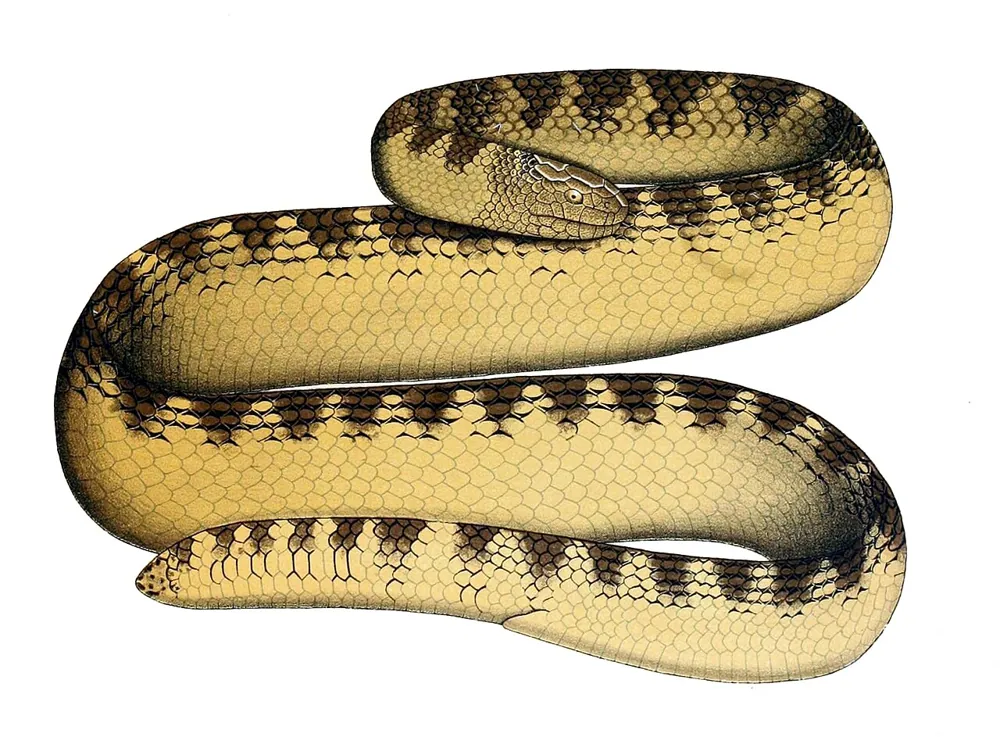
The spine-tailed sea snake is a sea snake that lives in shallow bays and estuaries in northern Australia, South-East Asia and New Guinea. It is unusual because it eats almost only fish eggs, and it has lost its fangs. It is one of the few sea snakes whose bite is unlikely to be dangerous to people.1


 Mmene ungaizindikirire
- Its head shields are regular and symmetrical.1
- Its smooth scales on the back are arranged in 17 rows around the middle of the body.1
- It has 141 to 149 distinct belly scales (ventrals) along its body and 27 to 30 scales under its tail (subcaudals).1
- Adults can reach a snout to vent length (the distance from the tip of the snout to the vent) of about 1 m.1
Mphamvu ya ululu
Ululu umatuluka kudzera m'mano ake ikaluma.
Ululu wake umachita chiyani?
Unlike most sea snakes, it has lost its fangs, and its venom glands have shrunk and are almost entirely non-functional. Its venom is much weaker than that of related sea snakes, because a small change in one of its venom genes reduces the venom's toxicity.1
Ndi yoopsa bwanji kwa anthu?
Ngozi kwa anthu: YopwetekaIngathe kupweteka kwambiri, koma pafupifupi nthawi zonse si vuto lalikulu.Because it has no fangs and its venom is very weak, its bite is unlikely to be a serious threat to people.1
 Ikaluma
- Kumanga ndi kusasuntha (pressure immobilisation): manga bandeji yotanuka mwamphamvu pamene walumidwa kenako mmwamba chiwalo chonse, ika chogwiriziza (splint), ndipo munthuyo akhale chete osasuntha konse mpaka thandizo litafika.
- Tulutsa munthuyo m'madzi ndipo mufikitse kuchipatala mwachangu.
Nthawi zonse yamba wayimbira nambala yadzidzidzi (112, 000, 911). Awa ndi malangizo wamba a chithandizo choyamba, osati malangizo a dokotala. Zoyambira za chithandizo choyamba
 Khala wotetezeka
- Usakhudze, kugwira kapena kuseweretsa nyama yakuthengo, ngakhale yaing'ono, ndipo ngakhale ikuoneka ngati yagona kapena yafa.
- Ipatse malo. Ukakumana nayo, khala chete, bwerera m'mbuyo pang'onopang'ono ndipo uilole ipite njira yake.
- Ikakuluma: khala chete, usasunthe, imbira nambala yadzidzidzi (112, 000, 911) kapena pita kuchipatala mwachangu. Kumbukira m'mene inkaonekera, chithunzi chimathandiza.
Sikufuna kukuvulaza. Imagwiritsa ntchito ululu wake kugwira chakudya kapena kudziteteza, ndipo imakonda kwambiri kubisala. Zambiri za kukhala wotetezeka
Kuti padziko lapansi?
Ndi yaikulu bwanji?
Ndi yaitali bwanji?
 yaitali ngati amphaka apakhomo 2 mphuno ndi mchira motsatizana
 yaitali ngati nthochi 6 zoyalidwa motsatizana
 ingasambire kutalika kwa dziwe lalikulu losambira (50 m) m'masekondi 47
Spine-tailed sea snake ndi yaikulu bwanji poyerekeza ndi IWE?
Ndi masamu chabe mu msakatuli wako. Palibe chomwe chimasungidwa kapena kutumizidwa kwina.
Imathamanga bwanji?
Mfundo
It feeds almost exclusively on fish eggs, which is very unusual among sea snakes.1
Only one other species of sea snake, Emydocephalus annulatus, shares this egg-only diet.1
It has strong throat muscles, reduced teeth and a much smaller body than most other sea snakes, all linked to its special diet.1
It gives birth to live young, even though it is a snake that hatches its eggs inside the body.1
Za akatswiri a ululu
- Dzina la sayansi
- Aipysurus eydouxii
- Gulu
- Njoka za m'nyanja
- Banja
- Elapidae2
- Dongosolo
- Squamata
- Makontinenti
- Nyanja ya Indian, Nyanja ya Pacific, Nyanja ya Coral, Nyanja ya Timor ndi Arafura, Nyanja zikuluzikulu
- Ana akhanda
- It is ovoviviparous, so its eggs hatch inside the mother and the young are born alive.1
- Ngozi kwa anthu
- 2 / 5: Yopweteka3
Kumene mfundo zimachokera
- Aipysurus eydouxii (Wikipedia (CC BY-SA 4.0))
- Aipysurus eydouxii (iNaturalist): mayina ndi magulu a sayansi.
- Venom Wiki: mlingo wa ngozi, kukula wamba ndi kuyerekeza kwa liwiro ndi zathu. Ona mmene timazipezera: Mmene timayezera ngozi.
Mfundo iliyonse patsamba lino ili ndi nambala yosonyeza kochokera. Ngati talakwitsa, pepani, ndife okonda nyama, osati magazini a sayansi. Tiuze pa [email protected] ndipo tikonza.
 Chinkhanira chili ndi njala! Venom Wiki ndi ntchito ya munthu mmodzi: yaulere, yopanda zotsatsa ndi zokutsatira. Mphatso yaing'ono imathandiza kuti ikhalebe pa intaneti.Dyetsa chinkhanira
Zina za gulu lomwelo: Njoka za m'nyanja
 Beaked sea snake
 Belcher's sea snake
 Black-banded sea krait
 Blue-lipped sea krait
 Dubois' sea snake
 Olive sea snake
Imakhalanso ku: Nyanja ya Indian
 Australian box jellyfishJellyfish ndi zolasa za m'nyanjaYakuphaUsakhudze
 Geography coneNkhono za cone ndi ma octopusYakupha
 Greater blue-ringed octopusNkhono za cone ndi ma octopusYakupha
 Southern blue-ringed octopusNkhono za cone ndi ma octopusYakupha
 Hawksbill sea turtleNyama zina za poizoniIngathe kupha
 Irukandji jellyfishJellyfish ndi zolasa za m'nyanjaIngathe kuphaUsakhudze