
 Afrika
 Asia
Asia Ulaya
Ulaya Amerika Kusini
 Australia na Oceania
 Antaktika
 Bahari ya Pasifiki
 Bahari ya Atlantiki
 Bahari ya Hindi
 Bahari ya Aktiki
 Bahari ya Mediterania
 Bahari ya Shamu
 Bahari ya Karibi
 Bahari ya Matumbawe
 Bahari ya Kusini ya China
 Bahari ya Ufilipino
 Bahari ya Andaman
 Bahari ya Kaskazini
 Bahari ya Timor na Arafura
 Ghuba ya Bengal
 Ghuba ya California
Port Jackson shark
 Miiba yenye sumu
The Port Jackson shark is a bottom-dwelling shark that lives in the cool coastal waters of southern Australia. It is active mostly at night, when it hunts shellfish, sea urchins and fish. It is harmless to people, though its spines have a reputation that is not confirmed.1



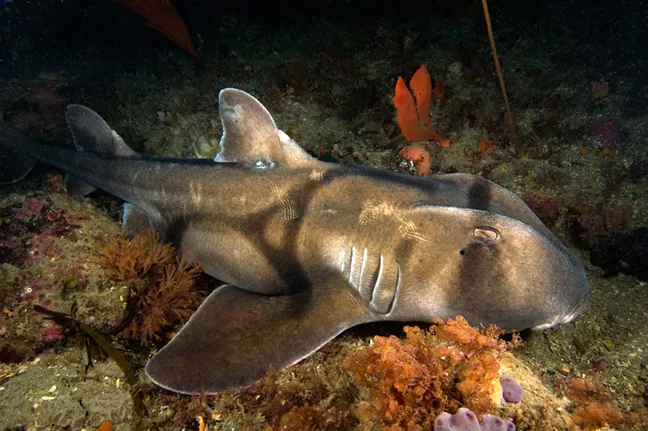
 Jinsi ya kumtambua
- Grey-brown body with dark brown, harness-like bands, including one that runs across the eyes.1
- Large, blunt, flat head with raised ridges above the eyes.1
- A spine at the front edge of each of its two dorsal fins, which are nearly equal in size.1
- Front teeth are small and pointed, while back teeth are flat and blunt.1
- Adults can grow up to 1.65 metres long.1
Nguvu ya sumu
Miiba mikali hubeba sumu. Kumkanyaga au kumshika kunauma.
Ana hatari gani kwa watu?
Hatari kwa watu: HafifuKama kudungwa na nyuki au chini ya hapo. Kimsingi hana madhara kwa watu.The shark poses no danger to humans. In October 2011, a man was bitten at Elwood Beach near Melbourne, but the bite did not pierce the skin and he was able to swim away while the shark was still attached to his calf.1
 Miiba yake ikikuchoma
- Weka jeraha kwenye maji ya moto, moto kiasi ambacho mtu anaweza kuvumilia bila kuungua (pima kwanza kwa mkono wako), kwa dakika 30 hadi 90. Tafuta msaada wa kitabibu, hasa kwa samaki-jiwe na taa.
Daima piga namba ya dharura kwanza (112, 000, 911). Huu ni mwongozo wa jumla wa huduma ya kwanza, si ushauri wa kitabibu. Misingi ya huduma ya kwanza
 Kaa salama
- Kamwe usimguse, kumkamata wala kumchokoza mnyama wa porini, hata akiwa mdogo, na hata akionekana amelala au amekufa.
- Mpe nafasi. Ukikutana naye, tulia, rudi nyuma polepole na umwache aende zake.
- Miiba yake ikikuchoma: tulia, usitikisike, piga namba yako ya dharura (112, 000, 911) au nenda hospitali haraka. Kumbuka alivyoonekana, picha husaidia.
Hakuwindi wewe. Hutumia sumu yake kukamata chakula au kujilinda, na hupendelea zaidi kujificha. Zaidi kuhusu kukaa salama
Wapi duniani?
Ana ukubwa gani?
Ana urefu gani?
 urefu sawa na paka wa nyumbani 3 kutoka pua hadi mkia
 urefu sawa na ndizi 9 zilizopangwa mstari
 angeweza kuogelea urefu wa bwawa kubwa (m 50) kwa sekunde 8.2
Port Jackson shark ana ukubwa gani ukilinganisha na WEWE?
Ni hesabu tu kwenye kivinjari chako. Hakuna kinachohifadhiwa wala kutumwa popote.
Ana kasi gani?


Ukweli
It can turn its stomach inside out and spit out unwanted contents.1
It can breathe while lying still on the bottom. It pumps water in through its first gill slit and out through the others, so it does not need to swim with its mouth open.1
Juveniles have individual personalities. Some are bolder than others when exploring new places, and they respond differently to stress.1
Juveniles can learn to link bubbles, lights or sounds with food, and they can learn by watching other sharks.1
Adults are often seen resting together in caves, but juveniles do not seem to be social.1
Each year it migrates south in summer and returns north to breed in winter.1
Kuvunja dhana potofu
Dhana potofu: Port Jackson sharks are dangerous to people.
Ukweli: The shark poses no danger to humans. Its spines are rumoured to be venomous, but this has not been confirmed.1
Kwa wataalamu wa sumu
- Jina la kisayansi
- Heterodontus portusjacksoni
- Kundi
- Samaki wenye sumu
- Familia
- Heterodontidae2
- Mpangilio
- Heterodontiformes
- Mabara
- Bahari ya Hindi, Bahari ya Kusini, Antaktika, Bahari kuu
- Watoto
- It lays eggs rather than giving birth to live young. From late August to mid-November, the female lays pairs of eggs every 8 to 17 days, up to eight pairs in total, and the eggs take 10 to 11 months to hatch.1
- Hali yake porini
- Least Concern (IUCN Red List)1
- Hatari kwa watu
- 1 / 5: Hafifu3
Ukweli unatoka wapi
- Port Jackson shark (Wikipedia (CC BY-SA 4.0))
- Heterodontus portusjacksoni (iNaturalist): majina na uainishaji.
- Venom Wiki: kiwango cha hatari, ukubwa wa kawaida na makadirio ya kasi ni yetu wenyewe. Ona jinsi tunavyovipata: Jinsi tunavyopima hatari.
Kila ukweli kwenye ukurasa huu una namba inayoonyesha chanzo chake. Kama tumekosea kitu, samahani, sisi ni wapenzi wa wanyama, si jarida la kisayansi. Tuambie kupitia [email protected] nasi tutarekebisha.
 Nge ana njaa! Venom Wiki ni mradi wa mtu mmoja: bure, bila matangazo na bila vifuatiliaji. Mchango mdogo husaidia kuiweka hewani.Mlishe nge
Zaidi kutoka kundi hilohilo: Samaki wenye sumu
 Reef stonefishSamaki wenye sumuAnaweza kuuaUsiguse
 Red lionfishSamaki wenye sumuAnahitaji daktariUsiguse
 Estuarine stonefishSamaki wenye sumuAnaweza kuuaUsiguse
 Short-tail stingraySamaki wenye sumuAnaweza kuua
 Striped eel catfishSamaki wenye sumuAnaweza kuuaUsiguse
 Bluespotted ribbontail raySamaki wenye sumuAnahitaji daktari
Pia anaishi: Bahari ya Hindi
 Australian box jellyfishYavuyavu na wadungaji wa bahariniAnauaUsiguse
 Geography coneKonokono koni na pwezaAnaua
 Greater blue-ringed octopusKonokono koni na pwezaAnaua
 Southern blue-ringed octopusKonokono koni na pwezaAnaua
 Hawksbill sea turtleWanyama wengine wenye sumu ya kugusa au kulaAnaweza kuua
 Irukandji jellyfishYavuyavu na wadungaji wa bahariniAnaweza kuuaUsiguse