
 Afrig
Afrig Asi
Asi Tugal
Tugal Amerig gu Bëj-saalum
 Ostarali ak Oseyani
 Antarktig
 Mbàmbulaanu Pasifik
 Mbàmbulaanu Atlantig
 Mbàmbulaanu End
 Mbàmbulaanu Arktik
 Géeju Mediteraane
 Géej gu Xonq
 Géeju Karayib
 Géeju Koraay
 Géeju Siin gu Bëj-saalum
 Géeju Filipin
 Géeju Andaman
 Géeju Bëj-gànnaar
 Géeju Timor ak Arafura
 Golfu Bengal
 Golfu Kaliforni
Coastal taipan
 Dafay màtt
The coastal taipan is one of the most feared snakes in Australia. It is a large, fast snake with a powerful venom, and it lives along the coasts of northern and eastern Australia and on the island of New Guinea. It is one of the reasons snake bite safety matters so much in these areas.1



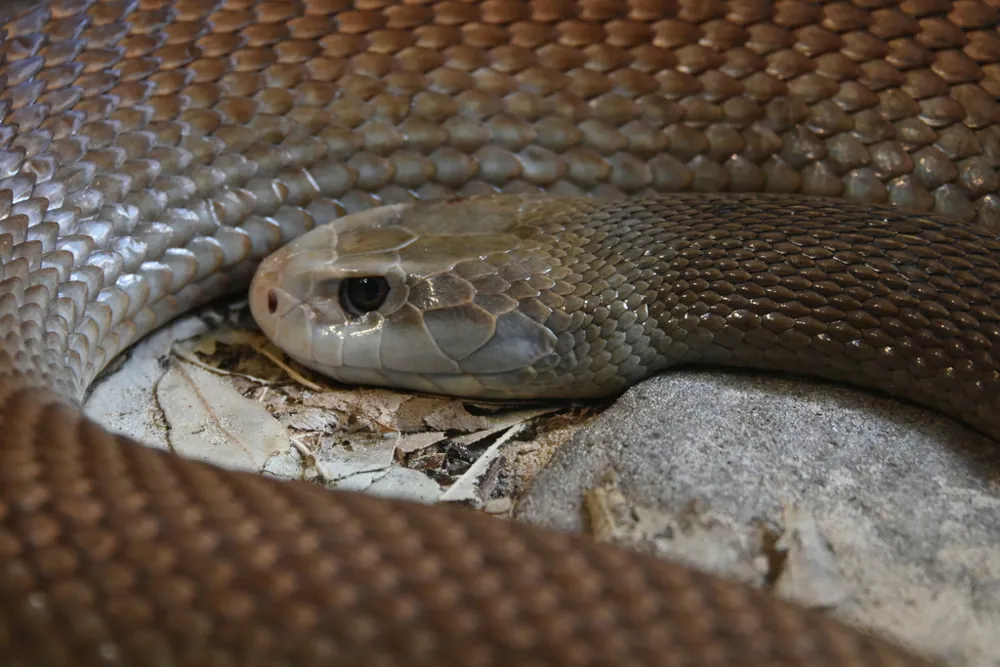
 Ni ngay ko xàmmee
- Light olive or reddish-brown upperparts, sometimes dark grey to black1
- Paler sides and a creamy-white to pale yellow belly, often marked with orange or pink flecks1
- Long, narrow head with an angular brow and a lighter-coloured face1
- Large, round, light brown or hazel eyes with large pupils1
- Typically about 2.0 m long as an adult, with a slender body1
Ñu ngi koy faral di jaxasoo ak: It is often confused with the eastern brown snake, northern brown snake and king brown snake. The coastal taipan has a larger head and a narrow neck, and a lighter face and snout. In the other species, the head and neck are the same width.1
Kàttanu daŋar
Daŋar bi dafay génn ci bëñam yi su màttee.
Lan la daŋar biy sóob di def?
Its venom is mainly neurotoxic, which means it attacks the nerves, and it is also coagulopathic, which means it disturbs blood clotting. In a recorded bite case, the victim became unwell within 15 to 30 minutes, with drooping eyelids, nausea and difficulty breathing. Some victims have also lost their sense of smell for a time.1
Ni mu lore nit ñi?
Musiba ci nit: Mën a reyBenn ci rab yi gën a am musiba ci àddina.It is considered one of the most dangerous snakes in the region and is classified by the World Health Organization as a snake of medical importance. Several deaths were recorded from its bites in the 1930s and 1940s, and more were added later as historical cases.1
 Xibaar bu baax: doktoor yi am nañu garab (sérum antivenimeux) walla ab paj ngir lii.1
Lan lay def bu tiitee?
It tends to avoid confrontation but becomes highly defensive if provoked.1
 Su màttee
- Any suspected bite needs urgent medical care. In one recorded case, the bitten man was taken to hospital, where he was given fluids and tiger snake antivenom, and he recovered after 19 days in hospital.1
- Immobilisation ak pression: laxasal ab bànd élastique bu dëgër ci kaw fa mu màtt, ba noppi nga laxas cër bi yépp jëm kaw, takkal ko attelle, te def ba nit ki bañ a yëngu dara ba ndimbal ñëw.
- Bul raxas fa mu màtt: lopitaan yi mën nañu saytu daŋar bi des ci der bi ngir tànn sérum antivenimeux bi baax.
Saa su nekk, woo jëkk sa nimerob urgence (112, 000, 911). Lii ay ndigal yu yaatu ci ndimbal yu jëkk la, du ndigalu doktoor. Li war a xam ci ndimbal yu jëkk
 Sàmmal sa bopp
- Bul laal mukk, bul jàpp, bul sonal ab rab bu àll, doonte bu ndaw la, te doonte dafa mel ni dafa nelaw walla dafa dee.
- May ko bérab. Su nga ko gisee, dalal, dellu ginnaaw ndànk-ndànk te bàyyi ko mu dem yoonam.
- Su benn màttee la: dalal, bul yëngu, woo sa nimerob urgence (112, 000, 911) walla dem lopitaan ci gaaw. Bul fàtte ni mu meloon, ab nataal dina dimbali.
Du la wut. Dafay jëfandikoo daŋaram ngir jàpp lu muy lekk walla ngir aar boppam, te nëbbu moo ko gën a neex. Yeneen ci ni ngay sàmme sa bopp
Ni mu réye?
Ni mu guddoo?
Ni mu diise?
 guddu na ni 3 xaj, bakkan ba geen
 guddu na ni 16 banaana yu ñu toftale
 diis na lu tollu ci muusu kër
 mën na daw 100 meetar ci 41 segond (nit ki gën a gaaw soxla na 9,6)
Coastal taipan ni mu réye ci wetu YOW?
Ay waññ rekk ci sa navigateur. Dara du denc te dara du yónnee fenn.
Ni mu gaawe?


Xibaar
The longest recorded coastal taipan was 2.9 m long and weighed 6.5 kg, and larger specimens of up to 3.3 m are widely believed to exist.1
Its hunting method, freezing, striking and releasing prey, is similar to that of the African black mamba.1
It is the second-longest venomous snake in Australia, after the king brown snake.1
Newly hatched young grow quickly, reaching about 1.0 m in their first year.1
It may have become more common since cane toads were introduced to Australia in 1935.1
Tasukatu léeb
Xalaat bu juum: The snake hides in trees and drops onto people, and it chases people for hours.
Dëgg: Stories of it hiding in trees and dropping on victims were spread in newspapers and books, but snake handlers say it is shy and avoids confrontation. It only becomes highly defensive when provoked.1
Ngir boroom xam-xam ci daŋar
- Turu xam-xam
- Oxyuranus scutellatus
- Mbooloo
- Jaani Ostarali
- Njaboot
- Elapidae2
- Toftal
- Squamata
- Kontinaa yi
- Ostarali ak Oseyani
- Liir yi
- It lays a clutch of 7 to 20 eggs. The eggs take 60 to 80 days to hatch, and the young are 30 to 34 cm long.1
- Ni mu nekke ci àll bi
- Least Concern (IUCN)1
- Musiba ci nit
- 5 / 5: Mën a rey3
Fa xibaar yi jóge
- Coastal taipan (Wikipedia (CC BY-SA 4.0))
- Oxyuranus scutellatus (iNaturalist): tur ak ni ñu leen séddale.
- Venom Wiki: tolluwaayu musiba bi, réyaay bu yem bi ak xalaatu gaawaay bi, nun ñoo leen defar. Seetal ni nu leen waññe: Ni nuy natte musiba.
Xibaar bu nekk ci xët wii am na ab nimero buy won fa mu jóge. Su nu juumee, baal nu, nun ay nit ñu bëgg rab lanu, du ab jurnaalu xam-xam. Wax nu ko ci [email protected] te dinanu ko jubbanti.
 Jiit bi dafa xiif! Venom Wiki ab liggéeyu kenn la: amul pay, amul piblisite te amul traceur. Ab may bu tuuti dafay dimbali ngir mu des ci internet.Leel jiit bi
Yeneen ci mbooloo mi: Jaani Ostarali
 Common death adder
 Eastern brown snake
 Taypan bu ëll-bi (Inland taipan)
 Jaan-tigr
 Collett's snake
 Desert death adder
Dafay dund itam ci: Ostarali ak Oseyani
 Sydney funnel-web spiderTarentule ak atraxMën a rey
 Redback spiderJargoñSoxla na doktoor
 Brown tree snakeJaan yu am bëñ ci ginnaaw gémmiñDafay metti rekk
 Hooded pitohuiYeneen rab yu am daŋar ci seen yaramDafay metti rekkBul laal
 PlatypusRab yuy nàmpal yu am daŋarDafay metti rekk
 Northern tree-dwelling funnel-web spiderTarentule ak atraxMën a rey