
 Afrig
Afrig Asi
Asi Tugal
Tugal Amerig gu Bëj-saalum
 Ostarali ak Oseyani
 Antarktig
 Mbàmbulaanu Pasifik
 Mbàmbulaanu Atlantig
 Mbàmbulaanu End
 Mbàmbulaanu Arktik
 Géeju Mediteraane
 Géej gu Xonq
 Géeju Karayib
 Géeju Koraay
 Géeju Siin gu Bëj-saalum
 Géeju Filipin
 Géeju Andaman
 Géeju Bëj-gànnaar
 Géeju Timor ak Arafura
 Golfu Bengal
 Golfu Kaliforni
Desert death adder
 Dafay màtt
The desert death adder is a venomous snake that lives in remote parts of Australia. It is one of the most venomous land snakes in the world. It hunts lizards and small mammals, and it gives birth to live young.1


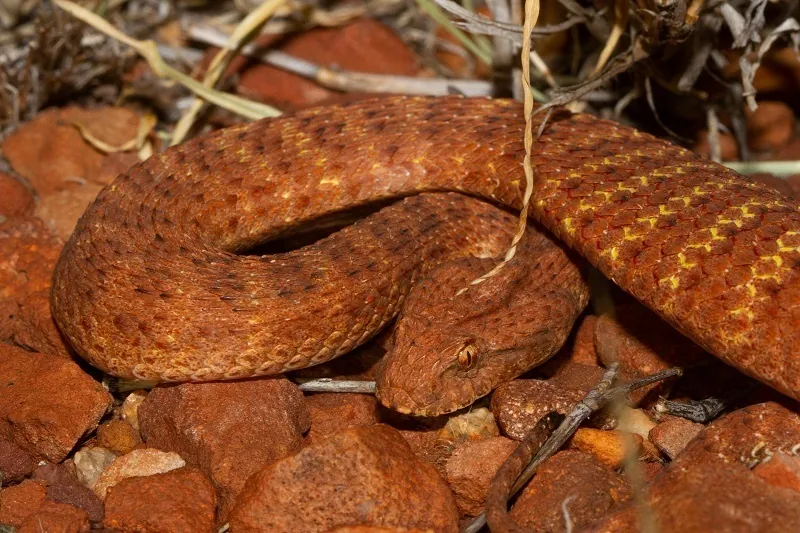
 Ni ngay ko xàmmee
- Coloured brick-red or yellow-reddish, with strong or inconspicuous yellow bands that blend in with the surroundings1
- Short, thick body with a triangular head and a thin, tapering tail1
- Flattened appearance1
- The tail tip is distinctly darker in colour1
- Grows to lengths up to 70 cm1
Ñu ngi koy faral di jaxasoo ak: The desert death adder is closely related to the common or southern death adder, which is found in a different range.1
Kàttanu daŋar
Daŋar bi dafay génn ci bëñam yi su màttee.
Lan la daŋar biy sóob di def?
Desert death adders have large fangs and produce a considerable quantity of toxic venom. The venom is mainly neurotoxic, which means it attacks the nerves. It once had a 50% mortality rate.1
Ni mu lore nit ñi?
Musiba ci nit: Am na musiba loolMën na rey nit ku ñu fajul.The desert death adder is one of the most venomous land snakes in the world and is regarded as very dangerous. Its venom rarely causes snake bites in Australia today. Its fangs are longer than those of most of Australia's venomous snakes.1
Lan lay def bu tiitee?
The desert death adder bites only when a threat or prey is very close. Its colours help it blend in with its surroundings.1
 Su màttee
- Immobilisation ak pression: laxasal ab bànd élastique bu dëgër ci kaw fa mu màtt, ba noppi nga laxas cër bi yépp jëm kaw, takkal ko attelle, te def ba nit ki bañ a yëngu dara ba ndimbal ñëw.
- Bul raxas fa mu màtt: lopitaan yi mën nañu saytu daŋar bi des ci der bi ngir tànn sérum antivenimeux bi baax.
Saa su nekk, woo jëkk sa nimerob urgence (112, 000, 911). Lii ay ndigal yu yaatu ci ndimbal yu jëkk la, du ndigalu doktoor. Li war a xam ci ndimbal yu jëkk
 Sàmmal sa bopp
- Bul laal mukk, bul jàpp, bul sonal ab rab bu àll, doonte bu ndaw la, te doonte dafa mel ni dafa nelaw walla dafa dee.
- May ko bérab. Su nga ko gisee, dalal, dellu ginnaaw ndànk-ndànk te bàyyi ko mu dem yoonam.
- Su benn màttee la: dalal, bul yëngu, woo sa nimerob urgence (112, 000, 911) walla dem lopitaan ci gaaw. Bul fàtte ni mu meloon, ab nataal dina dimbali.
Du la wut. Dafay jëfandikoo daŋaram ngir jàpp lu muy lekk walla ngir aar boppam, te nëbbu moo ko gën a neex. Yeneen ci ni ngay sàmme sa bopp
Ni mu réye?
Ni mu guddoo?
 guddu na ni 4 banaana yu ñu toftale
 mën na daw 100 meetar ci 58 segond (nit ki gën a gaaw soxla na 9,6)
Desert death adder ni mu réye ci wetu YOW?
Ay waññ rekk ci sa navigateur. Dara du denc te dara du yónnee fenn.
Ni mu gaawe?


Xibaar
The tip of its tail works as a lure. It looks like a worm or caterpillar, which tempts passing lizards.1
Its fangs are longer than those of most of Australia's venomous snakes.1
Unlike most other snakes, it gives birth to live young.1
It is most active after dark and is only occasionally seen during the day.1
Ngir boroom xam-xam ci daŋar
- Turu xam-xam
- Acanthophis pyrrhus
- Mbooloo
- Jaani Ostarali
- Njaboot
- Elapidae2
- Toftal
- Squamata
- Kontinaa yi
- Ostarali ak Oseyani
- Liir yi
- It gives birth to live young, up to 13 in each litter. Mating happens in spring or early summer, and the young are born in late summer or early autumn.1
- Ni mu nekke ci àll bi
- Under threat, mainly due to habitat destruction1
- Musiba ci nit
- 4 / 5: Am na musiba lool3
Fa xibaar yi jóge
- Desert death adder (Wikipedia (CC BY-SA 4.0))
- Acanthophis pyrrhus (iNaturalist): tur ak ni ñu leen séddale.
- Venom Wiki: tolluwaayu musiba bi, réyaay bu yem bi ak xalaatu gaawaay bi, nun ñoo leen defar. Seetal ni nu leen waññe: Ni nuy natte musiba.
Xibaar bu nekk ci xët wii am na ab nimero buy won fa mu jóge. Su nu juumee, baal nu, nun ay nit ñu bëgg rab lanu, du ab jurnaalu xam-xam. Wax nu ko ci [email protected] te dinanu ko jubbanti.
 Jiit bi dafa xiif! Venom Wiki ab liggéeyu kenn la: amul pay, amul piblisite te amul traceur. Ab may bu tuuti dafay dimbali ngir mu des ci internet.Leel jiit bi
Yeneen ci mbooloo mi: Jaani Ostarali
 Coastal taipan
 Common death adder
 Eastern brown snake
 Taypan bu ëll-bi (Inland taipan)
 Jaan-tigr
 Collett's snake
Dafay dund itam ci: Ostarali ak Oseyani
 Sydney funnel-web spiderTarentule ak atraxMën a rey
 Redback spiderJargoñSoxla na doktoor
 Brown tree snakeJaan yu am bëñ ci ginnaaw gémmiñDafay metti rekk
 Hooded pitohuiYeneen rab yu am daŋar ci seen yaramDafay metti rekkBul laal
 PlatypusRab yuy nàmpal yu am daŋarDafay metti rekk
 Northern tree-dwelling funnel-web spiderTarentule ak atraxMën a rey