
 Afrig
Afrig Asi
Asi Tugal
Tugal Amerig gu Bëj-saalum
 Ostarali ak Oseyani
 Antarktig
 Mbàmbulaanu Pasifik
 Mbàmbulaanu Atlantig
 Mbàmbulaanu End
 Mbàmbulaanu Arktik
 Géeju Mediteraane
 Géej gu Xonq
 Géeju Karayib
 Géeju Koraay
 Géeju Siin gu Bëj-saalum
 Géeju Filipin
 Géeju Andaman
 Géeju Bëj-gànnaar
 Géeju Timor ak Arafura
 Golfu Bengal
 Golfu Kaliforni
King brown snake
 Dafay màtt
The king brown snake is a highly venomous snake and the largest land-dwelling venomous snake in Australia. It lives across northern, western and Central Australia. Its size and venom make it one of the most important snakes to recognise in the region.1



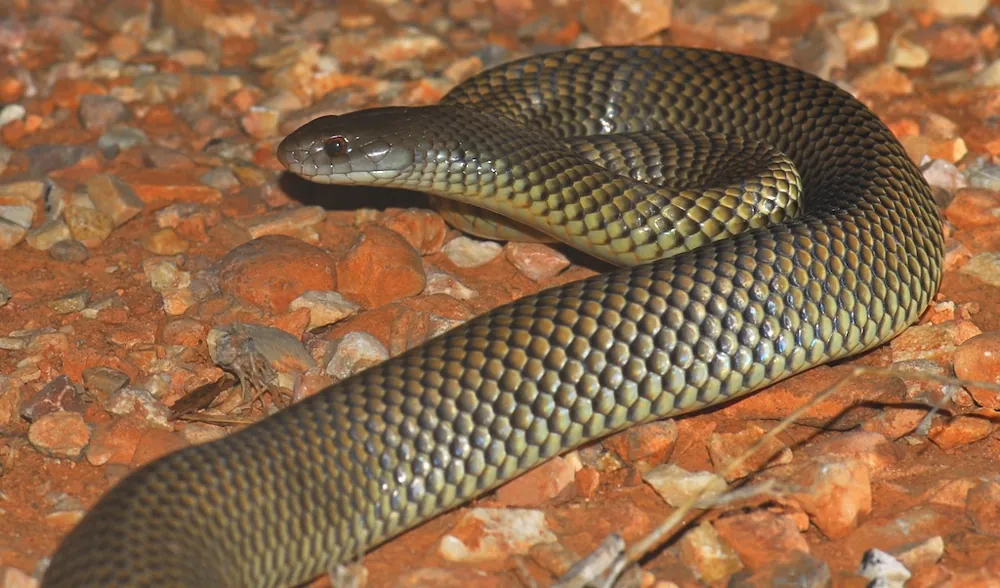
 Ni ngay ko xàmmee
- A large, robust snake that can reach 2.0 to 2.5 m, with a maximum confirmed length of 3.3 m.1
- Colour varies by area: tan in the north, and darker brown to blackish in the south.1
- Scales are two-toned, giving the upper body a reticulated (net-like) pattern.1
- The belly is cream, white or salmon, and often has orange marks.1
- The head is slightly wider than the body, with small eyes that have red-brown irises and a dark tongue.1
Ñu ngi koy faral di jaxasoo ak: King brown snakes can be confused with brown snakes of the genus Pseudonaja, olive pythons, water pythons, spotted mulga snakes and coastal taipans. In eastern brown snakes, the temporolabial scale and last supralabial scale (scales above the mouth) are fused. In king brown snakes, they are separate.1
Kàttanu daŋar
Daŋar bi dafay génn ci bëñam yi su màttee.
Lan la daŋar biy sóob di def?
The venom is not as potent as that of Australia's other dangerous snakes, but it can cause severe effects if delivered in large enough amounts. Its main effect is on striated (skeletal) muscle, which can cause paralysis through muscle damage. It also commonly affects blood clotting (coagulopathy).1
Ni mu lore nit ñi?
Musiba ci nit: Am na musiba loolMën na rey nit ku ñu fajul.Deaths from its bites have been recorded, with the most recent in 1969. Extensive pain and swelling often occur at the bite site, and necrosis (death of tissue) occurs rarely.1
 Xibaar bu baax: doktoor yi am nañu garab (sérum antivenimeux) walla ab paj ngir lii.1
 Su màttee
- Victims are treated with black snake (not brown snake) antivenom.1
- Immobilisation ak pression: laxasal ab bànd élastique bu dëgër ci kaw fa mu màtt, ba noppi nga laxas cër bi yépp jëm kaw, takkal ko attelle, te def ba nit ki bañ a yëngu dara ba ndimbal ñëw.
- Bul raxas fa mu màtt: lopitaan yi mën nañu saytu daŋar bi des ci der bi ngir tànn sérum antivenimeux bi baax.
Saa su nekk, woo jëkk sa nimerob urgence (112, 000, 911). Lii ay ndigal yu yaatu ci ndimbal yu jëkk la, du ndigalu doktoor. Li war a xam ci ndimbal yu jëkk
 Sàmmal sa bopp
- Bul laal mukk, bul jàpp, bul sonal ab rab bu àll, doonte bu ndaw la, te doonte dafa mel ni dafa nelaw walla dafa dee.
- May ko bérab. Su nga ko gisee, dalal, dellu ginnaaw ndànk-ndànk te bàyyi ko mu dem yoonam.
- Su benn màttee la: dalal, bul yëngu, woo sa nimerob urgence (112, 000, 911) walla dem lopitaan ci gaaw. Bul fàtte ni mu meloon, ab nataal dina dimbali.
Du la wut. Dafay jëfandikoo daŋaram ngir jàpp lu muy lekk walla ngir aar boppam, te nëbbu moo ko gën a neex. Yeneen ci ni ngay sàmme sa bopp
Ni mu réye?
Ni mu guddoo?
Ni mu diise?
 guddu na ni 3 xaj, bakkan ba geen
 guddu na ni 18 banaana yu ñu toftale
 diis na lu tollu ci muusu kër
 mën na daw 100 meetar ci 41 segond (nit ki gën a gaaw soxla na 9,6)
King brown snake ni mu réye ci wetu YOW?
Ay waññ rekk ci sa navigateur. Dara du denc te dara du yónnee fenn.
Ni mu gaawe?


Xibaar
Its name causes a real problem: its venom is not neutralised by brown snake antivenom, so the name has been criticised by medical researchers.1
It is the largest terrestrial venomous snake in Australia.1
In the Kaytetye language of Central Australia, it is called atetherr-ayne-wene, meaning "budgerigar-eater".1
Despite its common name, it belongs to the black snake genus Pseudechis and is only distantly related to true brown snakes.1
Males are around 20% larger than females.1
It has been reported to live up to 25 years in captivity.1
Tasukatu léeb
Xalaat bu juum: Because it is called a brown snake, brown snake antivenom will treat its bite.
Dëgg: Its venom is not neutralised by brown snake antivenom. Victims are treated with black snake antivenom.1
Ngir boroom xam-xam ci daŋar
- Turu xam-xam
- Pseudechis australis
- Mbooloo
- Jaani Ostarali
- Njaboot
- Elapidae2
- Toftal
- Squamata
- Kontinaa yi
- Ostarali ak Oseyani
- Liir yi
- King brown snakes lay eggs. A female produces a clutch of four to 19 eggs, usually around 10, which take 70 to 100 days to hatch.1
- Diiru dund
- lu tollu ci 25 at1
- Ni mu nekke ci àll bi
- Least concern (IUCN), though its numbers may have declined with the spread of the cane toad.1
- Musiba ci nit
- 4 / 5: Am na musiba lool3
Fa xibaar yi jóge
- King brown snake (Wikipedia (CC BY-SA 4.0))
- Pseudechis australis (iNaturalist): tur ak ni ñu leen séddale.
- Venom Wiki: tolluwaayu musiba bi, réyaay bu yem bi ak xalaatu gaawaay bi, nun ñoo leen defar. Seetal ni nu leen waññe: Ni nuy natte musiba.
Xibaar bu nekk ci xët wii am na ab nimero buy won fa mu jóge. Su nu juumee, baal nu, nun ay nit ñu bëgg rab lanu, du ab jurnaalu xam-xam. Wax nu ko ci [email protected] te dinanu ko jubbanti.
 Jiit bi dafa xiif! Venom Wiki ab liggéeyu kenn la: amul pay, amul piblisite te amul traceur. Ab may bu tuuti dafay dimbali ngir mu des ci internet.Leel jiit bi
Yeneen ci mbooloo mi: Jaani Ostarali
 Coastal taipan
 Common death adder
 Eastern brown snake
 Taypan bu ëll-bi (Inland taipan)
 Jaan-tigr
 Collett's snake
Dafay dund itam ci: Ostarali ak Oseyani
 Sydney funnel-web spiderTarentule ak atraxMën a rey
 Redback spiderJargoñSoxla na doktoor
 Brown tree snakeJaan yu am bëñ ci ginnaaw gémmiñDafay metti rekk
 Hooded pitohuiYeneen rab yu am daŋar ci seen yaramDafay metti rekkBul laal
 PlatypusRab yuy nàmpal yu am daŋarDafay metti rekk
 Northern tree-dwelling funnel-web spiderTarentule ak atraxMën a rey