
 Afrig
Afrig Asi
Asi Tugal
Tugal Amerig gu Bëj-saalum
 Ostarali ak Oseyani
 Antarktig
 Mbàmbulaanu Pasifik
 Mbàmbulaanu Atlantig
 Mbàmbulaanu End
 Mbàmbulaanu Arktik
 Géeju Mediteraane
 Géej gu Xonq
 Géeju Karayib
 Géeju Koraay
 Géeju Siin gu Bëj-saalum
 Géeju Filipin
 Géeju Andaman
 Géeju Bëj-gànnaar
 Géeju Timor ak Arafura
 Golfu Bengal
 Golfu Kaliforni
Lace monitor
 Dafay màtt
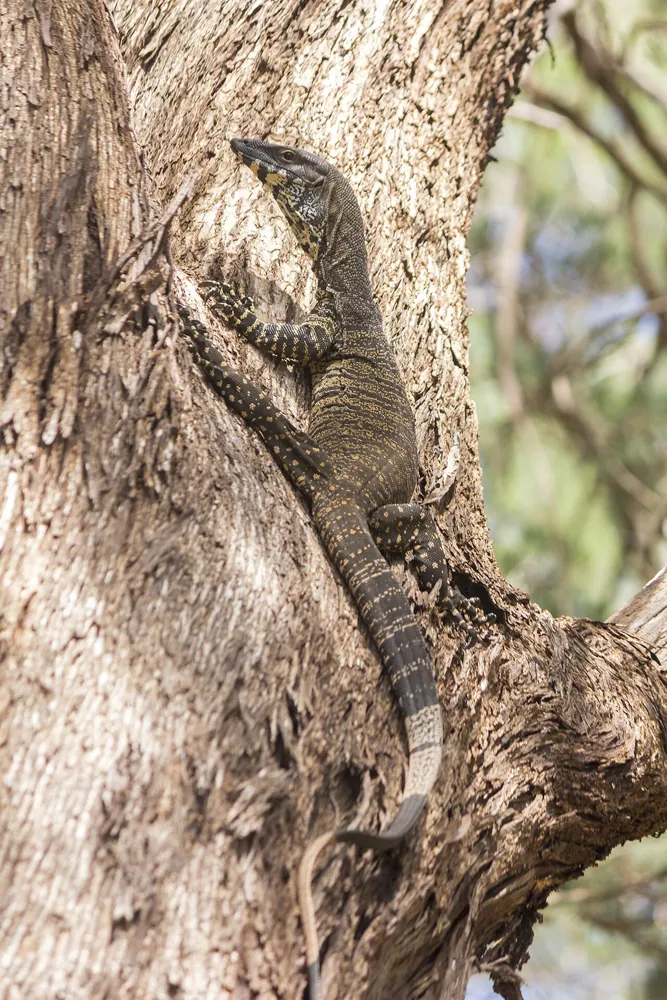
The lace monitor is a large lizard that lives in eastern Australia, and it can grow up to 2 metres long. It is a skilled climber that often lives in trees, and it is one of the country's biggest monitor lizards. It is also known as the tree goanna.1



 Ni ngay ko xàmmee
- The main form is dark grey to dull bluish-black with scattered cream-coloured spots.1
- The head is black, and the snout has prominent black and yellow bands that extend under the chin and neck.1
- The tail has narrow black and cream bands that get wider towards the tip.1
- Bell's form has a yellow-brown or yellow base colour with fine black mottling and broad black or dark brown bands from the shoulders to the tail.1
- Juveniles have more defined banding, with five narrow black bands on the neck and eight on the body.1
Kàttanu daŋar
Daŋar bi dafay génn ci bëñam yi su màttee.
Lan la daŋar biy sóob di def?
Lace monitors have venom glands, and their venom is similar to snake venom, but it is not strong enough to cause serious harm. A bite on the hand can cause swelling within minutes, localised disruption of blood clotting (the blood clots less well in that area), and shooting pain up to the elbow. This pain can often last for several hours.1
Ni mu lore nit ñi?
Musiba ci nit: Dafay mettiMën na metti lool, waaye lu bon du faral di am.Its venom is not enough to cause serious harm. Scientists have cautioned that calling these lizards venomous overestimates the medical risk to bite victims.1
Lan lay def bu tiitee?
When disturbed, lace monitors retreat to a nearby tree.1
 Su màttee
- Raxas gaañu-gaañu bi, def ba nit ki dal te wutal ndimbal doktoor.
Saa su nekk, woo jëkk sa nimerob urgence (112, 000, 911). Lii ay ndigal yu yaatu ci ndimbal yu jëkk la, du ndigalu doktoor. Li war a xam ci ndimbal yu jëkk
 Sàmmal sa bopp
- Bul laal mukk, bul jàpp, bul sonal ab rab bu àll, doonte bu ndaw la, te doonte dafa mel ni dafa nelaw walla dafa dee.
- May ko bérab. Su nga ko gisee, dalal, dellu ginnaaw ndànk-ndànk te bàyyi ko mu dem yoonam.
- Su benn màttee la: dalal, bul yëngu, woo sa nimerob urgence (112, 000, 911) walla dem lopitaan ci gaaw. Bul fàtte ni mu meloon, ab nataal dina dimbali.
Du la wut. Dafay jëfandikoo daŋaram ngir jàpp lu muy lekk walla ngir aar boppam, te nëbbu moo ko gën a neex. Yeneen ci ni ngay sàmme sa bopp
Ni mu réye?
Ni mu guddoo?
Ni mu diise?
 guddu na ni 4 muusu kër, bakkan ba geen
 guddu na ni 11 banaana yu ñu toftale
 mën na daw 100 meetar ci 22 segond (nit ki gën a gaaw soxla na 9,6)
Lace monitor ni mu réye ci wetu YOW?
Ay waññ rekk ci sa navigateur. Dara du denc te dara du yónnee fenn.
Ni mu gaawe?

Xibaar
Populations near rubbish tips were thirty five times greater than in natural forest, and individuals were around twice as heavy.1
Lace monitors quickly learned to avoid cane toads after they had been poisoned by them.1
One lace monitor was recorded climbing a brick wall to find shelter during a thunderstorm.1
Its closest living relative is the Komodo dragon.1
Tasukatu léeb
Xalaat bu juum: Bites from monitors were thought to be dangerous mainly because of infection from bacteria in their mouths.
Dëgg: Researchers found in 2005 that the immediate effects of bites were more likely caused by venom.1
Ngir boroom xam-xam ci daŋar
- Turu xam-xam
- Varanus varius
- Mbooloo
- Lézard yu am daŋar
- Njaboot
- Varanidae2
- Toftal
- Squamata
- Kontinaa yi
- Ostarali ak Oseyani
- Liir yi
- Females lay an average of eight eggs, and up to 12, in active termite nests on the ground or in trees. The eggs hatch 6 to 7 months later.1
- Diiru dund
- lu tollu ci 20 at1
- Ni mu nekke ci àll bi
- Least Concern1
- Musiba ci nit
- 2 / 5: Dafay metti3
Fa xibaar yi jóge
- Lace monitor (Wikipedia (CC BY-SA 4.0))
- Varanus varius (iNaturalist): tur ak ni ñu leen séddale.
- Venom Wiki: tolluwaayu musiba bi, réyaay bu yem bi ak xalaatu gaawaay bi, nun ñoo leen defar. Seetal ni nu leen waññe: Ni nuy natte musiba.
Xibaar bu nekk ci xët wii am na ab nimero buy won fa mu jóge. Su nu juumee, baal nu, nun ay nit ñu bëgg rab lanu, du ab jurnaalu xam-xam. Wax nu ko ci [email protected] te dinanu ko jubbanti.
 Jiit bi dafa xiif! Venom Wiki ab liggéeyu kenn la: amul pay, amul piblisite te amul traceur. Ab may bu tuuti dafay dimbali ngir mu des ci internet.Leel jiit bi
 Perentie
 Spiny-tailed monitor
 Yellow-spotted monitor
 Mitchell's water monitor
 Komodo dragon
 Gila monster
 Coastal taipan
 Common death adder
 Eastern brown snake
 Taypan bu ëll-bi (Inland taipan)
 Sydney funnel-web spider
 Jaan-tigr
,_photographed_in_the_Kindra_State_Forest.jpg)