
 Afrig
Afrig Asi
Asi Tugal
Tugal Amerig gu Bëj-saalum
 Ostarali ak Oseyani
 Antarktig
 Mbàmbulaanu Pasifik
 Mbàmbulaanu Atlantig
 Mbàmbulaanu End
 Mbàmbulaanu Arktik
 Géeju Mediteraane
 Géej gu Xonq
 Géeju Karayib
 Géeju Koraay
 Géeju Siin gu Bëj-saalum
 Géeju Filipin
 Géeju Andaman
 Géeju Bëj-gànnaar
 Géeju Timor ak Arafura
 Golfu Bengal
 Golfu Kaliforni
Perentie
 Dafay màtt
The perentie is one of the largest lizards alive, and the largest in Australia. It lives in the dry deserts of the west, centre and north of the country, where it is rarely seen. It is a powerful hunter that eats a wide range of animals, and it is important in many Aboriginal cultures.1



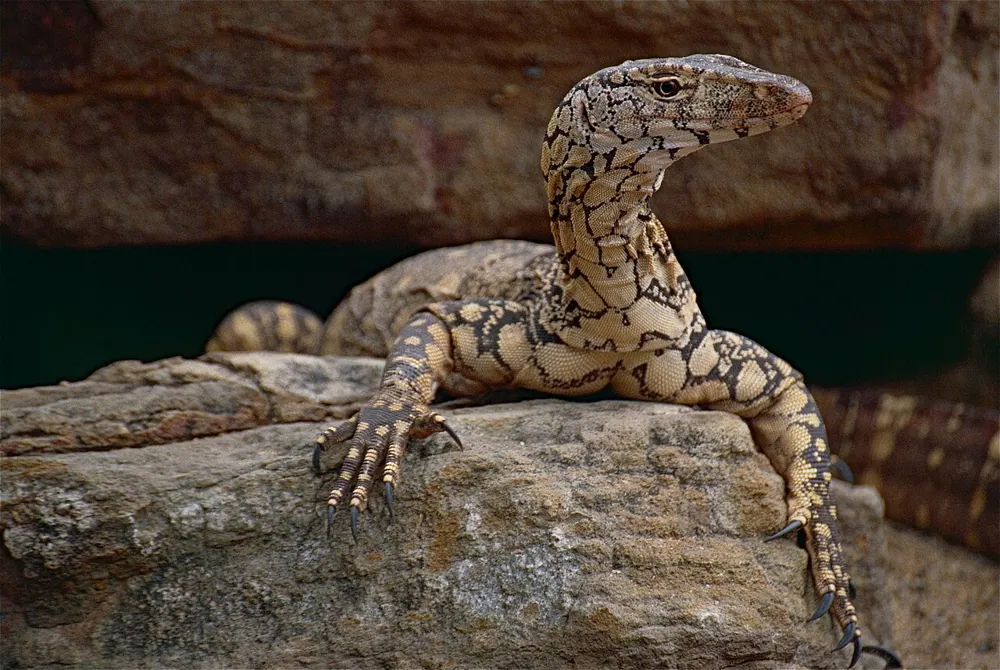
 Ni ngay ko xàmmee
- Head and neck are creamy-white with a net-like (reticulated) pattern of black lines and flecks.1
- Body is yellow or cream, with brown rosette markings on the back.1
- Limbs are dark with white spots.1
- Very lean for a large monitor, so much less bulky than a rock monitor of similar length.1
Ñu ngi koy faral di jaxasoo ak: Rock monitors can reach a similar length, but they are much bulkier. Perenties are very lean for their size.1
Kàttanu daŋar
Daŋar bi dafay génn ci bëñam yi su màttee.
Lan la daŋar biy sóob di def?
Researchers at the University of Melbourne found in 2005 that monitors may be somewhat venomous, which means they inject mild venom with a bite. A perentie bite can cause swelling within minutes, localised disruption of blood clotting (the blood's ability to clot is affected in the area), and shooting pain up to the elbow that can last several hours.1
Ni mu lore nit ñi?
Musiba ci nit: Dafay mettiMën na metti lool, waaye lu bon du faral di am.The bite can do much damage, not only from the teeth but also from the oral secretions.1
Lan lay def bu tiitee?
If threatened, a perentie will usually freeze flat on the ground or run away. If cornered, it stands its ground, inflates its throat, hisses, strikes with its tail, and may lunge with its mouth open.1
 Su màttee
- Raxas gaañu-gaañu bi, def ba nit ki dal te wutal ndimbal doktoor.
Saa su nekk, woo jëkk sa nimerob urgence (112, 000, 911). Lii ay ndigal yu yaatu ci ndimbal yu jëkk la, du ndigalu doktoor. Li war a xam ci ndimbal yu jëkk
 Sàmmal sa bopp
- Bul laal mukk, bul jàpp, bul sonal ab rab bu àll, doonte bu ndaw la, te doonte dafa mel ni dafa nelaw walla dafa dee.
- May ko bérab. Su nga ko gisee, dalal, dellu ginnaaw ndànk-ndànk te bàyyi ko mu dem yoonam.
- Su benn màttee la: dalal, bul yëngu, woo sa nimerob urgence (112, 000, 911) walla dem lopitaan ci gaaw. Bul fàtte ni mu meloon, ab nataal dina dimbali.
Du la wut. Dafay jëfandikoo daŋaram ngir jàpp lu muy lekk walla ngir aar boppam, te nëbbu moo ko gën a neex. Yeneen ci ni ngay sàmme sa bopp
Ni mu réye?
Ni mu guddoo?
Ni mu diise?

 guddu na ni 2,5 xaj, bakkan ba geen
 guddu na ni 14 banaana yu ñu toftale
 mën na daw 100 meetar ci 20 segond (nit ki gën a gaaw soxla na 9,6)
Perentie ni mu réye ci wetu YOW?
Ay waññ rekk ci sa navigateur. Dara du denc te dara du yónnee fenn.
Ni mu gaawe?

Xibaar
Perenties eat other monitor lizards, including a 2 m perentie that was seen killing and eating a 1.5 m one.1
They often stand on their back legs and tail to get a better view, a behaviour called "tripoding".1
Perenties are among the largest living lizards, after the Komodo dragon, Asian water monitor and crocodile monitor.1
Perenties can dig a burrow for shelter in only minutes.1
The species was first named the "gigantic water lizard", even though it lives in dry desert country.1
The perentie has long been important to desert Aboriginal peoples, who ate it as food and used its fat for medicinal and ceremonial purposes.1
Tasukatu léeb
Xalaat bu juum: Monitor lizard bites were thought to cause problems only because of infection from bacteria in the animal's mouth.
Dëgg: Researchers showed that the immediate effects of monitor bites, including swelling and pain, are caused by mild envenomation.1
Fa xibaar yi jóge
- Perentie (Wikipedia (CC BY-SA 4.0))
- Varanus giganteus (iNaturalist): tur ak ni ñu leen séddale.
- Venom Wiki: tolluwaayu musiba bi, réyaay bu yem bi ak xalaatu gaawaay bi, nun ñoo leen defar. Seetal ni nu leen waññe: Ni nuy natte musiba.
Xibaar bu nekk ci xët wii am na ab nimero buy won fa mu jóge. Su nu juumee, baal nu, nun ay nit ñu bëgg rab lanu, du ab jurnaalu xam-xam. Wax nu ko ci [email protected] te dinanu ko jubbanti.
 Jiit bi dafa xiif! Venom Wiki ab liggéeyu kenn la: amul pay, amul piblisite te amul traceur. Ab may bu tuuti dafay dimbali ngir mu des ci internet.Leel jiit bi
 Lace monitor
 Spiny-tailed monitor
 Yellow-spotted monitor
 Mitchell's water monitor
 Komodo dragon
 Gila monster
 Coastal taipan
 Common death adder
 Eastern brown snake
 Taypan bu ëll-bi (Inland taipan)
 Sydney funnel-web spider
 Jaan-tigr
_(10244734736).jpg)