
 IAfrika
 IAsiya
 IYurophu
 uMzantsi Melika
 IOstreliya neOceania
 IAntarctica
 uLwandlekazi lwePasifiki
 uLwandlekazi lweAtlantiki
 uLwandlekazi lwaseIndiya
 uLwandlekazi lweArctic
 uLwandle lweMeditera
 uLwandle oluBomvu
 uLwandle lweKharibhiya
 uLwandle lweCoral
 uLwandle lwaseMzantsi China
 uLwandle lwePhilippines
 uLwandle lweAndaman
 uLwandle lwaseMntla (North Sea)
 uLwandle lweTimor ne-Arafura
 iBhayi yaseBengal
 iGulf yaseCalifornia
Collared whip snake
 Ukuluma
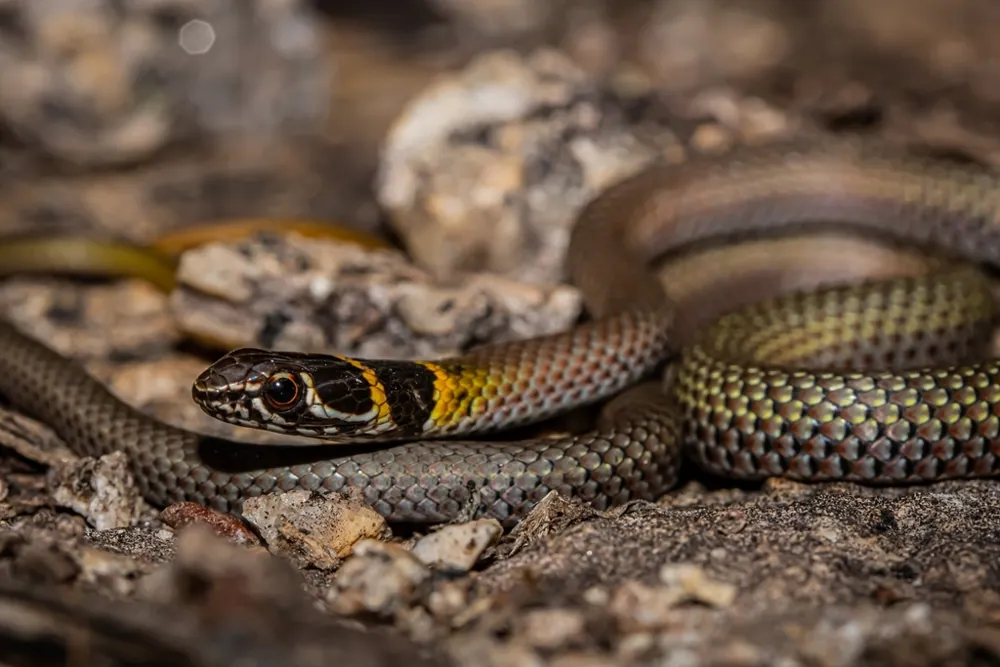
The collared whipsnake is a medium-sized snake that lives only in Australia. It is found in rainforest edges, tropical woodland, rocky places and on some offshore islands. It is easy to pick out by the dark collar behind its head.1

 Indlela yokusiqaphela
- A dark band runs across the back of the neck, with a pale edge. This collar is less obvious in adults than in juveniles.1
- A pale streak runs from the snout to the eye, and joins a pale streak behind the eye to make a teardrop-shaped marking on the head.1
- Juveniles have a dark brown head and back that contrast with a paler underside.1
- Adults are closer to olive-green on the head and back, and the back is a similar colour to the underside.1
- Adults usually measure between 17.1 and 63.6 cm from snout to vent (the body, not including the tail).1
Sidla ngokubhidaniswa no: The closest species by location is D. rimicola. The collared whipsnake has a pale upper edge to its teardrop marking that extends across the face and joins the front band of the neck collar. It also has a greyish underside, which differs from most other Demansia species. Counting the ventral (belly) and subcaudal (under-tail) scales can also help with identification.1
Amandla etyhefu yokuluma nokuhlaba
Ityhefu iphuma ngamazinyo aso etyhefu okanye ngamazinyo aso xa siluma.
Siyingozi kangakanani ebantwini?
Ingozi ebantwini: KubuhlunguKunokuba buhlungu ngokwenene, kodwa phantse akusoze kube kubi kakhulu. Ukuba siyaluma
- Ukubopha ngoxinzelelo nokunqanda ukushukuma (pressure immobilisation): songa ibhandeji eqinileyo enwebekayo phezu kwendawo elunyiweyo uze unyuke ngelungu lonke, uliqinise ngesiplinti, kwaye ugcine umntu engashukumi kwaphela de kufike uncedo.
- Musa ukuhlamba indawo elunyiweyo: izibhedlele zinokuvavanya ityhefu eseleyo esikhumbeni ukuze zikhethe i-antivenom echanekileyo.
Soloko utsalela inombolo kaxakeka kuqala (112, 000, 911). Esi sisikhokelo soncedo lokuqala ngokubanzi, asilocebiso lwezonyango. Iziseko zoncedo lokuqala
 Hlala ukhuselekile
- Ungaze uchukumise, ubambe okanye uqhule isilwanyana sasendle, nokuba sincinci, kwaye nokuba sibonakala silele okanye sifile.
- Sinike indawo. Ukuba udibana naso, hlala uzolile, buyela umva kancinci kwaye usiyeke sihambe ngendlela yaso.
- Ukuba siyakuluma: hlala uzolile, musa ukushukuma, tsalela inombolo kaxakeka (112, 000, 911) okanye uye esibhedlele ngokukhawuleza. Khumbula ukuba sasikhangeleka njani, ifoto iyanceda.
Asikuzingeli. Sisebenzisa ityhefu yaso ukubamba ukutya okanye ukuzikhusela, kwaye singakhetha ukuzimela. Okungakumbi malunga nokuhlala ukhuselekile
Sikhulu kangakanani?
Side kangakanani?
 ubude obulingana neebhanana eziyi-4 zilandelelana
 singagqiba iimitha ezili-100 ngemizuzwana eyi-58 (owona mntu ukhawulezayo udinga i-9,6)
U-Collared whip snake mkhulu kangakanani xa uthelekisa NAWE?
Zizibalo nje kwibhrawuza yakho. Akukho nto igcinwayo okanye ithunyelwa naphi na.
Sikhawuleza kangakanani?


Iinyaniso
Females appear to ovulate at the same time each year, during spring.1
This snake lays eggs rather than giving birth to live young. A typical clutch has about 4 eggs.1
Males usually have more ventral and subcaudal scales and longer tails than females, but there is no significant size difference between the sexes.1
Apho iinyaniso zivela khona
- Collared whipsnake (Wikipedia (CC BY-SA 4.0))
- Demansia torquata (iNaturalist): amagama nokuhlelwa.
- Venom Wiki: inqanaba lengozi, ubungakanani obuqhelekileyo noqikelelo lwesantya zezethu. Bona indlela esizifumana ngayo: Indlela esilinganisa ngayo ingozi.
Inyaniso nganye kweli phepha inenombolo ebonisa umthombo wayo. Ukuba senze impazamo, uxolo, sithanda izilwanyana, asiyomagazini yenzululwazi. Sixelele ku-[email protected] kwaye siza kuyilungisa.
 Unomadudwane ulambile! I-Venom Wiki yiprojekthi yomntu omnye: isimahla, ayinazibhengezo kwaye ayinazilandeli. Isipho esincinci sinceda ukuyigcina ikwi-intanethi.Yondla unomadudwane
Okungakumbi kwiqela elinye: Iinyoka zaseOstreliya
 Coastal taipanIinyoka zaseOstreliyaSiyabulala
 Common death adderIinyoka zaseOstreliyaSiyabulala
 Eastern brown snakeIinyoka zaseOstreliyaSiyabulala
 Inyoka ityhefu yaseOstreliya (Inland taipan)Iinyoka zaseOstreliyaSiyabulala
 Inyoka yengweIinyoka zaseOstreliyaSiyabulala
 Collett's snakeIinyoka zaseOstreliyaSinokubulala
Sikwahlala: IOstreliya neOceania
 Sydney funnel-web spiderIi-tarantula nee-funnel-webSiyabulala
 Redback spiderIzigcawuKufuna ugqirha
 Brown tree snakeIinyoka ezinamazinyo etyhefu ngasemvaKubuhlungu nje
 Hooded pitohuiEzinye izilwanyana ezityhefayoKubuhlungu njeMusa ukuchukumisa
 PlatypusIzilwanyana ezincancisayo ezinetyhefuKubuhlungu nje
 Northern tree-dwelling funnel-web spiderIi-tarantula nee-funnel-webSiyabulala