
 Áfíríkà
 Éṣíà
Éṣíà Yúróòpù
 Gúúsù Amẹ́ríkà
 Ọsirélíà àti Òṣéáníà
 Antáktíkà
 Òkun Pàsífíìkì
 Òkun Àtìláńtíìkì
 Òkun Íńdíà
 Òkun Áktíkì
 Òkun Mẹditaréníà
 Òkun Pupa
 Òkun Káríbíànù
 Òkun Coral
 Òkun Gúúsù Ṣáínà
 Òkun Fílípínì
 Òkun Andaman
 Òkun Àríwá
 Òkun Tímọ̀ àti Òkun Àráfúrà
 Ìyawọlẹ̀ Òkun Bẹ̀ngál
 Ìyawọlẹ̀ Òkun Kalifọ́níà
Green cat snake
 Ìbùjẹ
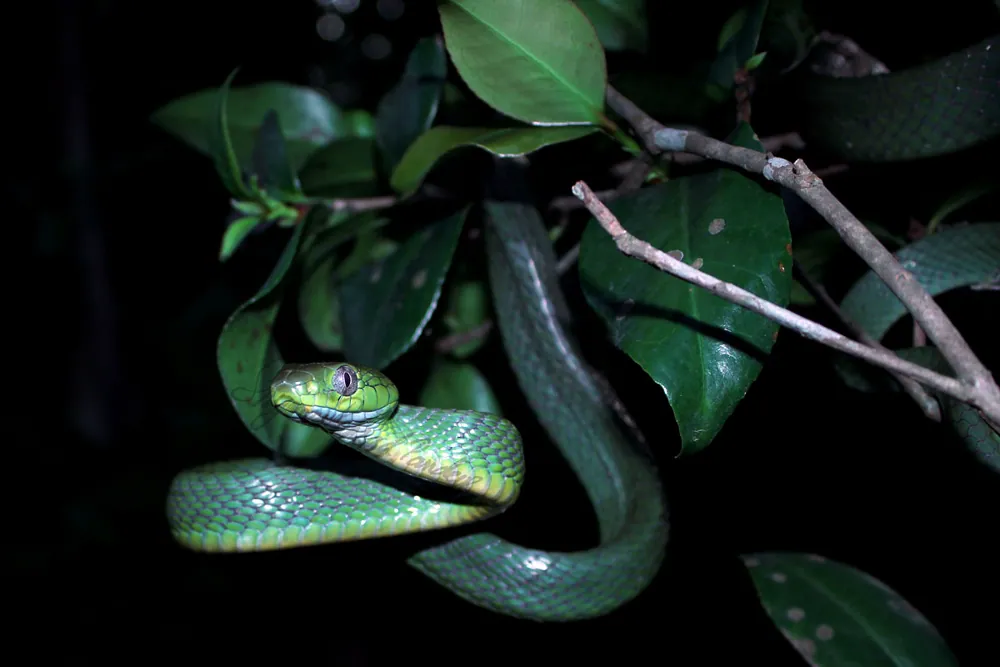
ÌbùjẹThe green cat snake is a slim, bright green snake that lives mostly in trees. It is found in South Asia, China and South-east Asia, mainly in forests. It is a rear-fanged snake that is only mildly venomous to people.1



 Bí o ṣe lè dá a mọ̀
- Uniform green back, or green mixed with grey or blue1
- Greenish or yellowish white belly1
- Large eyes with vertical, cat-like pupils, and golden brown irises1
- Yellowish upper lip, with most head scales edged in black1
- Hatchlings are reddish brown with a green head, and begin to turn green at about 8 to 9 months old1
Agbára oró
Oró ń jáde láti inú eyín oró tàbí eyín rẹ̀ nígbà tí ó bá bùjẹ.
Kí ni oró rẹ̀ máa ń ṣe?
This is a rear-fanged snake, meaning its fangs are at the back of the mouth, and it is described as mildly venomous. Its venom can paralyse small prey. Bites are expected to cause only mild to moderate local swelling and pain, with occasional bruising, numbness, redness or bleeding, but no tissue death (necrosis) and no whole-body (systemic) effects.1
Báwo ló ṣe léwu tó fún ènìyàn?
Ewu fún ènìyàn: Ó ń dunniÓ lè dunni gan-an, ṣùgbọ́n kì í fẹ́rẹ̀ẹ́ le rárá.Bites are not expected to cause medically significant effects. Most cases are minor, but some are more severe and need hospital admission and treatment.1
Kí ni ó máa ń ṣe nígbà tí ẹ̀rù bá bà á?
Usually sluggish and hard to provoke into striking, it may become hostile when threatened and display with its mouth wide open.1
 Bí ó bá bùjẹ
- Bites usually need no treatment beyond checking for infection and making sure tetanus protection is up to date. Anyone who develops local symptoms, such as signs of infection, should return for medical review. Some bites are more severe and need hospital care, so a careful assessment is needed before discharge.1
- Fọ ibi ìbùjẹ náà, jẹ́ kí ẹni náà farabalẹ̀, kí o sì wá ìrànlọ́wọ́ ìṣègùn. Àwọn irú kan (bí boomslang) lè pani ní wákàtí púpọ̀ lẹ́yìn náà.
Máa kọ́kọ́ pe nọ́ńbà pàjáwìrì rẹ nígbà gbogbo (112, 000, 911). Èyí jẹ́ ìtọ́sọ́nà ìtọ́jú àkọ́kọ́ gbogbogbò, kì í ṣe ìmọ̀ràn ìṣègùn. Ìpìlẹ̀ ìtọ́jú àkọ́kọ́
 Wà láìléwu
- Má ṣe fọwọ́ kan, mú tàbí yọ ẹranko igbó lẹ́nu láéláé, kódà bí ó bá kéré, kódà bí ó bá dà bí ẹni pé ó ń sùn tàbí ó ti kú.
- Fún un ní àyè. Bí o bá pàdé ọ̀kan, farabalẹ̀, sẹ́yìn díẹ̀díẹ̀ kí o sì jẹ́ kí ó máa bá ọ̀nà rẹ̀ lọ.
- Bí ọ̀kan bá bù ọ́ jẹ: farabalẹ̀, má ṣe mira, pe nọ́ńbà pàjáwìrì rẹ (112, 000, 911) tàbí lọ sí ilé ìwòsàn kíákíá. Rántí bí ó ṣe rí, fọ́tò máa ń ṣèrànwọ́.
Kò wá ọ kiri láti ṣe ọ́ léṣe. Ó ń lo oró rẹ̀ láti mú oúnjẹ tàbí láti dáàbò bo ara rẹ̀, ó sì fẹ́ràn láti farapamọ́ jù. Sí i nípa wíwà láìléwu
Báwo ló ṣe tóbi tó?
Báwo ló ṣe gùn tó?
 ó gùn tó ológbò ilé 4 láti imú dé ìrù
 ó gùn tó ọ̀gẹ̀dẹ̀ 11 tí a tò tẹ̀léra
 lè sáré mítà 100 ní ìṣẹ́jú-àáyá 60 (ènìyàn tó yára jùlọ nílò 9.6)
Báwo ni Green cat snake ṣe tóbi tó tí a bá fi wé ÌWỌ?
Ìṣirò nìkan nínú bráwúsà rẹ. A kò fi ohunkóhun pamọ́, a kò sì fi ránṣẹ́ sí ibikíbi.
Báwo ló ṣe yára tó?


Òtítọ́
It is one of the rear-fanged snakes, and its venom is used to paralyse small prey.1
Its long, grasping tail lets it live entirely in trees, so it is described as purely arboreal.1
Despite its size, it is sluggish and makes no attempt to escape when handled.1
Hatchlings look very different from adults, being reddish brown with a green head.1
It hunts at night and rests during the day, coiled among the branches.1
A female lays between 7 and 14 eggs, which take about 85 days to hatch.1
Ibi tí àwọn òtítọ́ ti wá
- Boiga cyanea (Wikipedia (CC BY-SA 4.0))
- Boiga cyanea (iNaturalist): orúkọ àti ìpínsísọ̀rí.
- Venom Wiki: ìpele ewu, ìtóbi déédé àti àfojúbù ìyára jẹ́ tiwa. Wo bí a ṣe ń ṣírò wọn: Bí a ṣe ń díwọ̀n ewu.
Gbogbo òtítọ́ ojú-ìwé yìí ní nọ́ńbà tó tọ́ka sí orísun rẹ̀. Bí a bá ṣe àṣìṣe, má bínú, olólùfẹ́ ẹranko ni wá, kì í ṣe ìwé ìròyìn sáyẹ́ǹsì. Sọ fún wa ní [email protected] a ó sì tún un ṣe.
 Ebi ń pa àkekèé! Iṣẹ́ akanṣe ẹnì kan ṣoṣo ni Venom Wiki: ọ̀fẹ́ ni, kò sí ìpolówó, kò sì sí olùtọpinpin. Ẹ̀bùn kékeré ń ràn án lọ́wọ́ láti wà lórí íńtánẹ́ẹ̀tì.Bọ́ àkekèé
 Brown tree snake
 Tiger keelback
 Red-necked keelback
 Mangrove snake
 Asian vine snake
 Golden tree snake
 Deathstalker
 Indian cobra
 Indian saw-scaled viper
 King cobra
 Puff adder
 Paramọlẹ Russell