
 Áfíríkà
 Éṣíà
Éṣíà Yúróòpù
 Gúúsù Amẹ́ríkà
 Ọsirélíà àti Òṣéáníà
 Antáktíkà
 Òkun Pàsífíìkì
 Òkun Àtìláńtíìkì
 Òkun Íńdíà
 Òkun Áktíkì
 Òkun Mẹditaréníà
 Òkun Pupa
 Òkun Káríbíànù
 Òkun Coral
 Òkun Gúúsù Ṣáínà
 Òkun Fílípínì
 Òkun Andaman
 Òkun Àríwá
 Òkun Tímọ̀ àti Òkun Àráfúrà
 Ìyawọlẹ̀ Òkun Bẹ̀ngál
 Ìyawọlẹ̀ Òkun Kalifọ́níà
McMahon's viper
 Ìbùjẹ
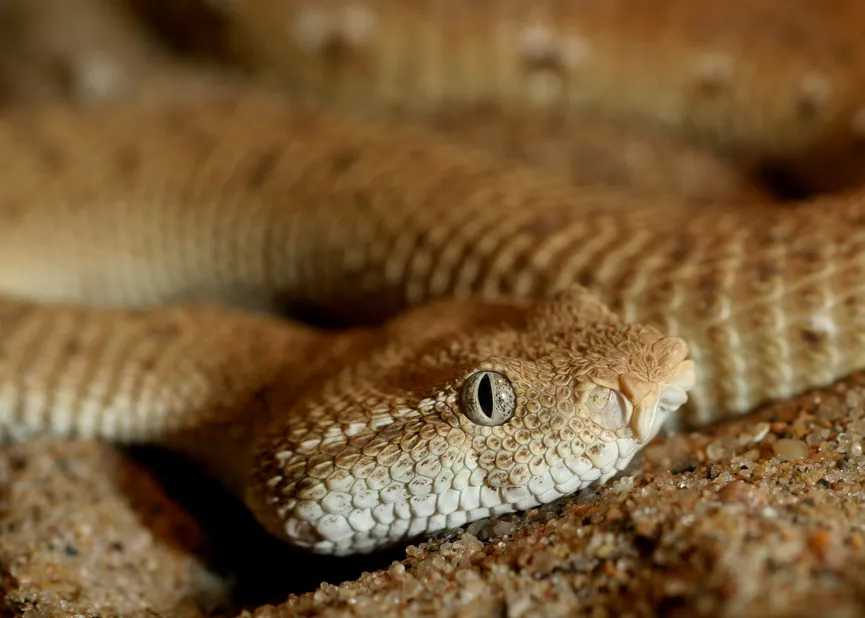
ÌbùjẹMcMahon's viper is a small, venomous snake that lives in the sandy deserts of Balochistan, near the borders of Iran, Pakistan and Afghanistan. It is well known for its habit of sinking into loose sand so that only its snout and eyes stay uncovered. Scientists have also studied a protein from its venom for its possible use against melanoma, a type of skin cancer.1



 Bí o ṣe lè dá a mọ̀
- Reddish to yellowish brown body with a regular series of 20 to 25 dark spots, each bordered partly or fully with white scales1
- A white stripe runs from the back of the eye to the corner of the mouth1
- Large, broad, flat, wedge-shaped head that is clearly distinct from the neck1
- Short tail with a yellow tip and distinct crossbands1
- Adults are under 1 m (39 in) in total length, tail included1
Agbára oró
Oró ń jáde láti inú eyín oró tàbí eyín rẹ̀ nígbà tí ó bá bùjẹ.
Kí ni oró rẹ̀ máa ń ṣe?
Relatively few data are available on its venom. The species is regarded as potentially dangerous, and its venom is said to be similar to that of snakes in the genus Echis. A venom protein called eristostatin has been reported to help in the fight against melanoma.1
Báwo ló ṣe léwu tó fún ènìyàn?
Ewu fún ènìyàn: Ó le gan-anÌbùjẹ nílò dókítà. Ikú kò wọ́pọ̀ rárá.It is regarded as a potentially dangerous species. It is described as bad-tempered, hissing very loudly and deeply, and it will strike aggressively when threatened.1
Kí ni ó máa ń ṣe nígbà tí ẹ̀rù bá bà á?
It hisses very loudly and deeply, raises the front of its body off the ground in a loop and strikes aggressively. It may also sink into sand and cover its head, leaving only its snout and eyes uncovered.1
 Bí ó bá bùjẹ
- Jẹ́ kí ẹni náà wà láìmira kí ó sì farabalẹ̀, jẹ́ kí apá tàbí ẹsẹ̀ tí ó bù jẹ wà ní ìpele ọkàn, yọ òrùka àti àwọn nǹkan tó há, kí ẹ sì lọ sí ilé ìwòsàn kíákíá.
Máa kọ́kọ́ pe nọ́ńbà pàjáwìrì rẹ nígbà gbogbo (112, 000, 911). Èyí jẹ́ ìtọ́sọ́nà ìtọ́jú àkọ́kọ́ gbogbogbò, kì í ṣe ìmọ̀ràn ìṣègùn. Ìpìlẹ̀ ìtọ́jú àkọ́kọ́
 Wà láìléwu
- Má ṣe fọwọ́ kan, mú tàbí yọ ẹranko igbó lẹ́nu láéláé, kódà bí ó bá kéré, kódà bí ó bá dà bí ẹni pé ó ń sùn tàbí ó ti kú.
- Fún un ní àyè. Bí o bá pàdé ọ̀kan, farabalẹ̀, sẹ́yìn díẹ̀díẹ̀ kí o sì jẹ́ kí ó máa bá ọ̀nà rẹ̀ lọ.
- Bí ọ̀kan bá bù ọ́ jẹ: farabalẹ̀, má ṣe mira, pe nọ́ńbà pàjáwìrì rẹ (112, 000, 911) tàbí lọ sí ilé ìwòsàn kíákíá. Rántí bí ó ṣe rí, fọ́tò máa ń ṣèrànwọ́.
Kò wá ọ kiri láti ṣe ọ́ léṣe. Ó ń lo oró rẹ̀ láti mú oúnjẹ tàbí láti dáàbò bo ara rẹ̀, ó sì fẹ́ràn láti farapamọ́ jù. Sí i nípa wíwà láìléwu
Báwo ló ṣe tóbi tó?
Báwo ló ṣe gùn tó?
 ó gùn tó ọ̀gẹ̀dẹ̀ 4 tí a tò tẹ̀léra
 lè sáré mítà 100 ní ìṣẹ́jú-àáyá 110 (ènìyàn tó yára jùlọ nílò 9.6)
Báwo ni McMahon's viper ṣe tóbi tó tí a bá fi wé ÌWỌ?
Ìṣirò nìkan nínú bráwúsà rẹ. A kò fi ohunkóhun pamọ́, a kò sì fi ránṣẹ́ sí ibikíbi.
Báwo ló ṣe yára tó?


Òtítọ́
A protein in its venom, called eristostatin, has been reported to help in the fight against melanoma.1
It can sink down into loose sand using a rocking or wave-like motion, then shake its head to cover it with sand.1
Its enlarged nasorostral scales are thought to keep sand out of its nostrils.1
It moves by sidewinding when crossing loose sand or when alarmed.1
Its short tail is prehensile, and it sometimes climbs into bushes with it.1
Ibi tí àwọn òtítọ́ ti wá
- Eristicophis (Wikipedia (CC BY-SA 4.0))
- Venom Wiki: ìpele ewu, ìtóbi déédé àti àfojúbù ìyára jẹ́ tiwa. Wo bí a ṣe ń ṣírò wọn: Bí a ṣe ń díwọ̀n ewu.
Gbogbo òtítọ́ ojú-ìwé yìí ní nọ́ńbà tó tọ́ka sí orísun rẹ̀. Bí a bá ṣe àṣìṣe, má bínú, olólùfẹ́ ẹranko ni wá, kì í ṣe ìwé ìròyìn sáyẹ́ǹsì. Sọ fún wa ní [email protected] a ó sì tún un ṣe.
 Ebi ń pa àkekèé! Iṣẹ́ akanṣe ẹnì kan ṣoṣo ni Venom Wiki: ọ̀fẹ́ ni, kò sí ìpolówó, kò sì sí olùtọpinpin. Ẹ̀bùn kékeré ń ràn án lọ́wọ́ láti wà lórí íńtánẹ́ẹ̀tì.Bọ́ àkekèé
 Indian saw-scaled viper
 Puff adder
 Paramọlẹ Russell
 Common European adder
 Eastern Russell's viper
 Northeast African carpet viper
 Deathstalker
 Indian cobra
 King cobra
 Asian giant hornet
 Komodo dragon
 Spanish fly