
 Abibirem
 Asia
Asia Yuropu
 Amerika Anaafoɔ
 Australia ne Oceania
 Antarctica
 Pacific Po
 Atlantic Po
 India Po
 Arctic Po
 Mediterranean Po
 Po Kɔkɔɔ
 Caribbean Po
 Coral Po
 China Anaafoɔ Po
 Philippine Po
 Andaman Po
 Atifi Po
 Timor ne Arafura Po
 Bengal Ɛpo Ano
 California Ɛpo Ano
Climbing mantella
 Awuduro wɔ ne honam muƆdi: MmoawaNe ho yɛ awuduro, onni bɔre
The climbing mantella is a small, brightly coloured frog that lives in the lowland rainforests of northeast Madagascar. It is a poison frog, so its skin holds chemicals that can harm predators. It is special because it is one of the few frogs whose parents care for their tadpoles by feeding them eggs.1



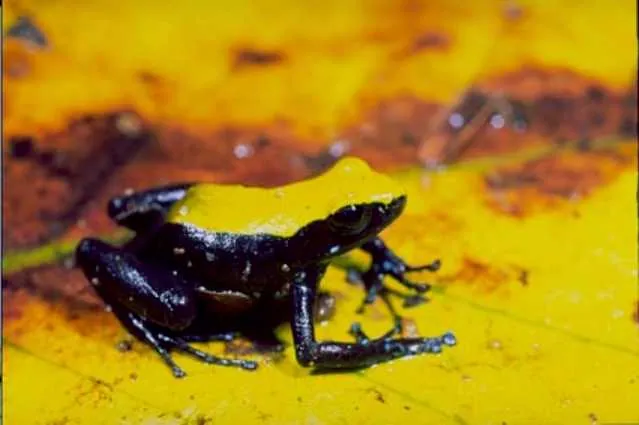
 Sɛdeɛ wobɛhunu no
- Adults are 24–30 mm long and weigh 1.2–2.0 g1
- Front of the back is bright yellow or pale green1
- Arms, legs, belly and rear are black, with blue spots on the limbs1
- Eyes are completely black1
- Has discs at the tips of its fingers and toes, and the toes are webbed1
Wɔtaa fa no sɛ: M. betsileo, M. viridis and M. expectata look similar but are differently coloured. They often have blue spots on the throat rather than the limbs, and they have a faint line along the upper lip, which the climbing mantella lacks.1
Awuduro ahoɔden
Ne honam yɛ awuduro. Ɛyɛ asiane sɛ wode wo nsa bɛka, wobɛtaforɔ anaa wobɛdi.
Ne ho awuduro yɛ dɛn?
This frog is poisonous rather than venomous. Its skin glands contain lipophilic alkaloids, the chemicals that make up its poison, which it gets from the arthropods it eats. Researchers have found 41 different potent alkaloids in its skin. Captive frogs lose their toxicity over time.1
Ne asiane ma nnipa te sɛn?
Asiane ma nnipa: Ɛnyɛ denƐte sɛ wowa wɔ anaa ɛnnu saa. Ɛkame ayɛ sɛ ɛnni asiane ma nnipa.Ɛyɛ dɛn bere a ehu aka no?
Its bright colours warn predators that its skin is toxic.1
 Sɛ obi de ne nsa ka anaa ɔdi a
- Sɛ obi de ne nsa aka bi a: hohoro ne nsa yie na mfa nsa nka ani anaa ano. Sɛ abofra anaa fie aboa bi taforɔɔ bi anaa ɔdii bi a: frɛ awuduro ho mmoa adwumayɛbea (poison centre) anaa wo ahohiahia nɔma.
Di kan frɛ wo ahohiahia nɔma (112, 000, 911). Yei yɛ mmoa a ɛdi kan ho akwankyerɛ, ɛnyɛ dɔkota afotuo. Mmoa a ɛdi kan ho nsɛm titiriw
 Hwɛ wo ho so
- Mfa wo nsa nka wiram aboa biara, nkyere no na mfa no nni agorɔ, sɛ ɔyɛ ketewa mpo, na sɛ ɛte sɛ ɔrededa anaa wawu mpo a.
- Ma no kwan. Sɛ wohyia baako a, ma wo bo nnwo, san w'akyi brɛoo na ma ɔnkɔ ne kwan.
- Sɛ wode wo nsa kaa no anaa wodii a: mfa wo nsa ntwitwi w'ani anaa w'ano, hohoro wo nsa na hwehwɛ dɔkota mmoa.
Ɛnhwehwɛ wo sɛ ɛbɛpira wo. Ne ho awuduro no wɔ hɔ sɛdeɛ ɛbɛyɛ a biribiara renni no. Nsɛm pii fa ahobammɔ ho
Wiase mu baabi bɛn?
Ne kɛseɛ te sɛn?
Ne tenten te sɛn?
Ne mu duru te sɛn?
 ne tenten bɛyɛ sɛ paper clip
 ne mu yɛ hare araa sɛ worente nka wɔ wo nsa so
 ɛbɛtumi atu mita 100 wɔ anibu 100 mu (onipa a ɔwɔ ntɛm sen biara hia 9.6)
Climbing mantella kɛseɛ te sɛn sɛ wode toto WO ho a?
Akontabuo kɛkɛ wɔ wo browser mu. Wɔnkora hwee, na wɔmfa hwee nkɔ baabiara.
Ne ntɛm te sɛn?


Nsɛm
Its tadpoles eat only the eggs of their own species, and the parents feed them unfertilized eggs.1
Males defend territories of about 2 square metres and fight by wrestling, chasing and leaping, sometimes for over 1.5 hours.1
Female frogs choose a mate based on the quality of the male's well, not on his call.1
The climbing mantella is the only member of the Mantella genus that breeds in water-filled wells in trees, tree holes or broken bamboo stalks.1
Its chemical defence has developed in a similar way to that of the dart frogs of Dendrobatidae, although the two families are only distantly related.1
Ma bɔre ho animdefoɔ
- Nyansahu din
- Mantella laevigata
- Kuo
- Apɔtorɔwa a wɔn ho yɛ awuduro, apɔtorɔ ne newt
- Abusua
- Mantellidae2
- Nhyehyɛeɛ (Order)
- Anura
- Asaase akɛseɛ
- Abibirem
- Mmofra nketewa
- Usually lays only one large egg, 3–3.5 mm across, at the side of a water-filled well or above the water line. The parents feed tadpoles unfertilized eggs.1
- Sɛdeɛ ɔte wɔ kwaem
- Least Concern (IUCN Red List, 2016), though its population is suspected to be decreasing1
- Asiane ma nnipa
- 1 / 5: Ɛnyɛ den3
Baabi a nsɛm no fi
- Climbing mantella (Wikipedia (CC BY-SA 4.0))
- Mantella laevigata (iNaturalist): din ne nkyekyɛmu.
- Venom Wiki: asiane gyinabea, kɛseɛ a ɛtaa yɛ ne ntɛm susuo no yɛ yɛn ankasa deɛ. Hwɛ sɛdeɛ yɛbu no: Sɛdeɛ yɛkyerɛ asiane gyinabea.
Nsɛm biara a ɛwɔ kratafa yi so wɔ nɔma a ɛkyerɛ ne fibea. Sɛ yɛfom biribi a, kafra, yɛyɛ mmoa ho akɔnnɔfoɔ, ɛnyɛ nyansahu nwoma. Ka kyerɛ yɛn wɔ [email protected] na yɛbɛsiesie.
 Ɔkɔm de akekantwerɛ no! Onipa baako na ɔyɛ Venom Wiki: ɛyɛ kwa, dawurubɔ nni so na biribiara nni so a ɛdi w'akyi. Akyɛdeɛ ketewa bi boa ma ɛkɔ so tena internet so.Ma akekantwere no aduane
Pii fi kuo korɔ no mu: Apɔtorɔwa a wɔn ho yɛ awuduro, apɔtorɔ ne newt
 Golden mantellaApɔtorɔwa a wɔn ho yɛ awuduro, apɔtorɔ ne newtƐnni asiane
 Iberian ribbed newtApɔtorɔwa a wɔn ho yɛ awuduro, apɔtorɔ ne newtƐnni asiane
 Tomato frogApɔtorɔwa a wɔn ho yɛ awuduro, apɔtorɔ ne newtƐnni asiane
 African common toadApɔtorɔwa a wɔn ho yɛ awuduro, apɔtorɔ ne newtƐyɛ yaw kɛkɛMfa wo nsa nka
 Baron's mantellaApɔtorɔwa a wɔn ho yɛ awuduro, apɔtorɔ ne newtƐnni asiane
 Blue-legged mantellaApɔtorɔwa a wɔn ho yɛ awuduro, apɔtorɔ ne newtƐnni asiane
 Black mamba
 Deathstalker
 Egyptian cobra
 Puff adder
 Boomslang
 Fat-tailed scorpion