
 Abibirem
 Asia
Asia Yuropu
 Amerika Anaafoɔ
 Australia ne Oceania
 Antarctica
 Pacific Po
 Atlantic Po
 India Po
 Arctic Po
 Mediterranean Po
 Po Kɔkɔɔ
 Caribbean Po
 Coral Po
 China Anaafoɔ Po
 Philippine Po
 Andaman Po
 Atifi Po
 Timor ne Arafura Po
 Bengal Ɛpo Ano
 California Ɛpo Ano
Egyptian cobra
 Ka
KaThe Egyptian cobra is one of the most venomous snakes in Northern Africa. It lives across much of North Africa and the savannas of West Africa, and it often lives close to people, sometimes entering villages and houses. Its bite is dangerous, so it is important to know what it looks like.1



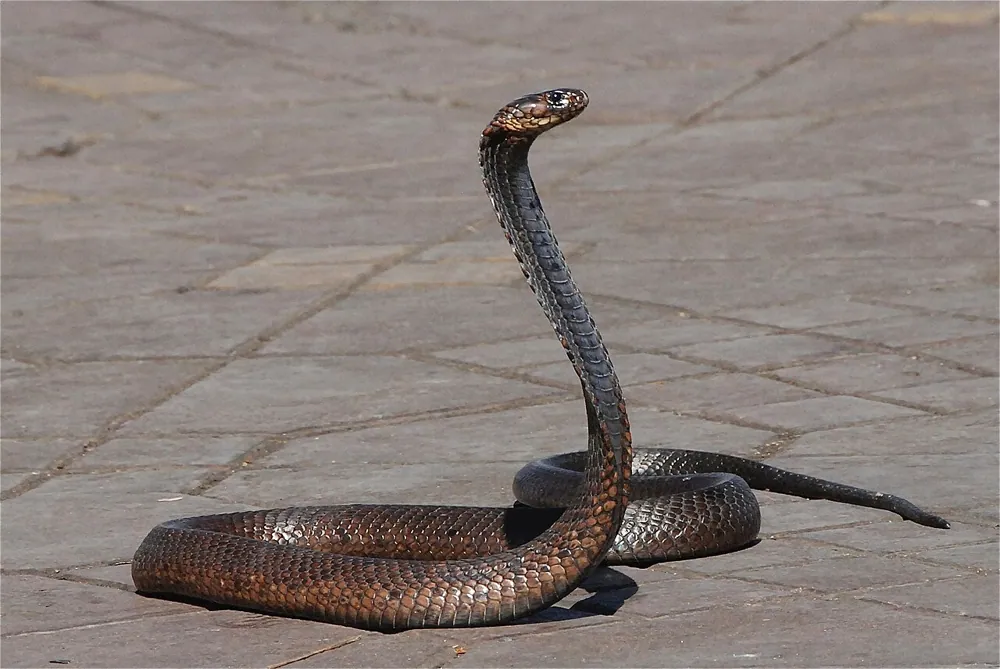
 Sɛdeɛ wobɛhunu no
- Its large, flattened head is slightly distinct from its neck, and it can spread a hood like other cobras.1
- Most individuals are some shade of brown, often with a tear-drop mark below the eye.1
- Some are copper-red or grey-brown, and those from Morocco are almost entirely black.1
- The belly is mostly creamy white, yellow brown, grey, blue grey, dark brown or black, often with dark spots.1
- It is a large snake, with an average length of roughly 1.4 metres.1
Bɔre ahoɔden
Bɔre fi ne se mu ba bere a ɔka.
Ne bɔre yɛ dɛn?
Its venom is mainly made of neurotoxins, which attack the nerves, and cytotoxins, which damage cells. The venom stops nerve signals reaching the muscles, and in later stages it also affects the heart and lungs, which can lead to death from respiratory failure. A bite causes local pain, severe swelling, bruising, blistering and tissue death, and may also cause headache, vomiting, dizziness, convulsions or paralysis.1
Ne asiane ma nnipa te sɛn?
Asiane ma nnipa: ƐkumMmoa a asiane wɔ wɔn ho sen biara wɔ wiase no mu baako.The venom is strong enough to kill a person. A single bite can release an average of 175 to 300 mg of venom. Its venom is slow-acting and does not always cause death. Venom from northern African populations, especially from Egypt, Tunisia, Algeria and Libya, is more potent than venom from southern and western populations.1
 Asɛmpa: dɔkotafoɔ wɔ aduro (antivenom) anaa ayaresa ma yei.1
Ɛyɛ dɛn bere a ehu aka no?
When approached, it usually tries to escape, but if threatened it rises up with its hood spread and strikes.1
 Sɛ ɛka a
- Get to a hospital fast: antivenom is the treatment. In a 2018 case, a bitten man was evacuated to Egypt, treated with antivenom and made a full recovery.1
- Ma onipa no ntena dinn na ne bo nnwo, yi kawa ne nneɛma a ɛkyere no den, na kɔ ayaresabea ntɛm: antivenom ne ayaresa no.
Di kan frɛ wo ahohiahia nɔma (112, 000, 911). Yei yɛ mmoa a ɛdi kan ho akwankyerɛ, ɛnyɛ dɔkota afotuo. Mmoa a ɛdi kan ho nsɛm titiriw
 Hwɛ wo ho so
- Mfa wo nsa nka wiram aboa biara, nkyere no na mfa no nni agorɔ, sɛ ɔyɛ ketewa mpo, na sɛ ɛte sɛ ɔrededa anaa wawu mpo a.
- Ma no kwan. Sɛ wohyia baako a, ma wo bo nnwo, san w'akyi brɛoo na ma ɔnkɔ ne kwan.
- Sɛ baako ka wo a: ma wo bo nnwo, tena dinn, frɛ wo ahohiahia nɔma (112, 000, 911) anaa kɔ ayaresabea ntɛm. Kae sɛdeɛ na ɛte, mfonini bɛboa.
Ɛnhwehwɛ wo sɛ ɛbɛpira wo. Ɛde ne bɔre kyere aduane anaa ɛbɔ ne ho ban, na ɛpɛ sɛ ɛhinta sene biribiara. Nsɛm pii fa ahobammɔ ho
Wiase mu baabi bɛn?
Ne kɛseɛ te sɛn?
Ne tenten te sɛn?
 ne tenten te sɛ nkraman 2,5 a wɔde hwene ne dua to ntoatoasoɔ mu
 ne tenten te sɛ kwadu 14 a wɔde to ntoatoasoɔ mu
 ɛbɛtumi atu mita 100 wɔ anibu 44 mu (onipa a ɔwɔ ntɛm sen biara hia 9.6)
Egyptian cobra kɛseɛ te sɛn sɛ wode toto WO ho a?
Akontabuo kɛkɛ wɔ wo browser mu. Wɔnkora hwee, na wɔmfa hwee nkɔ baabiara.
Ne ntɛm te sɛn?


Nsɛm
Most ancient sources blame an Egyptian cobra for the death of Cleopatra and her two handmaidens, though recent researchers have questioned this.1
Ancient Egyptian pharaohs wore a stylised cobra, the uraeus, on their diadem as a symbol of sovereignty.1
In 2006, a pet cobra escaped in Toronto and forced the evacuation of a house for more than five months.1
In 2011, a venomous female cobra went missing from the Bronx Zoo and was found in a dark corner of the reptile house six days later. Staff named her "Mia", for "missing in action".1
It is often found in water, and there are records of it swimming in the Mediterranean Sea.1
Atosɛm sɛefoɔ
Atosɛm: Egyptian cobras spit venom, like some other African cobras.
Nokorɛ: This species does not spit venom. It delivers its venom by biting.1
Baabi a nsɛm no fi
- Egyptian cobra (Wikipedia (CC BY-SA 4.0))
- Naja haje (iNaturalist): din ne nkyekyɛmu.
- Venom Wiki: asiane gyinabea, kɛseɛ a ɛtaa yɛ ne ntɛm susuo no yɛ yɛn ankasa deɛ. Hwɛ sɛdeɛ yɛbu no: Sɛdeɛ yɛkyerɛ asiane gyinabea.
Nsɛm biara a ɛwɔ kratafa yi so wɔ nɔma a ɛkyerɛ ne fibea. Sɛ yɛfom biribi a, kafra, yɛyɛ mmoa ho akɔnnɔfoɔ, ɛnyɛ nyansahu nwoma. Ka kyerɛ yɛn wɔ [email protected] na yɛbɛsiesie.
 Ɔkɔm de akekantwerɛ no! Onipa baako na ɔyɛ Venom Wiki: ɛyɛ kwa, dawurubɔ nni so na biribiara nni so a ɛdi w'akyi. Akyɛdeɛ ketewa bi boa ma ɛkɔ so tena internet so.Ma akekantwere no aduane
 Black mamba
 Cape cobra
 Eastern green mamba
 Jameson's mamba
 Western green mamba
 Ashe's spitting cobra
 Deathstalker
 Puff adder
 Boomslang
 Fat-tailed scorpion
 Gaboon viper
 Western honey bee