
 Afrique
 Asie
Asie Europe
 Amérique du Sud
 Australie et Océanie
 Antarctique
 Océan Pacifique
 Océan Atlantique
 Océan Indien
 Océan Arctique
 Mer Méditerranée
 Mer Rouge
 Mer des Caraïbes
 Mer de Corail
 Mer de Chine méridionale
 Mer des Philippines
 Mer d'Andaman
 Mer du Nord
 Mer de Timor et d'Arafura
 Golfe du Bengale
 Golfe de Californie
Greening's frog
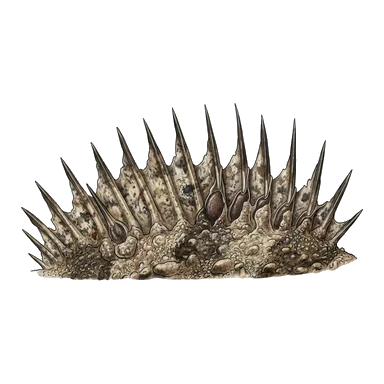 Épines venimeuses
Greening's frog is a small tree frog that lives in the dry thorn scrub of eastern Brazil. It is venomous: it has spines on its skull that can inject venom when it headbutts. It is special because it survives a semi-desert climate by hiding in tree hollows, rock cracks and bromeliads.1
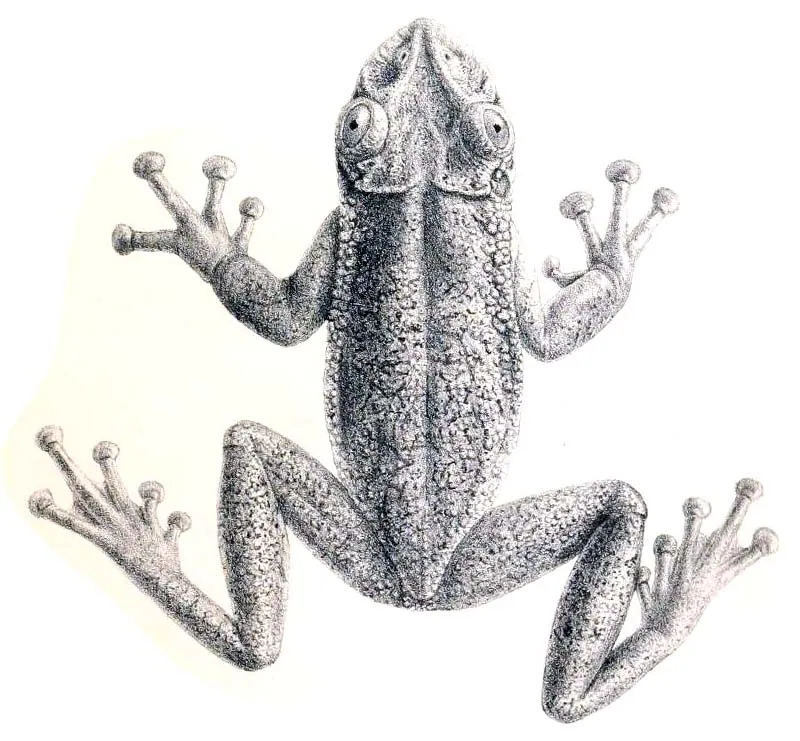
 Comment le reconnaître
Puissance du venin
Des épines pointues portent le venin. Marcher dessus ou l'attraper fait mal.
Que fait son venin ?
Its skull spines inject venom into other animals, or into a human hand, when it headbutts. Its skin secretions contain steroids and alkaloids, which in laboratory tests caused a powerful painful effect and swelling in mouse cells. In the wild these secretions act as a chemical defence against predators.1
À quel point est-il dangereux pour l'homme ?
Danger pour l'homme: DouloureuxÇa peut faire très mal, mais ce n'est presque jamais grave.Que fait-il quand il a peur ?
It hides in a tree hollow, rock crevice or bromeliad, sealing the entrance with its head, and it defends itself by headbutting with its skull spines.1
 Si ses épines s'enfoncent dans ta peau
- Si quelqu'un en a touché un : lave-toi bien les mains et ne touche pas tes yeux ni ta bouche. Si un enfant ou un animal en a léché ou mangé un : appelle le centre antipoison ou ton numéro d'urgence.
Appelle toujours d'abord ton numéro d'urgence (112, 000, 911). Ce sont des conseils généraux de premiers secours, pas un avis médical. Les bases des premiers secours
 Reste en sécurité
- Ne touche, n'attrape et n'embête jamais un animal sauvage, même petit, et même s'il a l'air endormi ou mort.
- Laisse-lui de la place. Si tu en croises un, reste calme, recule doucement et laisse-le passer son chemin.
- Si ses épines s'enfoncent dans ta peau : reste calme, ne bouge pas, appelle ton numéro d'urgence (112, 000, 911) ou va vite à l'hôpital. Souviens-toi de quoi il avait l'air, une photo aide.
Il ne t'en veut pas. Il utilise son venin pour attraper sa nourriture ou se protéger, et il préfère de loin se cacher. Plus d'infos pour rester en sécurité
Où dans le monde ?
Quelle taille fait-il ?
Quelle longueur fait-il ?
 aussi long que 2,5 briques de construction en ligne
 pourrait parcourir 100 mètres en 82 secondes (l'humain le plus rapide met 9,6)
Quelle taille fait Greening's frog comparé à TOI ?
Juste des calculs dans ton navigateur. Rien n'est enregistré ni envoyé nulle part.
À quelle vitesse va-t-il ?


Faits
Unlike poison dart frogs, which only secrete poison from their skin, this frog can inject venom through spines on its skull.1
The skin of its head is fused to the skull to form a casque, a hard helmet-like structure.1
In laboratory tests, its skin secretions also slowed the growth of mouse fibroblast and melanoma cells.1
It has a tough, water-resistant skin and a low metabolic rate, which help it survive the dry semi-desert climate.1
When the rains start and the streams run with water, males set up territories near the water and call to attract females.1
It shares its headbutting, spine-injecting defence with another frog, Nyctimantis brunoi.1
Pour les experts en venin
- Nom scientifique
- Corythomantis greeningi
- Groupe
- Grenouilles toxiques, crapauds et tritons
- Famille
- Hylidae2
- Ordre
- Anura
- Continents
- Amérique du Sud
- Petits
- The female lays several hundred eggs, attached to a rock in the watercourse.1
- Comment il se porte dans la nature
- Least Concern1
- Danger pour l'homme
- 2 / 5: Douloureux3
D'où viennent les faits
- Corythomantis greeningi (Wikipedia (CC BY-SA 4.0))
- Corythomantis greeningi (iNaturalist): noms et classification.
- Venom Wiki: le niveau de danger, la taille typique et la vitesse estimée sont les nôtres. Regarde comment on les calcule : Comment on évalue le danger.
Chaque fait sur cette page a un numéro qui renvoie à sa source. Si on s'est trompés, désolés, on est des fans d'animaux, pas une revue scientifique. Dis-le-nous à [email protected] et on corrigera.
 Le scorpion a faim ! Venom Wiki est le projet d'une seule personne : gratuit, sans pub et sans traceurs. Un petit pourboire aide à le garder en ligne.Nourris le scorpion
Plus du même groupe: Grenouilles toxiques, crapauds et tritons
 Golden poison frogGrenouilles toxiques, crapauds et tritonsMortelNe pas toucher
 Cane toadGrenouilles toxiques, crapauds et tritonsNécessite un médecinNe pas toucher
 Dyeing poison dart frogGrenouilles toxiques, crapauds et tritonsFait juste malNe pas toucher
 Black-legged poison frogGrenouilles toxiques, crapauds et tritonsPeut tuerNe pas toucher
 Bruno's casque-headed frogGrenouilles toxiques, crapauds et tritonsNécessite un médecinNe pas toucher
 Harlequin poison frogGrenouilles toxiques, crapauds et tritonsNécessite un médecinNe pas toucher
 Terciopelo
 Brazilian wandering spider
 Eyelash viper
 Golden lancehead
 South American bushmaster
 Peruvian giant centipede