
 Afrika
 Asia
Asia Yuropu
 Amerika yeKumaodzanyemba
 Australia neOceania
 Antarctica
 Gungwa rePacific
 Gungwa reAtlantic
 Gungwa reIndia
 Gungwa reArctic
 Gungwa reMediterranean
 Gungwa Dzvuku
 Gungwa reCaribbean
 Gungwa reCoral
 Gungwa reChina yeKumaodzanyemba
 Gungwa rePhilippines
 Gungwa reAndaman
 Gungwa reKuchamhembe
 Gungwa reTimor neArafura
 Gungwa reBengal
 Gulf yeCalifornia
Giant leaf frog
 Chepfu muganda rayoIne chepfu, haina uturu hwekuruma kana kubaya
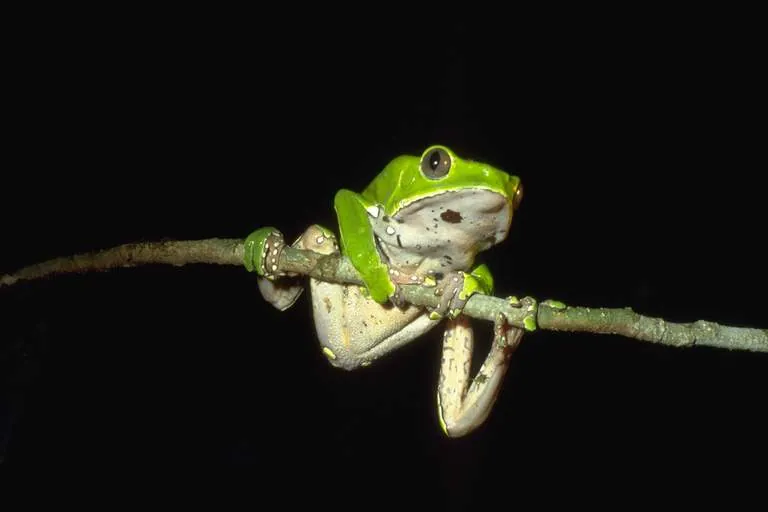
The giant leaf frog is a large tree frog with lime green skin and a white or cream belly. It lives in the rainforests of the Amazon basin in South America. Its skin releases chemicals that act as a defence against predators.1
 Maziviro ayo
- Lime green back with a white to yellow-white or cream belly1
- Sparse white spots with dark frames on the lower lips, chest and front legs, denser on the flanks and hind legs1
- Transparent brown fingers with large green adhesive discs1
- A prominent gland behind each eye, extending over the eardrum1
- Dark grey iris1
Simba rechepfu
Ganda rayo rine chepfu. Ine ngozi kubata, kunanzva kana kudya.
Chepfu yayo inoitei?
The giant leaf frog's skin secretion contains opioid peptides, including deltorphin and dermorphin. Its skin peptides act as a chemical defence against predators. In kambo rituals, where the secretion is used, it induces intense vomiting.1
Ine ngozi yakadii kuvanhu?
Ngozi kuvanhu: InorwadzaInogona kurwadza chaizvo, asi kazhinji haisi njodzi huru.Inoitei kana yatya?
When threatened, its skin produces peptides that act as a chemical defence against predators.1
 Kana munhu akaibata kana kuidya
- Kana munhu akabata imwe: geza maoko zvakanaka uye usabata maziso kana muromo. Kana mwana kana chipfuwo chakananzva kana kudya imwe: fonera nzvimbo yeruzivo rwechepfu kana nhamba yechimbichimbi.
Gara uchitanga wafonera nhamba yechimbichimbi (112, 000, 911). Iri izano rakajairika rerubatsiro rwekutanga, kwete zano rechiremba. Zvakakosha zverubatsiro rwekutanga
 Gara wakachengeteka
- Usambobata mhuka yesango, kuedza kuitora kana kuinetsa, kunyange iri diki, uye kunyange ichiita seyakarara kana yakafa.
- Ipa nzvimbo. Kana ukasangana nayo, dzikama, dzokera shure zvishoma nezvishoma uirege iende nenzira yayo.
- Kana wakaibata kana kuidya: usakwesha maziso kana muromo wako, geza maoko ako uye wana rubatsiro rwechiremba.
Haisi kukutsvaga. Chepfu yayo iripo chete kuti pasava nechinhu chinoidya. Zvimwe pamusoro pekugara wakachengeteka
Yakakura sei?
Yakareba zvakadii?
 yakareba sezvidhinha zvematoyi 4 zvakateedzana
 inogona kumhanya mamita 100 mumasekondi 72 (munhu anomhanyisa kupfuura vose anoda 9.6)
Giant leaf frog yakakura sei kana yaenzaniswa NEWE?
Masvomhu chete mubrowser yako. Hapana chinochengetwa kana kutumirwa kupi zvako.
Inomhanya zvakadii?


Chokwadi
Its skin secretion is known as Vacina do sapo, or frog vaccine, and is used in a ritual called kambo or sapo.1
Up to 61% of the eggs of the giant leaf frog are eaten by predators.1
Males fight rivals for mating rights by using their heads to separate a rival male from a female, and by pushing with their hind legs.1
Males are more likely to be targeted by predators during mating season, because their loud fights can be heard easily.1
Eggs are eaten by rove beetles, phorid flies, possibly tufted capuchins and banded cat-eyed snakes, because they are a source of protein.1
Kune nyanzvi dzeuturu
- Zita resainzi
- Phyllomedusa bicolor
- Boka
- Matatya ane chepfu, matoad nemanewt
- Mhuri
- Phyllomedusidae2
- Odha
- Anura
- Makondinendi
- Amerika yeKumaodzanyemba
- Vacheche
- The female and male build a leaf-nest above forest pools and lay eggs in a gelatinous mass about 70 cm above the water. The eggs hatch in about 14 days, and the tadpoles fall into the water to develop into adult frogs.1
- Iri kurarama sei musango
- Least Concern1
- Ngozi kuvanhu
- 2 / 5: Inorwadza3
Kwakabva chokwadi
- Phyllomedusa bicolor (Wikipedia (CC BY-SA 4.0))
- Phyllomedusa bicolor (iNaturalist): mazita nekurongwa kwemhuka.
- Venom Wiki: danho rengozi, saizi yakajairika nekufungidzira kwekumhanya ndezvedu. Ona kuti tinozviwana sei: Matinoyera ngozi.
Chokwadi chimwe nechimwe pane peji rino chine nhamba inoratidza kwachakabva. Kana takakanganisa, ruregerero, tiri vanoda mhuka, kwete magazini yesainzi. Tiudze pa[email protected] tichazvigadzirisa.
 Chinyavada chine nzara! Venom Wiki iprojekiti yemunhu mumwe: yemahara, isina kushambadza uye isina zvinokuteedzera. Chipo chidiki chinobatsira kuti irambe iri paindaneti.Fudza chinyavada
Zvimwe kubva muboka rimwe chete: Matatya ane chepfu, matoad nemanewt
 Golden poison frogMatatya ane chepfu, matoad nemanewtInourayaUsabata
 Cane toadMatatya ane chepfu, matoad nemanewtInoda chirembaUsabata
 Dyeing poison dart frogMatatya ane chepfu, matoad nemanewtInongorwadzaUsabata
 Black-legged poison frogMatatya ane chepfu, matoad nemanewtInogona kuurayaUsabata
 Bruno's casque-headed frogMatatya ane chepfu, matoad nemanewtInoda chirembaUsabata
 Harlequin poison frogMatatya ane chepfu, matoad nemanewtInoda chirembaUsabata
 Terciopelo
 Brazilian wandering spider
 Eyelash viper
 Golden lancehead
 South American bushmaster
 Peruvian giant centipede