
 Afrika
 Asia
Asia Yuropu
 Amerika yeKumaodzanyemba
 Australia neOceania
 Antarctica
 Gungwa rePacific
 Gungwa reAtlantic
 Gungwa reIndia
 Gungwa reArctic
 Gungwa reMediterranean
 Gungwa Dzvuku
 Gungwa reCaribbean
 Gungwa reCoral
 Gungwa reChina yeKumaodzanyemba
 Gungwa rePhilippines
 Gungwa reAndaman
 Gungwa reKuchamhembe
 Gungwa reTimor neArafura
 Gungwa reBengal
 Gulf yeCalifornia
Harlequin poison frog
 Chepfu muganda rayoInodya: ZvipukananaIne chepfu, haina uturu hwekuruma kana kubaya
The harlequin poison frog is a small, brightly marked frog that lives on the forest floor of western Colombia. Its skin carries strong toxins, so it is one of the poison dart frogs that should never be handled. It is now critically endangered because its rainforest home is being destroyed.1

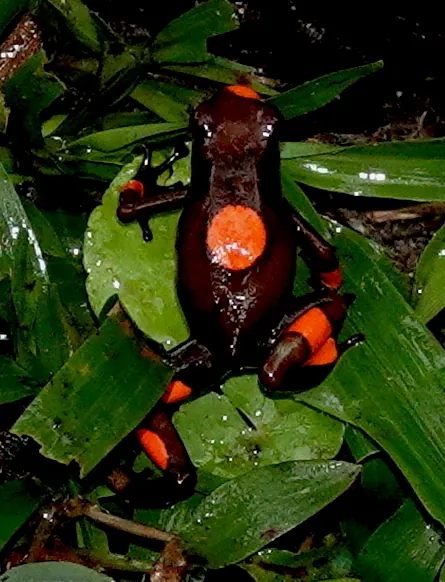
 Maziviro ayo
- Background colour ranges from light to dark brown.1
- Usually has a vivid, bright spot on its back.1
- Small, with an average snout-to-vent length of about 3.3 cm.1
- Active on the forest floor, feeding on the ground after sunrise and hiding under leaf litter or on fallen logs by 16:00.1
Inowanzovhiringidzwa ne: Some frogs that were once classed as this species were separated into new species in 2018: Oophaga anchicayensis, Oophaga andresi and Oophaga solanensis.1
Simba rechepfu
Ganda rayo rine chepfu. Ine ngozi kubata, kunanzva kana kudya.
Chepfu yayo inoitei?
The frog produces histrionicotoxins, which are cardiotoxins, meaning they affect the heart. These compounds act as potent blockers of nicotinic acetylcholine receptors, the sites that receive nerve signals at muscle and nerve junctions. They also affect sodium and potassium channels, though much less strongly.1
Ine ngozi yakadii kuvanhu?
Ngozi kuvanhu: YakakombaKana munhu akaibata kana kuidya, enda kuna chiremba. Kufa hakuwanzoitiki zvachose.The frog's toxins can be dangerous. Wild-caught frogs may be toxic and dangerous to handle, and they often have a much higher fatality rate in captivity.1
 Kana munhu akaibata kana kuidya
- Kana munhu akabata imwe: geza maoko zvakanaka uye usabata maziso kana muromo. Kana mwana kana chipfuwo chakananzva kana kudya imwe: fonera nzvimbo yeruzivo rwechepfu kana nhamba yechimbichimbi.
Gara uchitanga wafonera nhamba yechimbichimbi (112, 000, 911). Iri izano rakajairika rerubatsiro rwekutanga, kwete zano rechiremba. Zvakakosha zverubatsiro rwekutanga
 Gara wakachengeteka
- Usambobata mhuka yesango, kuedza kuitora kana kuinetsa, kunyange iri diki, uye kunyange ichiita seyakarara kana yakafa.
- Ipa nzvimbo. Kana ukasangana nayo, dzikama, dzokera shure zvishoma nezvishoma uirege iende nenzira yayo.
- Kana wakaibata kana kuidya: usakwesha maziso kana muromo wako, geza maoko ako uye wana rubatsiro rwechiremba.
Haisi kukutsvaga. Chepfu yayo iripo chete kuti pasava nechinhu chinoidya. Zvimwe pamusoro pekugara wakachengeteka
Yakakura sei?
Yakareba zvakadii?
 inenge kureba sechibatanidzo chemapepa
 inogona kumhanya mamita 100 mumasekondi 97 (munhu anomhanyisa kupfuura vose anoda 9.6)
Harlequin poison frog yakakura sei kana yaenzaniswa NEWE?
Masvomhu chete mubrowser yako. Hapana chinochengetwa kana kutumirwa kupi zvako.
Inomhanya zvakadii?


Chokwadi
The tadpoles cannot feed on their own. They are obligate egg-feeders and will starve without the unfertilised eggs their mother provides.1
A parent carries the tadpoles to tiny water pools, often found in the axil of a bromeliad plant, where they develop.1
Histrionicotoxins are hard to make in a lab. Synthesising them has been the subject of many different attempts.1
Harlequin poison frogs are among the most difficult poison dart frogs to raise in captivity.1
Adults are active on the ground during the day and retreat to refuge by mid-afternoon.1
Kune nyanzvi dzeuturu
- Zita resainzi
- Oophaga histrionica
- Boka
- Matatya ane chepfu, matoad nemanewt
- Mhuri
- Dendrobatidae2
- Odha
- Anura
- Makondinendi
- Amerika yeKumaodzanyemba
- Vacheche
- The female lays eggs among leaf litter. A parent carries the newly hatched tadpoles to a small water pool, often in a bromeliad, and the mother later lays unfertilised eggs for the tadpoles to eat.1
- Iri kurarama sei musango
- Critically Endangered1
- Ngozi kuvanhu
- 3 / 5: Yakakomba3
Kwakabva chokwadi
- Harlequin poison frog (Wikipedia (CC BY-SA 4.0))
- Oophaga histrionica (iNaturalist): mazita nekurongwa kwemhuka.
- Venom Wiki: danho rengozi, saizi yakajairika nekufungidzira kwekumhanya ndezvedu. Ona kuti tinozviwana sei: Matinoyera ngozi.
Chokwadi chimwe nechimwe pane peji rino chine nhamba inoratidza kwachakabva. Kana takakanganisa, ruregerero, tiri vanoda mhuka, kwete magazini yesainzi. Tiudze pa[email protected] tichazvigadzirisa.
 Chinyavada chine nzara! Venom Wiki iprojekiti yemunhu mumwe: yemahara, isina kushambadza uye isina zvinokuteedzera. Chipo chidiki chinobatsira kuti irambe iri paindaneti.Fudza chinyavada
Zvimwe kubva muboka rimwe chete: Matatya ane chepfu, matoad nemanewt
 Golden poison frogMatatya ane chepfu, matoad nemanewtInourayaUsabata
 Cane toadMatatya ane chepfu, matoad nemanewtInoda chirembaUsabata
 Dyeing poison dart frogMatatya ane chepfu, matoad nemanewtInongorwadzaUsabata
 Black-legged poison frogMatatya ane chepfu, matoad nemanewtInogona kuurayaUsabata
 Bruno's casque-headed frogMatatya ane chepfu, matoad nemanewtInoda chirembaUsabata
 Giant leaf frogMatatya ane chepfu, matoad nemanewtInongorwadzaUsabata
 Terciopelo
 Brazilian wandering spider
 Eyelash viper
 Golden lancehead
 South American bushmaster
 Peruvian giant centipede